







Iran turns to AI, satellite data in push for homegrown space economy
Iran is seeking to turn its growing satellite capabilities into practical services and a domestic space economy, using artificial intelligence to process imagery, predict technical failures and build platforms that can make satellite data more accessible to researchers, businesses and government agencies.
At the center of the effort is “RAZ”, a national platform for monitoring and processing Earth-observation data being developed by the Iranian Space Research Center (ISRC), bringing together years of work by Iranian researchers in remote sensing.
The ISRC is also developing “Iran-Zamin”, a domestic platform described by its acting head Nader Makari as an Iranian version of Google Earth, as Tehran seeks to make greater use of its own satellite resources.
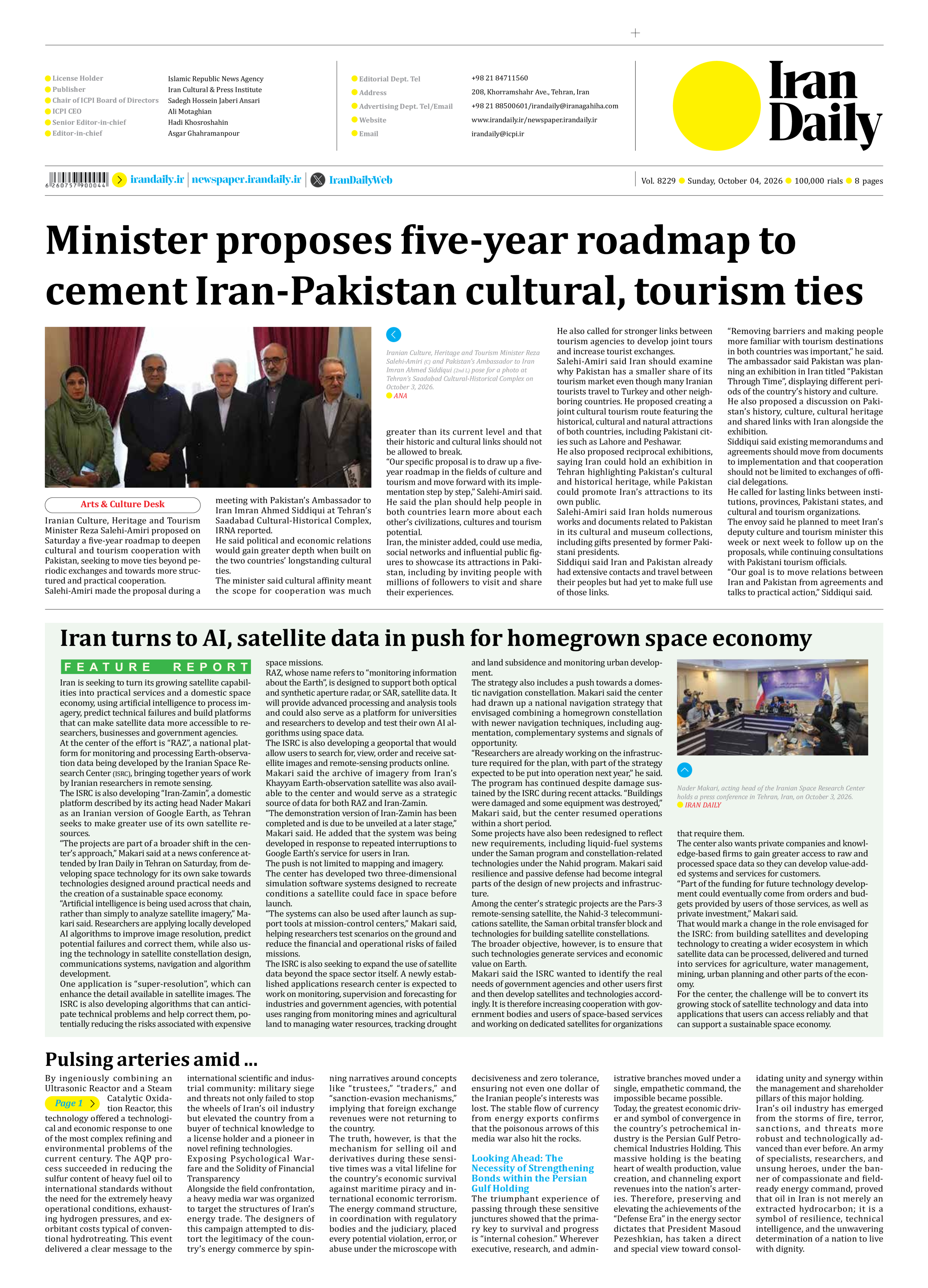
“The projects are part of a broader shift in the center’s approach,” Makari said at a news conference attended by Iran Daily in Tehran on Saturday, from developing space technology for its own sake towards technologies designed around practical needs and the creation of a sustainable space economy.
“Artificial intelligence is being used across that chain, rather than simply to analyze satellite imagery,” Makari said. Researchers are applying locally developed AI algorithms to improve image resolution, predict potential failures and correct them, while also using the technology in satellite constellation design, communications systems, navigation and algorithm development.
One application is “super-resolution”, which can enhance the detail available in satellite images. The ISRC is also developing algorithms that can anticipate technical problems and help correct them, potentially reducing the risks associated with expensive space missions.
RAZ, whose name refers to “monitoring information about the Earth”, is designed to support both optical and synthetic aperture radar, or SAR, satellite data. It will provide advanced processing and analysis tools and could also serve as a platform for universities and researchers to develop and test their own AI algorithms using space data.
The ISRC is also developing a geoportal that would allow users to search for, view, order and receive satellite images and remote-sensing products online.
Makari said the archive of imagery from Iran’s Khayyam Earth-observation satellite was also available to the center and would serve as a strategic source of data for both RAZ and Iran-Zamin.
“The demonstration version of Iran-Zamin has been completed and is due to be unveiled at a later stage,” Makari said. He added that the system was being developed in response to repeated interruptions to Google Earth’s service for users in Iran.
The push is not limited to mapping and imagery.
The center has developed two three-dimensional simulation software systems designed to recreate conditions a satellite could face in space before launch.
“The systems can also be used after launch as support tools at mission-control centers,” Makari said, helping researchers test scenarios on the ground and reduce the financial and operational risks of failed missions.
The ISRC is also seeking to expand the use of satellite data beyond the space sector itself. A newly established applications research center is expected to work on monitoring, supervision and forecasting for industries and government agencies, with potential uses ranging from monitoring mines and agricultural land to managing water resources, tracking drought and land subsidence and monitoring urban development.
The strategy also includes a push towards a domestic navigation constellation. Makari said the center had drawn up a national navigation strategy that envisaged combining a homegrown constellation with newer navigation techniques, including augmentation, complementary systems and signals of opportunity.
“Researchers are already working on the infrastructure required for the plan, with part of the strategy expected to be put into operation next year,” he said.
The program has continued despite damage sustained by the ISRC during recent attacks. “Buildings were damaged and some equipment was destroyed,” Makari said, but the center resumed operations within a short period.
Some projects have also been redesigned to reflect new requirements, including liquid-fuel systems under the Saman program and constellation-related technologies under the Nahid program. Makari said resilience and passive defense had become integral parts of the design of new projects and infrastructure.
Among the center’s strategic projects are the Pars-3 remote-sensing satellite, the Nahid-3 telecommunications satellite, the Saman orbital transfer block and technologies for building satellite constellations.
The broader objective, however, is to ensure that such technologies generate services and economic value on Earth.
Makari said the ISRC wanted to identify the real needs of government agencies and other users first and then develop satellites and technologies accordingly. It is therefore increasing cooperation with government bodies and users of space-based services and working on dedicated satellites for organizations that require them.
The center also wants private companies and knowledge-based firms to gain greater access to raw and processed space data so they can develop value-added systems and services for customers.
“Part of the funding for future technology development could eventually come from orders and budgets provided by users of those services, as well as private investment,” Makari said.
That would mark a change in the role envisaged for the ISRC: from building satellites and developing technology to creating a wider ecosystem in which satellite data can be processed, delivered and turned into services for agriculture, water management, mining, urban planning and other parts of the economy.
For the center, the challenge will be to convert its growing stock of satellite technology and data into applications that users can access reliably and that can support a sustainable space economy.