







Aichi-Nagoya 2026 Asian Games:
Historic rowing triumph ‘three years in the making’, Mojallal says
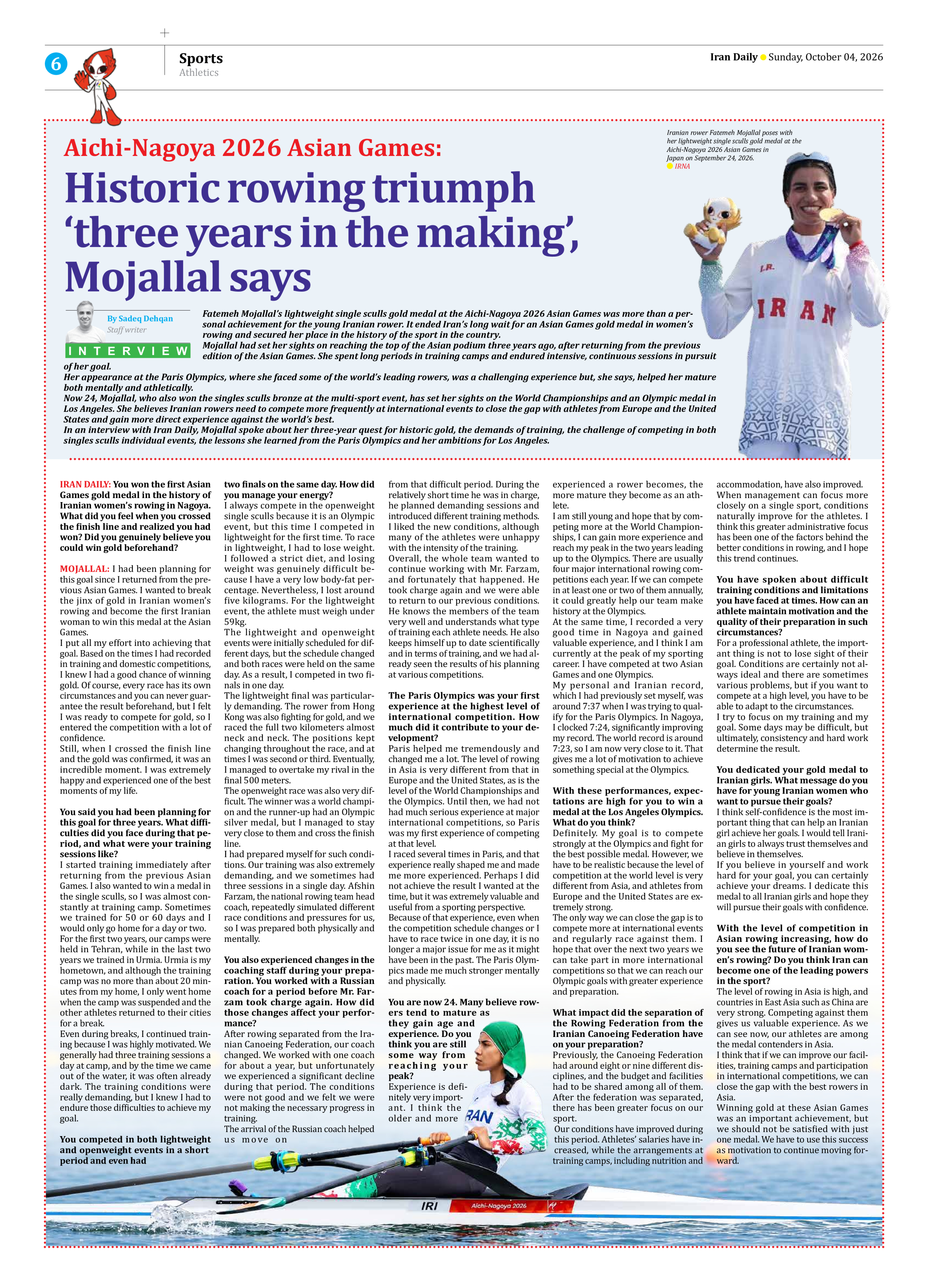
Fatemeh Mojallal’s lightweight single sculls gold medal at the Aichi-Nagoya 2026 Asian Games was more than a personal achievement for the young Iranian rower. It ended Iran’s long wait for an Asian Games gold medal in women’s rowing and secured her place in the history of the sport in the country. Mojallal had set her sights on reaching the top of the Asian podium three years ago, after returning from the previous edition of the Asian Games. She spent long periods in training camps and endured intensive, continuous sessions in pursuit of her goal. Her appearance at the Paris Olympics, where she faced some of the world’s leading rowers, was a challenging experience but, she says, helped her mature both mentally and athletically. Now 24, Mojallal, who also won the singles sculls bronze at the multi-sport event, has set her sights on the World Championships and an Olympic medal in Los Angeles. She believes Iranian rowers need to compete more frequently at international events to close the gap with athletes from Europe and the United States and gain more direct experience against the world’s best. In an interview with Iran Daily, Mojallal spoke about her three-year quest for historic gold, the demands of training, the challenge of competing in both singles sculls individual events, the lessons she learned from the Paris Olympics and her ambitions for Los Angeles.
By Sadeq Dehqan
Staff writer
IRAN DAILY: You won the first Asian Games gold medal in the history of Iranian women’s rowing in Nagoya. What did you feel when you crossed the finish line and realized you had won? Did you genuinely believe you could win gold beforehand?
MOJALLAL: I had been planning for this goal since I returned from the previous Asian Games. I wanted to break the jinx of gold in Iranian women’s rowing and become the first Iranian woman to win this medal at the Asian Games.
I put all my effort into achieving that goal. Based on the times I had recorded in training and domestic competitions, I knew I had a good chance of winning gold. Of course, every race has its own circumstances and you can never guarantee the result beforehand, but I felt I was ready to compete for gold, so I entered the competition with a lot of confidence.
Still, when I crossed the finish line and the gold was confirmed, it was an incredible moment. I was extremely happy and experienced one of the best moments of my life.
You said you had been planning for this goal for three years. What difficulties did you face during that period, and what were your training sessions like?
I started training immediately after returning from the previous Asian Games. I also wanted to win a medal in the single sculls, so I was almost constantly at training camp. Sometimes we trained for 50 or 60 days and I would only go home for a day or two.
For the first two years, our camps were held in Tehran, while in the last two years we trained in Urmia. Urmia is my hometown, and although the training camp was no more than about 20 minutes from my home, I only went home when the camp was suspended and the other athletes returned to their cities for a break.
Even during breaks, I continued training because I was highly motivated. We generally had three training sessions a day at camp, and by the time we came out of the water, it was often already dark. The training conditions were really demanding, but I knew I had to endure those difficulties to achieve my goal.
You competed in both lightweight and openweight events in a short period and even had two finals on the same day. How did you manage your energy?
I always compete in the openweight single sculls because it is an Olympic event, but this time I competed in lightweight for the first time. To race in lightweight, I had to lose weight. I followed a strict diet, and losing weight was genuinely difficult because I have a very low body-fat percentage. Nevertheless, I lost around five kilograms. For the lightweight event, the athlete must weigh under 59kg.
The lightweight and openweight events were initially scheduled for different days, but the schedule changed and both races were held on the same day. As a result, I competed in two finals in one day.
The lightweight final was particularly demanding. The rower from Hong Kong was also fighting for gold, and we raced the full two kilometers almost neck and neck. The positions kept changing throughout the race, and at times I was second or third. Eventually, I managed to overtake my rival in the final 500 meters.
The openweight race was also very difficult. The winner was a world champion and the runner-up had an Olympic silver medal, but I managed to stay very close to them and cross the finish line.
I had prepared myself for such conditions. Our training was also extremely demanding, and we sometimes had three sessions in a single day. Afshin Farzam, the national rowing team head coach, repeatedly simulated different race conditions and pressures for us, so I was prepared both physically and mentally.
You also experienced changes in the coaching staff during your preparation. You worked with a Russian coach for a period before Mr. Farzam took charge again. How did those changes affect your performance?
After rowing separated from the Iranian Canoeing Federation, our coach changed. We worked with one coach for about a year, but unfortunately we experienced a significant decline during that period. The conditions were not good and we felt we were not making the necessary progress in training.
The arrival of the Russian coach helped us move on from that difficult period. During the relatively short time he was in charge, he planned demanding sessions and introduced different training methods. I liked the new conditions, although many of the athletes were unhappy with the intensity of the training.
Overall, the whole team wanted to continue working with Mr. Farzam, and fortunately that happened. He took charge again and we were able to return to our previous conditions. He knows the members of the team very well and understands what type of training each athlete needs. He also keeps himself up to date scientifically and in terms of training, and we had already seen the results of his planning at various competitions.
The Paris Olympics was your first experience at the highest level of international competition. How much did it contribute to your development?
Paris helped me tremendously and changed me a lot. The level of rowing in Asia is very different from that in Europe and the United States, as is the level of the World Championships and the Olympics. Until then, we had not had much serious experience at major international competitions, so Paris was my first experience of competing at that level.
I raced several times in Paris, and that experience really shaped me and made me more experienced. Perhaps I did not achieve the result I wanted at the time, but it was extremely valuable and useful from a sporting perspective.
Because of that experience, even when the competition schedule changes or I have to race twice in one day, it is no longer a major issue for me as it might have been in the past. The Paris Olympics made me much stronger mentally and physically.
You are now 24. Many believe rowers tend to mature as they gain age and experience. Do you think you are still some way from reaching your peak?
Experience is definitely very important. I think the older and more experienced a rower becomes, the more mature they become as an athlete.
I am still young and hope that by competing more at the World Championships, I can gain more experience and reach my peak in the two years leading up to the Olympics. There are usually four major international rowing competitions each year. If we can compete in at least one or two of them annually, it could greatly help our team make history at the Olympics.
At the same time, I recorded a very good time in Nagoya and gained valuable experience, and I think I am currently at the peak of my sporting career. I have competed at two Asian Games and one Olympics.
My personal and Iranian record, which I had previously set myself, was around 7:37 when I was trying to qualify for the Paris Olympics. In Nagoya, I clocked 7:24, significantly improving my record. The world record is around 7:23, so I am now very close to it. That gives me a lot of motivation to achieve something special at the Olympics.
With these performances, expectations are high for you to win a medal at the Los Angeles Olympics. What do you think?
Definitely. My goal is to compete strongly at the Olympics and fight for the best possible medal. However, we have to be realistic because the level of competition at the world level is very different from Asia, and athletes from Europe and the United States are extremely strong.
The only way we can close the gap is to compete more at international events and regularly race against them. I hope that over the next two years we can take part in more international competitions so that we can reach our Olympic goals with greater experience and preparation.
What impact did the separation of the Rowing Federation from the Iranian Canoeing Federation have on your preparation?
Previously, the Canoeing Federation had around eight or nine different disciplines, and the budget and facilities had to be shared among all of them. After the federation was separated, there has been greater focus on our sport.
Our conditions have improved during this period. Athletes’ salaries have increased, while the arrangements at training camps, including nutrition and accommodation, have also improved.
When management can focus more closely on a single sport, conditions naturally improve for the athletes. I think this greater administrative focus has been one of the factors behind the better conditions in rowing, and I hope this trend continues.
You have spoken about difficult training conditions and limitations you have faced at times. How can an athlete maintain motivation and the quality of their preparation in such circumstances?
For a professional athlete, the important thing is not to lose sight of their goal. Conditions are certainly not always ideal and there are sometimes various problems, but if you want to compete at a high level, you have to be able to adapt to the circumstances.
I try to focus on my training and my goal. Some days may be difficult, but ultimately, consistency and hard work determine the result.
You dedicated your gold medal to Iranian girls. What message do you have for young Iranian women who want to pursue their goals?
I think self-confidence is the most important thing that can help an Iranian girl achieve her goals. I would tell Iranian girls to always trust themselves and believe in themselves.
If you believe in yourself and work hard for your goal, you can certainly achieve your dreams. I dedicate this medal to all Iranian girls and hope they will pursue their goals with confidence.
With the level of competition in Asian rowing increasing, how do you see the future of Iranian women’s rowing? Do you think Iran can become one of the leading powers in the sport?
The level of rowing in Asia is high, and countries in East Asia such as China are very strong. Competing against them gives us valuable experience. As we can see now, our athletes are among the medal contenders in Asia.
I think that if we can improve our facilities, training camps and participation in international competitions, we can close the gap with the best rowers in Asia.
Winning gold at these Asian Games was an important achievement, but we should not be satisfied with just one medal. We have to use this success as motivation to continue moving forward.