







Copy in clipboard...
Army’s spox reaffirms Armed Forces’ readiness for any scenario
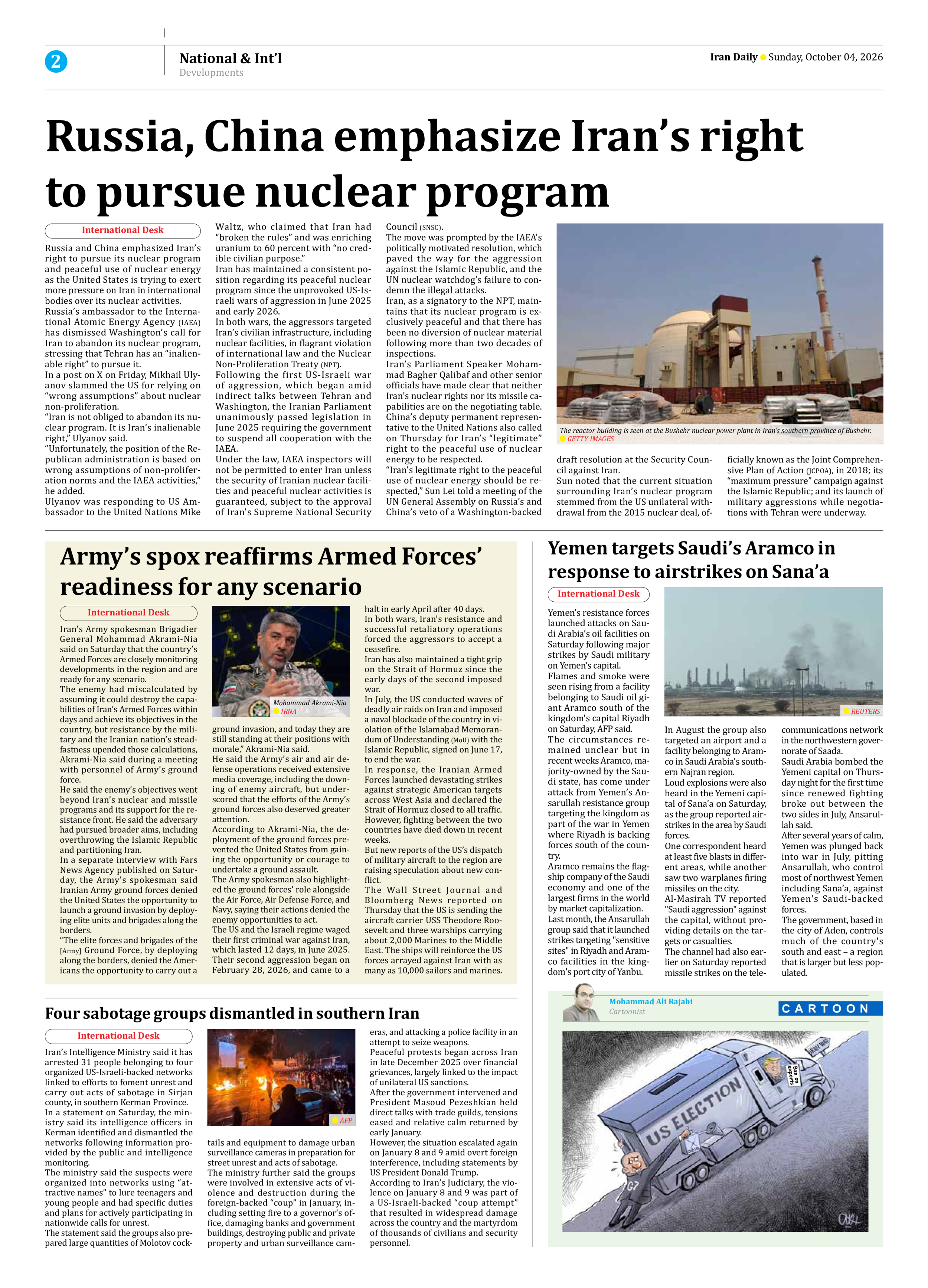
Iran’s Army spokesman Brigadier General Mohammad Akrami-Nia said on Saturday that the country’s Armed Forces are closely monitoring developments in the region and are ready for any scenario.
The enemy had miscalculated by assuming it could destroy the capabilities of Iran’s Armed Forces within days and achieve its objectives in the country, but resistance by the military and the Iranian nation’s steadfastness upended those calculations, Akrami-Nia said during a meeting with personnel of Army’s ground force.
He said the enemy’s objectives went beyond Iran’s nuclear and missile programs and its support for the resistance front. He said the adversary had pursued broader aims, including overthrowing the Islamic Republic and partitioning Iran.
In a separate interview with Fars News Agency published on Saturday, the Army’s spokesman said Iranian Army ground forces denied the United States the opportunity to launch a ground invasion by deploying elite units and brigades along the borders.
“The elite forces and brigades of the [Army] Ground Force, by deploying along the borders, denied the Americans the opportunity to carry out a ground invasion, and today they are still standing at their positions with morale,” Akrami-Nia said.
He said the Army’s air and air defense operations received extensive media coverage, including the downing of enemy aircraft, but underscored that the efforts of the Army’s ground forces also deserved greater attention.
According to Akrami-Nia, the deployment of the ground forces prevented the United States from gaining the opportunity or courage to undertake a ground assault.
The Army spokesman also highlighted the ground forces’ role alongside the Air Force, Air Defense Force, and Navy, saying their actions denied the enemy opportunities to act.
The US and the Israeli regime waged their first criminal war against Iran, which lasted 12 days, in June 2025. Their second aggression began on February 28, 2026, and came to a halt in early April after 40 days.
In both wars, Iran’s resistance and successful retaliatory operations forced the aggressors to accept a ceasefire.
Iran has also maintained a tight grip on the Strait of Hormuz since the early days of the second imposed war.
In July, the US conducted waves of deadly air raids on Iran and imposed a naval blockade of the country in violation of the Islamabad Memorandum of Understanding (MoU) with the Islamic Republic, signed on June 17, to end the war.
In response, the Iranian Armed Forces launched devastating strikes against strategic American targets across West Asia and declared the Strait of Hormuz closed to all traffic.
However, fighting between the two countries have died down in recent weeks.
But new reports of the US’s dispatch of military aircraft to the region are raising speculation about new conflict.
The Wall Street Journal and Bloomberg News reported on Thursday that the US is sending the aircraft carrier USS Theodore Roosevelt and three warships carrying about 2,000 Marines to the Middle East. The ships will reinforce the US forces arrayed against Iran with as many as 10,000 sailors and marines.