







Forgotten buildings keep Bandar Anzali’s history alive
Bandar Anzali, a city with a rich history, culture and architectural heritage, is home to buildings scattered throughout the city, each of which tells a part of its identity and collective memory. Some of these structures may receive little attention today, but their walls continue to preserve stories from Bandar Anzali’s past.
“Music Jiga” and the “Municipality Building” are just two examples of these historic structures. Their stories continue to live on in different corners of the city, and Tourism Week (Sept. 27-Oct.4) could provide an opportunity to revisit, introduce and revive this overlooked heritage.
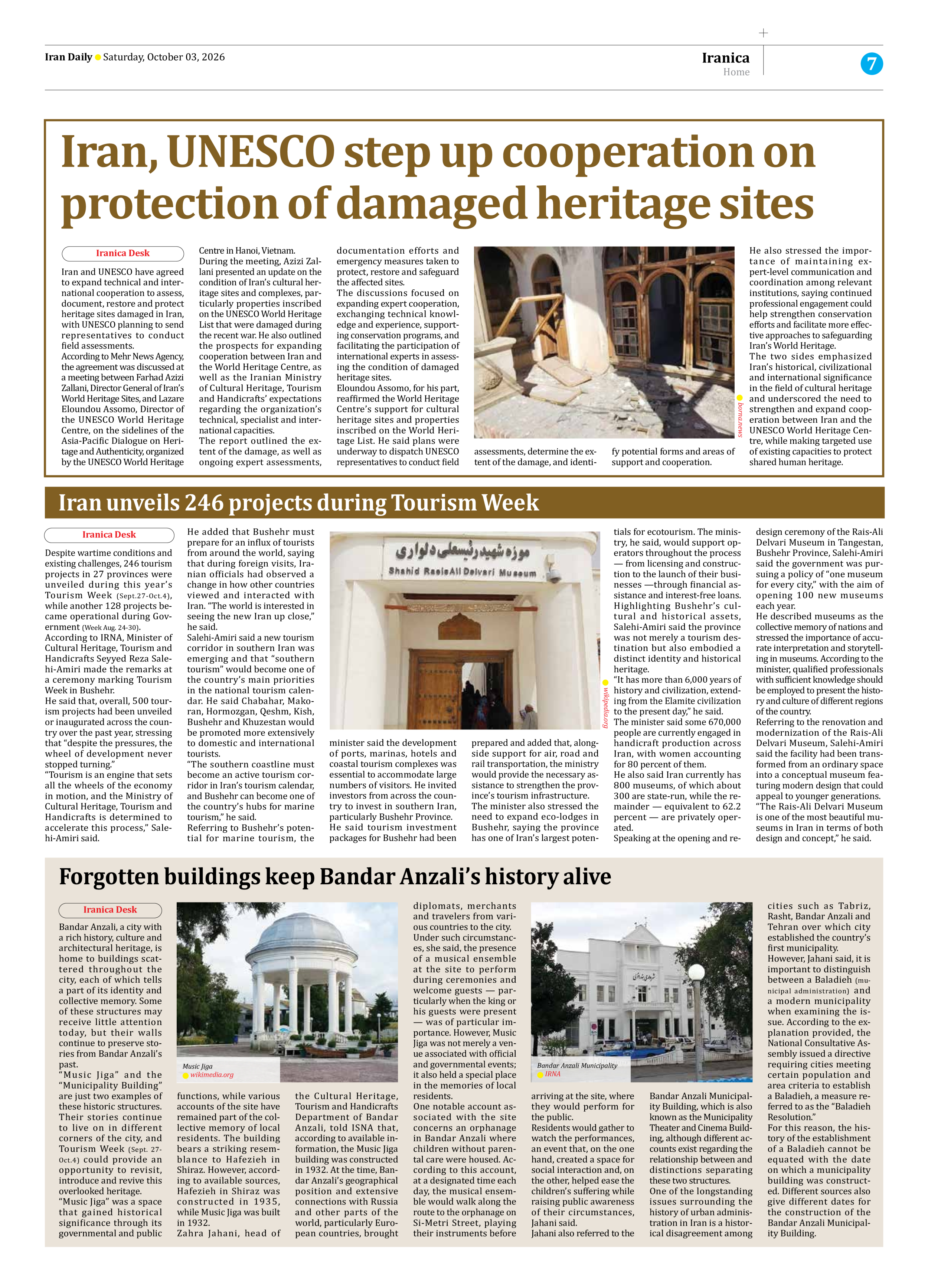
“Music Jiga” was a space that gained historical significance through its governmental and public functions, while various accounts of the site have remained part of the collective memory of local residents. The building bears a striking resemblance to Hafezieh in Shiraz. However, according to available sources, Hafezieh in Shiraz was constructed in 1935, while Music Jiga was built in 1932.
Zahra Jahani, head of the Cultural Heritage, Tourism and Handicrafts Department of Bandar Anzali, told ISNA that, according to available information, the Music Jiga building was constructed in 1932. At the time, Bandar Anzali’s geographical position and extensive connections with Russia and other parts of the world, particularly European countries, brought diplomats, merchants and travelers from various countries to the city.
Under such circumstances, she said, the presence of a musical ensemble at the site to perform during ceremonies and welcome guests — particularly when the king or his guests were present — was of particular importance. However, Music Jiga was not merely a venue associated with official and governmental events; it also held a special place in the memories of local residents.
One notable account associated with the site concerns an orphanage in Bandar Anzali where children without parental care were housed. According to this account, at a designated time each day, the musical ensemble would walk along the route to the orphanage on Si-Metri Street, playing their instruments before arriving at the site, where they would perform for the public.
Residents would gather to watch the performances, an event that, on the one hand, created a space for social interaction and, on the other, helped ease the children’s suffering while raising public awareness of their circumstances, Jahani said.
Jahani also referred to the Bandar Anzali Municipality Building, which is also known as the Municipality Theater and Cinema Building, although different accounts exist regarding the relationship between and distinctions separating these two structures.
One of the longstanding issues surrounding the history of urban administration in Iran is a historical disagreement among cities such as Tabriz, Rasht, Bandar Anzali and Tehran over which city established the country’s first municipality.
However, Jahani said, it is important to distinguish between a Baladieh (municipal administration) and a modern municipality when examining the issue. According to the explanation provided, the National Consultative Assembly issued a directive requiring cities meeting certain population and area criteria to establish a Baladieh, a measure referred to as the “Baladieh Resolution.”
For this reason, the history of the establishment of a Baladieh cannot be equated with the date on which a municipality building was constructed. Different sources also give different dates for the construction of the Bandar Anzali Municipality Building.