







China kiwifruit laboratory seeks deeper cooperation with Iran
By Delaram Ahmadi
Staff writer
A Chinese kiwifruit research laboratory has expressed interest in expanding cooperation with Iran, inviting Iranian scientists and businesses to collaborate on research, cultivation and the development of new kiwifruit varieties.
The China-New Zealand Belt and Road Joint Laboratory on Kiwifruit also hopes to work with Iranian partners to introduce red- and yellow-fleshed varieties to the Iranian market, subject to the agricultural conditions, regulations and standards of both countries.
Kiwifruit is a common autumn fruit in Iran, where an increasing number of farmers have turned to its cultivation in recent years as a profitable crop.
Native to China, the fruit was introduced to New Zealand in 1904 by teacher Isabel Fraser. New Zealand growers spent years developing the first commercially viable varieties, and in the 1950s, as merchants began promoting the fruit overseas, it was given the name “kiwifruit” after New Zealand’s national bird, the kiwi.
Today, only a limited number of countries cultivate the fruit, with China by far the world’s largest producer. The country produces about 2.3 to 2.4 million tons of kiwifruit annually, accounting for roughly half of global production.
Iran also holds a significant position in the global kiwifruit market, producing between 250,000 and 300,000 tons a year, or around 5% to 7% of global output.
Yet for many Iranians, kiwifruit is associated almost exclusively with the familiar hairy, green-fleshed variety, with relatively little awareness of the diversity of species and varieties found around the world.
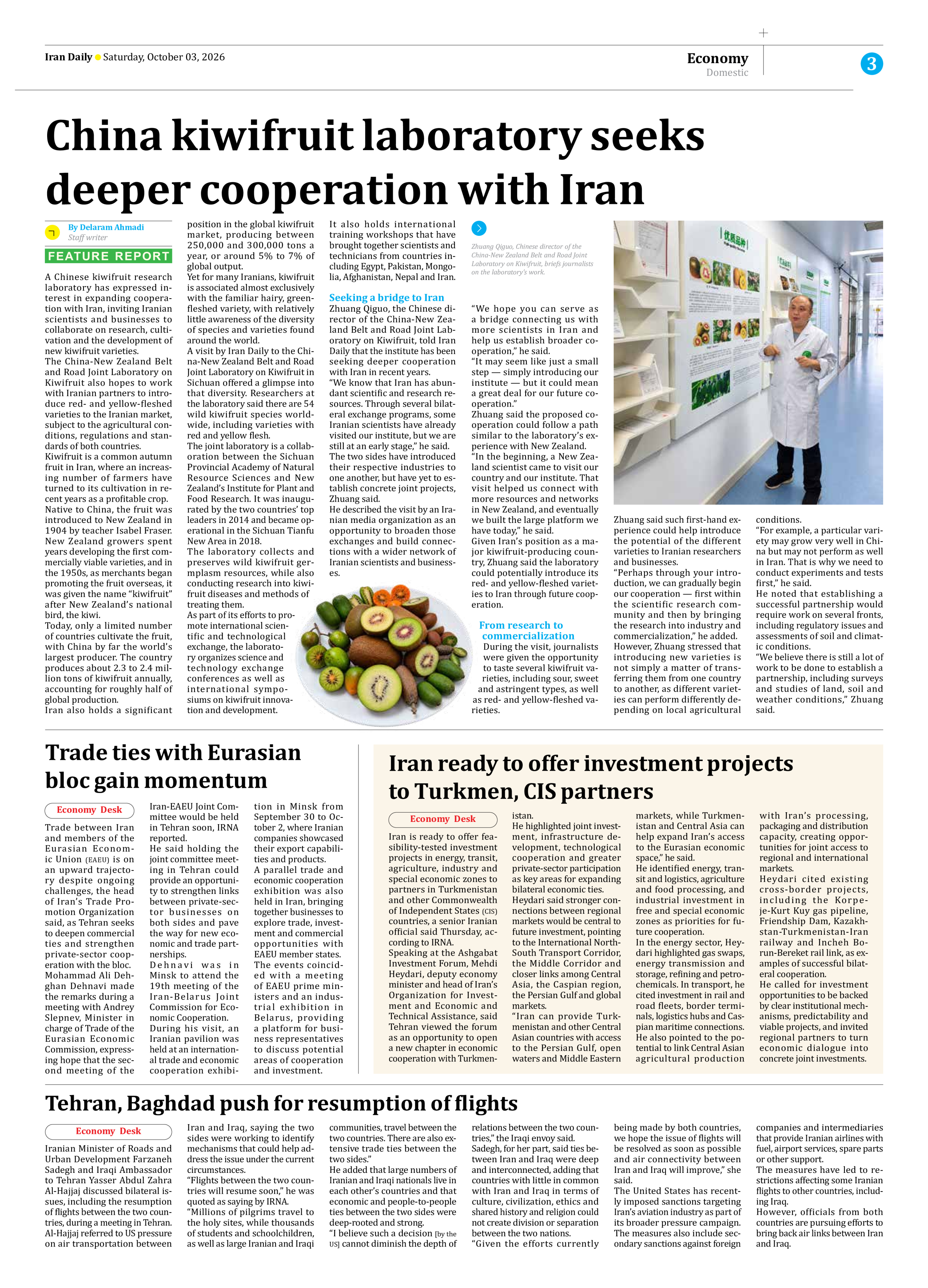
A visit by Iran Daily to the China-New Zealand Belt and Road Joint Laboratory on Kiwifruit in Sichuan offered a glimpse into that diversity. Researchers at the laboratory said there are 54 wild kiwifruit species worldwide, including varieties with red and yellow flesh.
The joint laboratory is a collaboration between the Sichuan Provincial Academy of Natural Resource Sciences and New Zealand’s Institute for Plant and Food Research. It was inaugurated by the two countries’ top leaders in 2014 and became operational in the Sichuan Tianfu New Area in 2018.
The laboratory collects and preserves wild kiwifruit germplasm resources, while also conducting research into kiwifruit diseases and methods of treating them.
As part of its efforts to promote international scientific and technological exchange, the laboratory organizes science and technology exchange conferences as well as international symposiums on kiwifruit innovation and development.
It also holds international training workshops that have brought together scientists and technicians from countries including Egypt, Pakistan, Mongolia, Afghanistan, Nepal and Iran.
Seeking a bridge to Iran
Zhuang Qiguo, the Chinese director of the China-New Zealand Belt and Road Joint Laboratory on Kiwifruit, told Iran Daily that the institute has been seeking deeper cooperation with Iran in recent years.
“We know that Iran has abundant scientific and research resources. Through several bilateral exchange programs, some Iranian scientists have already visited our institute, but we are still at an early stage,” he said.
The two sides have introduced their respective industries to one another, but have yet to establish concrete joint projects, Zhuang said.
He described the visit by an Iranian media organization as an opportunity to broaden those exchanges and build connections with a wider network of Iranian scientists and businesses.
“We hope you can serve as a bridge connecting us with more scientists in Iran and help us establish broader cooperation,” he said.
“It may seem like just a small step — simply introducing our institute — but it could mean a great deal for our future cooperation.”
Zhuang said the proposed cooperation could follow a path similar to the laboratory’s experience with New Zealand.
“In the beginning, a New Zealand scientist came to visit our country and our institute. That visit helped us connect with more resources and networks in New Zealand, and eventually we built the large platform we have today,” he said.
Given Iran’s position as a major kiwifruit-producing country, Zhuang said the laboratory could potentially introduce its red- and yellow-fleshed varieties to Iran through future cooperation.
From research to commercialization
During the visit, journalists were given the opportunity to taste several kiwifruit varieties, including sour, sweet and astringent types, as well as red- and yellow-fleshed varieties.
Zhuang said such first-hand experience could help introduce the potential of the different varieties to Iranian researchers and businesses.
“Perhaps through your introduction, we can gradually begin our cooperation — first within the scientific research community and then by bringing the research into industry and commercialization,” he added.
However, Zhuang stressed that introducing new varieties is not simply a matter of transferring them from one country to another, as different varieties can perform differently depending on local agricultural conditions.
“For example, a particular variety may grow very well in China but may not perform as well in Iran. That is why we need to conduct experiments and tests first,” he said.
He noted that establishing a successful partnership would require work on several fronts, including regulatory issues and assessments of soil and climatic conditions.
“We believe there is still a lot of work to be done to establish a partnership, including surveys and studies of land, soil and weather conditions,” Zhuang said.