







Copy in clipboard...
Iran receives US response to its proposal on Hormuz
Iranian authorities said on Wednesday they received the official US response to their proposal to end the US-Israeli aggression against Iran and reopen the Strait of Hormuz, days after US President Donald Trump rejected the plan.
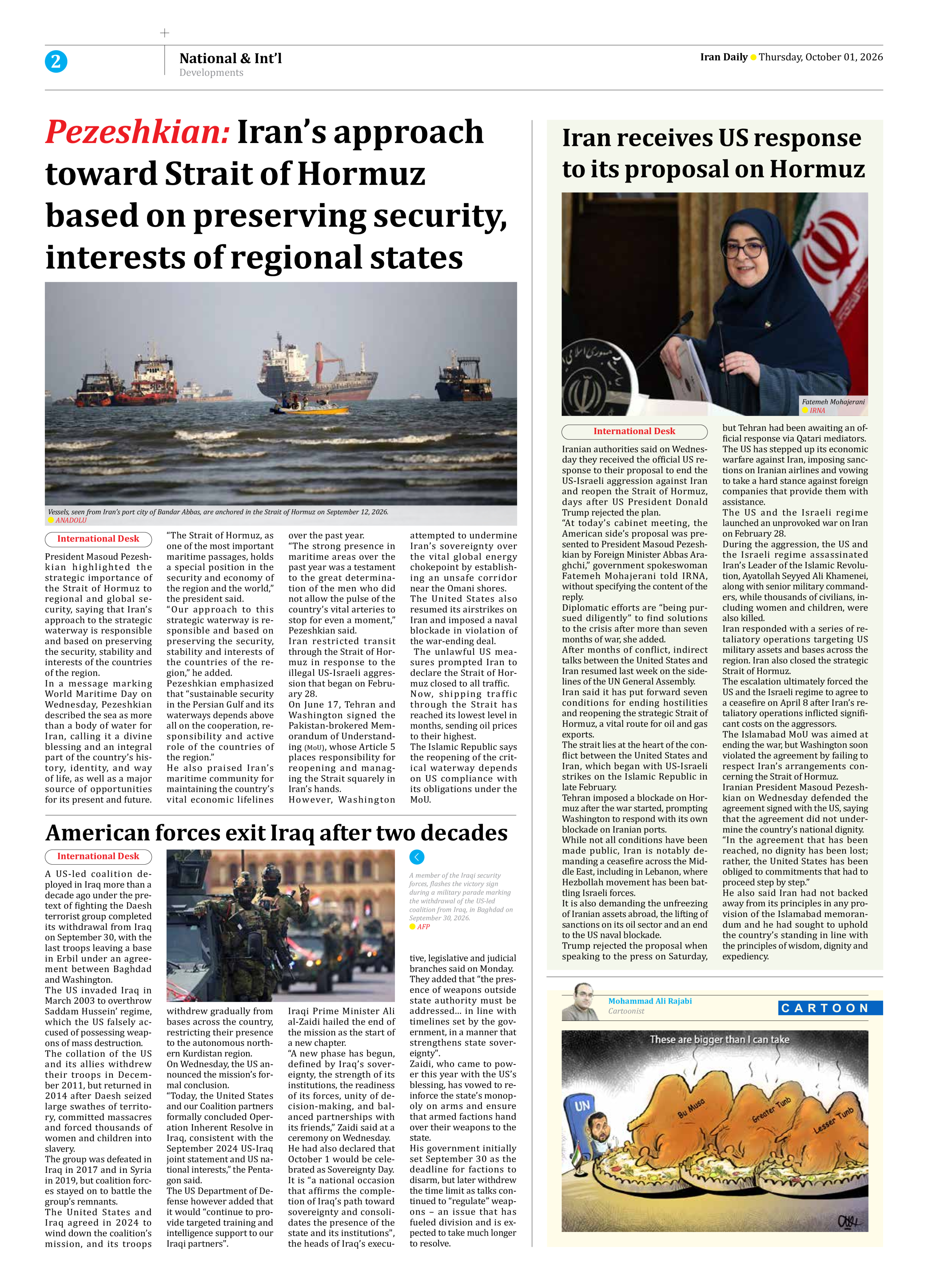
“At today’s cabinet meeting, the American side’s proposal was presented to President Masoud Pezeshkian by Foreign Minister Abbas Araghchi,” government spokeswoman Fatemeh Mohajerani told IRNA, without specifying the content of the reply.
Diplomatic efforts are “being pursued diligently” to find solutions to the crisis after more than seven months of war, she added.
After months of conflict, indirect talks between the United States and Iran resumed last week on the sidelines of the UN General Assembly.
Iran said it has put forward seven conditions for ending hostilities and reopening the strategic Strait of Hormuz, a vital route for oil and gas exports.
The strait lies at the heart of the conflict between the United States and Iran, which began with US-Israeli strikes on the Islamic Republic in late February.
Tehran imposed a blockade on Hormuz after the war started, prompting Washington to respond with its own blockade on Iranian ports.
While not all conditions have been made public, Iran is notably demanding a ceasefire across the Middle East, including in Lebanon, where Hezbollah movement has been battling Israeli forces.
It is also demanding the unfreezing of Iranian assets abroad, the lifting of sanctions on its oil sector and an end to the US naval blockade.
Trump rejected the proposal when speaking to the press on Saturday, but Tehran had been awaiting an official response via Qatari mediators.
The US has stepped up its economic warfare against Iran, imposing sanctions on Iranian airlines and vowing to take a hard stance against foreign companies that provide them with assistance.
The US and the Israeli regime launched an unprovoked war on Iran on February 28.
During the aggression, the US and the Israeli regime assassinated Iran’s Leader of the Islamic Revolution, Ayatollah Seyyed Ali Khamenei, along with senior military commanders, while thousands of civilians, including women and children, were also killed.
Iran responded with a series of retaliatory operations targeting US military assets and bases across the region. Iran also closed the strategic Strait of Hormuz.
The escalation ultimately forced the US and the Israeli regime to agree to a ceasefire on April 8 after Iran’s retaliatory operations inflicted significant costs on the aggressors.
The Islamabad MoU was aimed at ending the war, but Washington soon violated the agreement by failing to respect Iran’s arrangements concerning the Strait of Hormuz.
Iranian President Masoud Pezeshkian on Wednesday defended the agreement signed with the US, saying that the agreement did not undermine the country’s national dignity.
“In the agreement that has been reached, no dignity has been lost; rather, the United States has been obliged to commitments that had to proceed step by step.”
He also said Iran had not backed away from its principles in any provision of the Islamabad memorandum and he had sought to uphold the country’s standing in line with the principles of wisdom, dignity and expediency.