







Visit Khoein where heritage meets everyday life
The historic village of Khoein in Ijrud, Zanjan Province, is a place where history is not confined to the stones and mud bricks of old buildings. In Khoein, history lives in the names of alleyways and gardens, local customs, oral traditions and even in the language spoken by its people.
Located in the Halab region of Ijrud-e Pain Rural District, the historic village is home to a combination of cultural and natural heritage, as well as an ancient Iranian dialect. Its attractions range from the village’s historic tower to mosques, a bathhouse, mills, fortifications, garden-lined lanes and the surrounding mountainous landscape.
Perhaps most significantly, the Khoein language — classified in linguistic studies as part of the Tati group of languages and dialects — is an important element of the village’s cultural identity. Alongside its architectural heritage, the language also needs to be documented and passed on to future generations.
Khoein lies approximately 60 kilometers from Zanjan, on the Zanjan–Bijar route. Thanks to its combination of historical and natural attractions, it has in recent years attracted attention as one of Zanjan Province’s designated tourism villages. Tourism sources identify the village’s tower, Mandeh Fortress, mill, historic bathhouse and mosques, together with the surrounding landscape and valleys, among its principal attractions.
The village developed in a mountainous area, and its geographical setting has influenced both its architecture and the way of life of its residents. Garden-lined lanes, agricultural land and orchards form an important part of the village’s traditional landscape. Grapes, apples, apricots, cherries, sour cherries, dried apricots, walnuts, almonds, figs, peaches, quinces, pears and various varieties of plums are among the area’s reported orchard products. Farmers also grow watermelons, melons, cantaloupes, eggplants, squash, cucumbers, tomatoes and various vegetables.
In such an environment, the village’s architecture cannot be separated from its natural surroundings. Houses, lanes and gardens form an interconnected landscape whose value lies not only in the age of individual structures, but also in the relationship between everyday life and the surrounding environment.
Alongside this historic fabric, Khoein has a wealth of local stories about its past. Oral accounts describe connections with different parts of Iran and even the migration of some Khoein residents to areas outside Iran during the Qajar period. Such accounts remain primarily part of local and oral tradition and would require documentary and historical research before they could be regarded as established historical facts.
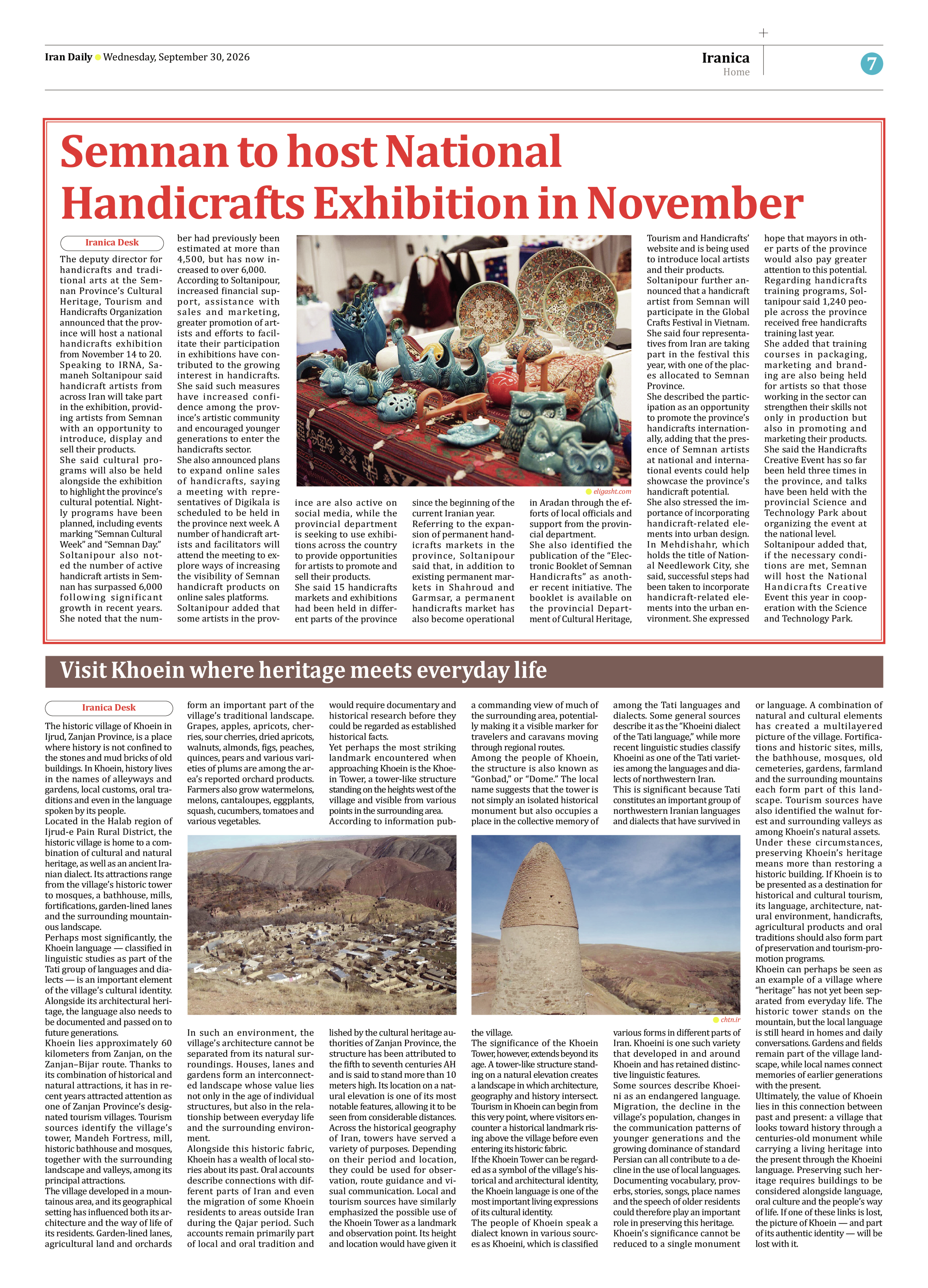
Yet perhaps the most striking landmark encountered when approaching Khoein is the Khoein Tower, a tower-like structure standing on the heights west of the village and visible from various points in the surrounding area.
According to information published by the cultural heritage authorities of Zanjan Province, the structure has been attributed to the fifth to seventh centuries AH and is said to stand more than 10 meters high. Its location on a natural elevation is one of its most notable features, allowing it to be seen from considerable distances.
Across the historical geography of Iran, towers have served a variety of purposes. Depending on their period and location, they could be used for observation, route guidance and visual communication. Local and tourism sources have similarly emphasized the possible use of the Khoein Tower as a landmark and observation point. Its height and location would have given it a commanding view of much of the surrounding area, potentially making it a visible marker for travelers and caravans moving through regional routes.
Among the people of Khoein, the structure is also known as “Gonbad,” or “Dome.” The local name suggests that the tower is not simply an isolated historical monument but also occupies a place in the collective memory of the village.
The significance of the Khoein Tower, however, extends beyond its age. A tower-like structure standing on a natural elevation creates a landscape in which architecture, geography and history intersect. Tourism in Khoein can begin from this very point, where visitors encounter a historical landmark rising above the village before even entering its historic fabric.
If the Khoein Tower can be regarded as a symbol of the village’s historical and architectural identity, the Khoein language is one of the most important living expressions of its cultural identity.
The people of Khoein speak a dialect known in various sources as Khoeini, which is classified among the Tati languages and dialects. Some general sources describe it as the “Khoeini dialect of the Tati language,” while more recent linguistic studies classify Khoeini as one of the Tati varieties among the languages and dialects of northwestern Iran.
This is significant because Tati constitutes an important group of northwestern Iranian languages and dialects that have survived in various forms in different parts of Iran. Khoeini is one such variety that developed in and around Khoein and has retained distinctive linguistic features.
Some sources describe Khoeini as an endangered language. Migration, the decline in the village’s population, changes in the communication patterns of younger generations and the growing dominance of standard Persian can all contribute to a decline in the use of local languages. Documenting vocabulary, proverbs, stories, songs, place names and the speech of older residents could therefore play an important role in preserving this heritage.
Khoein’s significance cannot be reduced to a single monument or language. A combination of natural and cultural elements has created a multilayered picture of the village. Fortifications and historic sites, mills, the bathhouse, mosques, old cemeteries, gardens, farmland and the surrounding mountains each form part of this landscape. Tourism sources have also identified the walnut forest and surrounding valleys as among Khoein’s natural assets.
Under these circumstances, preserving Khoein’s heritage means more than restoring a historic building. If Khoein is to be presented as a destination for historical and cultural tourism, its language, architecture, natural environment, handicrafts, agricultural products and oral traditions should also form part of preservation and tourism-promotion programs.
Khoein can perhaps be seen as an example of a village where “heritage” has not yet been separated from everyday life. The historic tower stands on the mountain, but the local language is still heard in homes and daily conversations. Gardens and fields remain part of the village landscape, while local names connect memories of earlier generations with the present.
Ultimately, the value of Khoein lies in this connection between past and present: a village that looks toward history through a centuries-old monument while carrying a living heritage into the present through the Khoeini language. Preserving such heritage requires buildings to be considered alongside language, oral culture and the people’s way of life. If one of these links is lost, the picture of Khoein — and part of its authentic identity — will be lost with it.