







From Silk Road to Bazargan border crossing
Commerce of Iran, Turkey ‘unstoppable’
The commercial relations of Iran and Turkey possess deep historical relations in the region; relations whose formation harkens back centuries ago and which, throughout history, have conjoined the commercial routes of the East and the West to one another. The place of the two countries along the historical Silk Road and the possession of shared terrestrial frontiers, alongside the geographical situation of Iran as a connective bridge betwixt the East and the West, has caused the economic exchanges of the two countries to perpetually have special significance. This commercial nexus has preserved its significance under contemporary conditions as well. The routes that go through Iran are important to Turkey for access to the countries of Central Asia, Afghanistan, and the regions beyond the Caspian Sea. Likewise, Turkey is situated upon one of the most important terrestrial routes for Iran’s commercial dealings with Europe. For this very reason, the economic and geographical necessities of the two countries are interwoven to such a degree that political developments and disagreements, although capable of affecting the trajectory and cost of commerce, do not eliminate the principle of the mutual need of both parties for the continuation of commercial exchanges. Under conditions in which sanctions and international restrictions, banking pressures, and difficulties of maritime transportation have confronted the foreign commerce of Iran with challenges, the significance of land routes has garnered attention more than before, and Turkey can, in this midst, play an important role in the continuation of Iran’s commerce with regional and European markets. As Jalal Ebrahimi, the head of the Iran-Turkey Council of Common Commerce and the director of the Iran-Turkey Studies Center, said in an exclusive interview with Iran Daily, Turkey is one of the important chokepoints for Iran’s commerce with Europe, and both countries, in many economic domains, are indispensable to one another. In the following, you read the detailed text of this conversation:
By Sadeq Dehqan
Staff writer
IRAN DAILY: Given the current conditions of Iran’s foreign commerce and the restrictions that have been imposed in the domain of maritime transportation and international exchanges, how do you assess the condition of the bilateral commerce of Iran and Turkey?
EBRAHIMI: Iran and Turkey are, in a sense, indispensable to each other. Turkey is an important gateway for our connection with Europe, while we are a gateway for Turkey’s connection with Central Asian countries, Afghanistan, countries beyond the Caspian Sea and even eastern routes.
Of course, political issues and what is referred to today, in the discourse of international relations, as “geopolitics” and “political economy” can affect Iran-Turkey economic relations. Global pressures may also subject different governments, even against their wishes, to certain international requirements and pressures.
Nevertheless, we have extensive land borders with Turkey, and in this region, there are two important free trade zones, namely the Maku Free Zone and the Aras Free Zone, whose significance is linked to Iran-Turkey relations and trade.
What role do the Maku and Aras free zones play in developing Iran-Turkey trade relations?
In terms of area, the Maku Free Zone is one of the largest free zones in the world and has extensive potential. This zone begins at the Bazargan border crossing and encompasses a significant part of Iran’s border strip. Further along, there is the Aras Free Zone, which extends that border strip.
This region has considerable potential in terms of territorial resources, agriculture, industry and commerce. In fact, if we want to discuss Iran’s most important communication route with the West, one of the most important points is precisely this border region with Turkey.
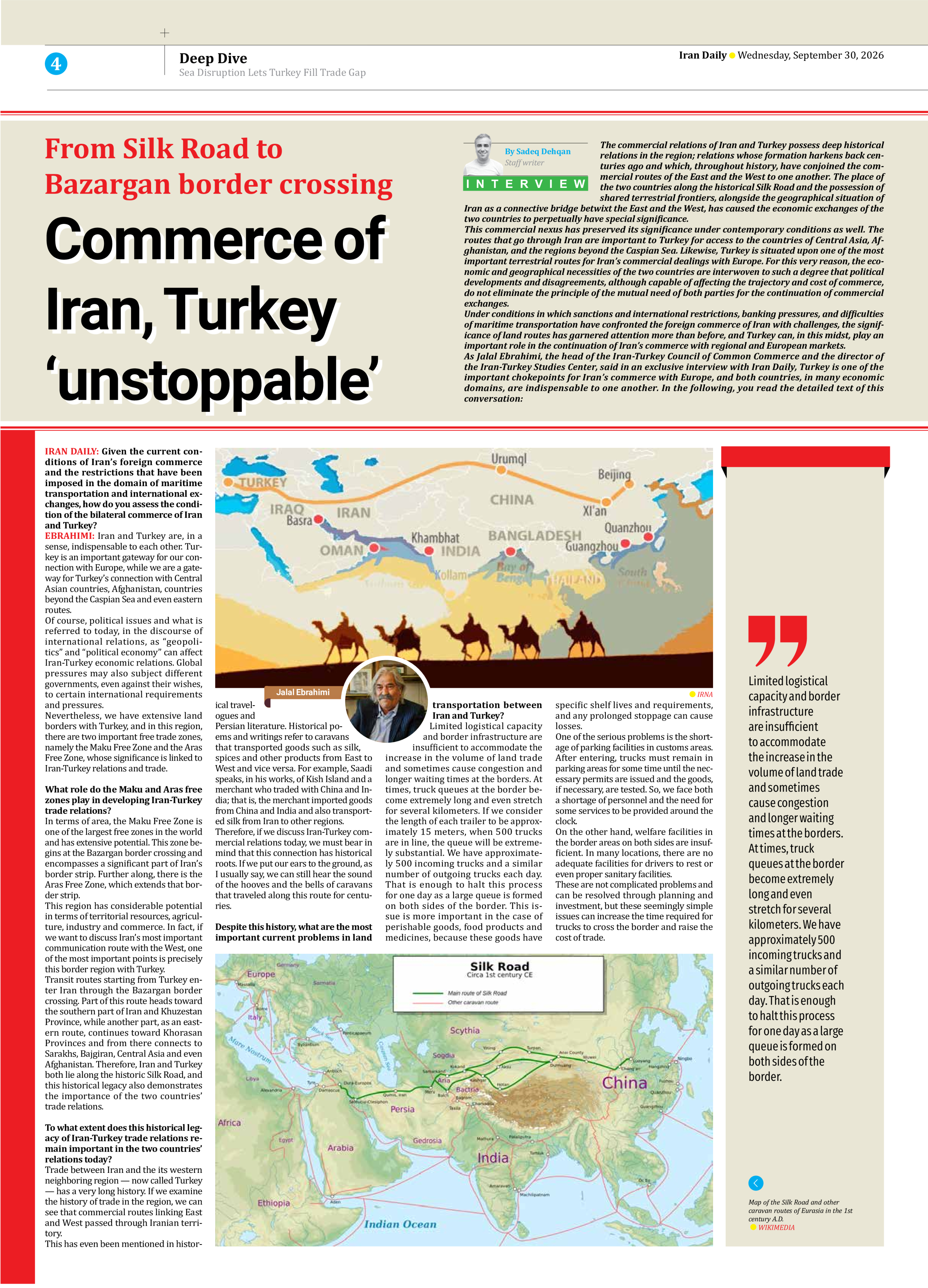
Transit routes starting from Turkey enter Iran through the Bazargan border crossing. Part of this route heads toward the southern part of Iran and Khuzestan Province, while another part, as an eastern route, continues toward Khorasan Provinces and from there connects to Sarakhs, Bajgiran, Central Asia and even Afghanistan. Therefore, Iran and Turkey both lie along the historic Silk Road, and this historical legacy also demonstrates the importance of the two countries’ trade relations.
To what extent does this historical legacy of Iran-Turkey trade relations remain important in the two countries’ relations today?
Trade between Iran and the its western neighboring region — now called Turkey — has a very long history. If we examine the history of trade in the region, we can see that commercial routes linking East and West passed through Iranian territory.
This has even been mentioned in historical travelogues and Persian literature. Historical poems and writings refer to caravans that transported goods such as silk, spices and other products from East to West and vice versa. For example, Saadi speaks, in his works, of Kish Island and a merchant who traded with China and India; that is, the merchant imported goods from China and India and also transported silk from Iran to other regions.
Therefore, if we discuss Iran-Turkey commercial relations today, we must bear in mind that this connection has historical roots. If we put our ears to the ground, as I usually say, we can still hear the sound of the hooves and the bells of caravans that traveled along this route for centuries.
Despite this history, what are the most important current problems in land transportation between Iran and Turkey?
Limited logistical capacity and border infrastructure are insufficient to accommodate the increase in the volume of land trade and sometimes cause congestion and longer waiting times at the borders. At times, truck queues at the border become extremely long and even stretch for several kilometers. If we consider the length of each trailer to be approximately 15 meters, when 500 trucks are in line, the queue will be extremely substantial. We have approximately 500 incoming trucks and a similar number of outgoing trucks each day. That is enough to halt this process for one day as a large queue is formed on both sides of the border. This issue is more important in the case of perishable goods, food products and medicines, because these goods have specific shelf lives and requirements, and any prolonged stoppage can cause losses.
One of the serious problems is the shortage of parking facilities in customs areas. After entering, trucks must remain in parking areas for some time until the necessary permits are issued and the goods, if necessary, are tested. So, we face both a shortage of personnel and the need for some services to be provided around the clock.
On the other hand, welfare facilities in the border areas on both sides are insufficient. In many locations, there are no adequate facilities for drivers to rest or even proper sanitary facilities.
These are not complicated problems and can be resolved through planning and investment, but these seemingly simple issues can increase the time required for trucks to cross the border and raise the cost of trade.
Can rail transportation also help reduce some of these problems?
Certainly. The Iran-Turkey rail route has significant capacity. Turkish trains can enter Iran through the Razi border crossing and continue their journey. This route can ultimately connect to the country’s rail network and transit routes toward Central Asia and even beyond the Caspian Sea.
In recent years, various facilities have also been developed for Iran’s transit and road routes. In addition to direct transit revenues, these routes provide the country with numerous economic benefits.
Therefore, we should ask why some companies and trucks, despite the shorter length of certain routes through Iran, prefer to choose other routes. The answer must be sought in the combination of border problems, prolonged stoppages and logistical costs. These issues must be examined in bilateral negotiations because when Iran and Turkey are expected to function as two hosts to important international transit routes in the region, rules must be established that secure the interests of both sides.
To what extent do political and international pressures affect Iran-Turkey economic relations?
Throughout history, major powers have consistently sought to use their political and economic power. Today, colonialism no longer has its former form, and terms such as “neocolonialism” are used in economic discourse. In the past, a country might directly occupy a territory and take control of its resources, but today, influence may be created through investment, loans, infrastructure development or major economic projects, while long-term economic benefits are obtained in return.
Under such circumstances, countries should strive to ensure that their relations with one another are not affected by the influence of major powers and their policies, and should make maximum use of their geopolitical and transit capacities.
What impact have banking sanctions had on Iran-Turkey trade?
Banking pressures are one of the main problems facing Iran’s foreign trade. In Turkey, we have had Iranian banks such as Bank Mellat and Bank Melli, and their branches and banking systems have been used to conduct transactions. If these banks come under pressure or their activities are restricted, a greater share of money transfers will shift toward exchange offices.
However, exchange offices cannot, on their own, meet all the requirements of foreign trade and ultimately depend on the banking network for transferring money. Therefore, the greater the pressure on banks, the higher the cost and complexity of transferring money.
Given these circumstances, to what extent can Turkey play the role that the UAE has played in Iran’s foreign trade?
Turkey currently plays this role, to some extent. In the past, the Persian Gulf countries, particularly the UAE and Dubai, played an important role in Iran’s commercial and financial connections with the world. A significant number of commercial offices and exchange offices were active there. However, Turkey has also stood alongside Iran, in different periods and particularly during periods of crisis. Of course, we must be realistic; Turkey, like any other country, pursues its own economic interests.
During the Iran-Iraq War, part of Iran’s trade was also conducted through Turkey, and goods were transported through this route. Therefore, Turkey has a history of cooperation with Iran under difficult circumstances. Of course, this does not mean that there are no disagreements in any area. The two countries have differences of opinion in some areas, but overall, Iran-Turkey commercial and economic relations have considerable history and potential.
What is the state of trade between the two countries in terms of the volume of exchanges?
Regarding the figures, we must refer to the official statistics of the customs administration and the Trade Promotion Organization. Reaching the $30 billion trade target between the two countries is achievable, but these figures require careful examination, and it must be determined how much of this consists of exports, how much of imports and how much relates to direct trade with Turkey. Today, too, for an accurate assessment, the trade balance of the two countries must be examined alongside their total trade volume.
What matters is knowing how much goods are exported from Iran to Turkey and how much is imported from Turkey, as well as what the composition of these goods is.
What are the main goods exported by Iran to Turkey?
Turkey is now an industrial country and ranks among the world’s major exporters. Therefore, Iran’s exports to Turkey consist primarily of raw materials and goods such as dried fruits and nuts. Of course, petrochemical products, gas condensates and certain products related to the oil industries are also included, but part of this trade is state-based in nature, and it cannot all be assessed as non-oil exports by the private sector. In the non-oil export sector, we must strive to produce and export goods with higher added value.
Does a high volume of imports from Turkey necessarily harm Iran?
Imports, when a country requires goods and parts, can help meet production needs; however, the main issue is the final cost and structure of these imports.
When Iran is under sanctions, it may purchase a product through a Turkish trader, but it could have ideally purchased the same product directly from a European country at a lower price. The Turkish trader purchases the product from Germany or Belgium, adds his own profit and then sells it to Iran.
At the next stage, the Iranian trader may also add his own costs and profit. Therefore, a product that, for example, cost €3 may ultimately reach the Iranian consumer or producer at a price of €5 or more. Of course, this increase in costs is one of the direct consequences of sanctions pressure and banking and trade restrictions.
To what extent can restrictions on air transportation affect our trade?
Some goods and parts must reach the country quickly. Now that air transportation and access to aircraft, too, have come under sanctions, we are forced to transport these goods by land, which requires more time. When a factory requires a specific part to continue operating, it cannot wait several weeks or months. The absence of a single part may cause a production line to stop and create losses far greater than the price of the part itself.
Under conditions of maritime restrictions, how important is Turkey’s capacity to Iran?
Any disruption to the main maritime routes can increase the cost of trade. When a ship waits for five days instead of three, or even for a considerably longer period, various costs are imposed on it. Customs costs, fuel, vessel detention, insurance and other logistical costs increase, and these costs are ultimately transferred to the final price of the goods.
Countries that are subject to restrictions and economic blockades are more vulnerable in this regard and must simultaneously have several alternative routes for their trade. From this perspective, the capacity for land trade with Turkey is extremely important to us. Iran enjoys major advantages; one such advantage is that it has access both to open waters and maritime routes and to extensive land borders.
The Persian Gulf has historically been one of the most important centers of global trade, and Iran’s ports are also located along this route. However, when, for any reason, the maritime route faces restrictions, land routes become more important. Under such circumstances, Turkey can be one of Iran’s important trade routes with Europe. Of course, using this capacity requires the resolution of border, logistical, banking and transportation problems.
Under such circumstances, what solution would you propose for developing land trade with Turkey?
We must adopt a long-term perspective and strengthen border and transit infrastructure. Increasing customs capacity, establishing suitable parking facilities, operating customs offices and laboratories around the clock, providing welfare facilities for drivers and resolving fuel-related problems are among the measures that can reduce the time required for goods to cross the border.
We must also take rail transportation more seriously and use the capacity of Iran-Turkey rail routes to connect with Europe and Central Asia.
Alongside these measures, the issue of money transfers must also be resolved. If banks are under pressure and exchange offices also face restrictions, trade with any country will become costly and difficult.
Is the problem solely related to sanctions and international restrictions, or do traders’ practices also contribute to higher prices?
Sanctions certainly play an important role, but some of the problems are also related to the culture and conventions of trade. I recently wrote a book, analyzing the commercial letters of Qajar Era. In them, we can see how merchants used to deal with one another rationally, ethically and even on the basis of religious convictions.
Today, we sometimes observe that a trader purchased a product three months earlier at a specified price, but when the exchange rate or market price changes, he sells the same product at the current price, which may be 200% or 300% higher, generating an extremely high profit margin. In my view, one of the issues that has harmed trade today is precisely this; that is, ethics, trust and fairness in transactions must be strengthened once again. Trade is not merely a calculation of profit; if trust disappears, trade itself will also suffer in the long term.