







Copy in clipboard...
Iran calls for roadmap to turn Russia cultural ties into sustained cooperation
Iranian National Library, Russin Oriental Manuscripts Institute sign MoU
Iran’s Culture Minister Abbas Salehi called for a roadmap and sustained activity to turn cultural exchanges with Russia into longer-term cooperation, saying cultural events should serve as a starting point rather than an end in themselves.
Speaking to Iranian artists in Moscow during Iran’s Cultural Days, Salehi described Russia as a priority in Iran’s cultural diplomacy and said the two countries needed a “roadmap and continuity of activities” after the cultural week ends, IRNA reported on Monday.
“Iran’s cultural days in Russia should be the starting point for sustained interactions between the two countries,” Salehi said, calling the participating Iranian artists “cultural ambassadors of the nation”.
He said the 168-member Iranian delegation included musicians, visual artists, handicraft producers, filmmakers, theatre professionals, writers, Persian-language specialists, experts in manuscripts and media workers.
The program is being held in Moscow, St Petersburg in northwestern Russia, Kazan in western Russia and Astrakhan in southern Russia.
Salehi said Russia’s size, population and large Russian-speaking community gave it an important place in Iran’s cultural diplomacy.
He estimated that 250 million to 300 million people in countries across the region speak Russian as a first or second language.
He also pointed to the long history of cultural relations between Iran and Russia, saying the first cultural agreement between Iran and the Soviet Union was exchanged in 1966.
The minister said the government should make greater use of the private sector and act more as a facilitator in cultural and artistic cooperation.
He also called for the development of the cultural economy alongside the preservation of cultural identity, describing the cultural days as an “opening for expanding this path”.
The comments came as Iranian and Russian cultural institutions stepped up cooperation in several fields.
At the third Iran-Russia Cultural Committee meeting in St Petersburg, Salehi and Russian Culture Minister Olga Lyubimova discussed new avenues for cultural and artistic cooperation.
Manuscripts, research take center stage
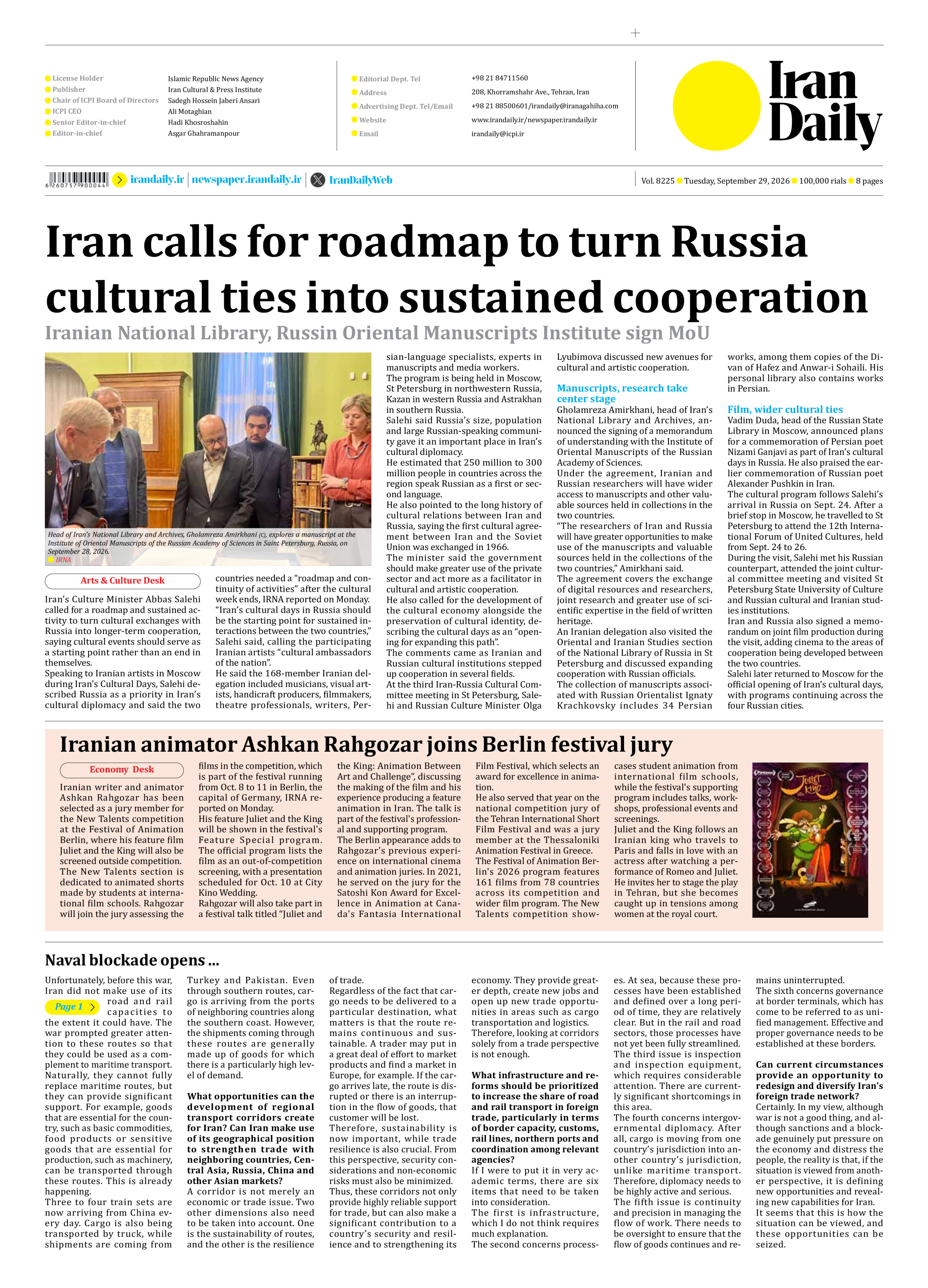
Gholamreza Amirkhani, head of Iran’s National Library and Archives, announced the signing of a memorandum of understanding with the Institute of Oriental Manuscripts of the Russian Academy of Sciences.
Under the agreement, Iranian and Russian researchers will have wider access to manuscripts and other valuable sources held in collections in the two countries.
“The researchers of Iran and Russia will have greater opportunities to make use of the manuscripts and valuable sources held in the collections of the two countries,” Amirkhani said.
The agreement covers the exchange of digital resources and researchers, joint research and greater use of scientific expertise in the field of written heritage.
An Iranian delegation also visited the Oriental and Iranian Studies section of the National Library of Russia in St Petersburg and discussed expanding cooperation with Russian officials.
The collection of manuscripts associated with Russian Orientalist Ignaty Krachkovsky includes 34 Persian works, among them copies of the Divan of Hafez and Anwar-i Sohaili. His personal library also contains works in Persian.
Film, wider cultural ties
Vadim Duda, head of the Russian State Library in Moscow, announced plans for a commemoration of Persian poet Nizami Ganjavi as part of Iran’s cultural days in Russia. He also praised the earlier commemoration of Russian poet Alexander Pushkin in Iran.
The cultural program follows Salehi’s arrival in Russia on Sept. 24. After a brief stop in Moscow, he travelled to St Petersburg to attend the 12th International Forum of United Cultures, held from Sept. 24 to 26.
During the visit, Salehi met his Russian counterpart, attended the joint cultural committee meeting and visited St Petersburg State University of Culture and Russian cultural and Iranian studies institutions.
Iran and Russia also signed a memorandum on joint film production during the visit, adding cinema to the areas of cooperation being developed between the two countries.
Salehi later returned to Moscow for the official opening of Iran’s cultural days, with programs continuing across the four Russian cities.