







Copy in clipboard...
FM warns Iran to fight back any aggression, even an ‘apocalyptic war’
Iran’s Foreign Minister Abbas Araghchi said on Sunday that Iranian delegation came to New York to forge peace but he stressed that “Iran nonetheless remains steadfast in the face of any aggression — even if it comes to an apocalyptic war”.
“President Pezeshkian and I did not come to New York to sell a war. We came to forge peace. Iran nonetheless remains steadfast in the face of any aggression—even if it comes to an apocalyptic war. At the same time, we are ready for real diplomacy”, he made the remarks in a post on X.
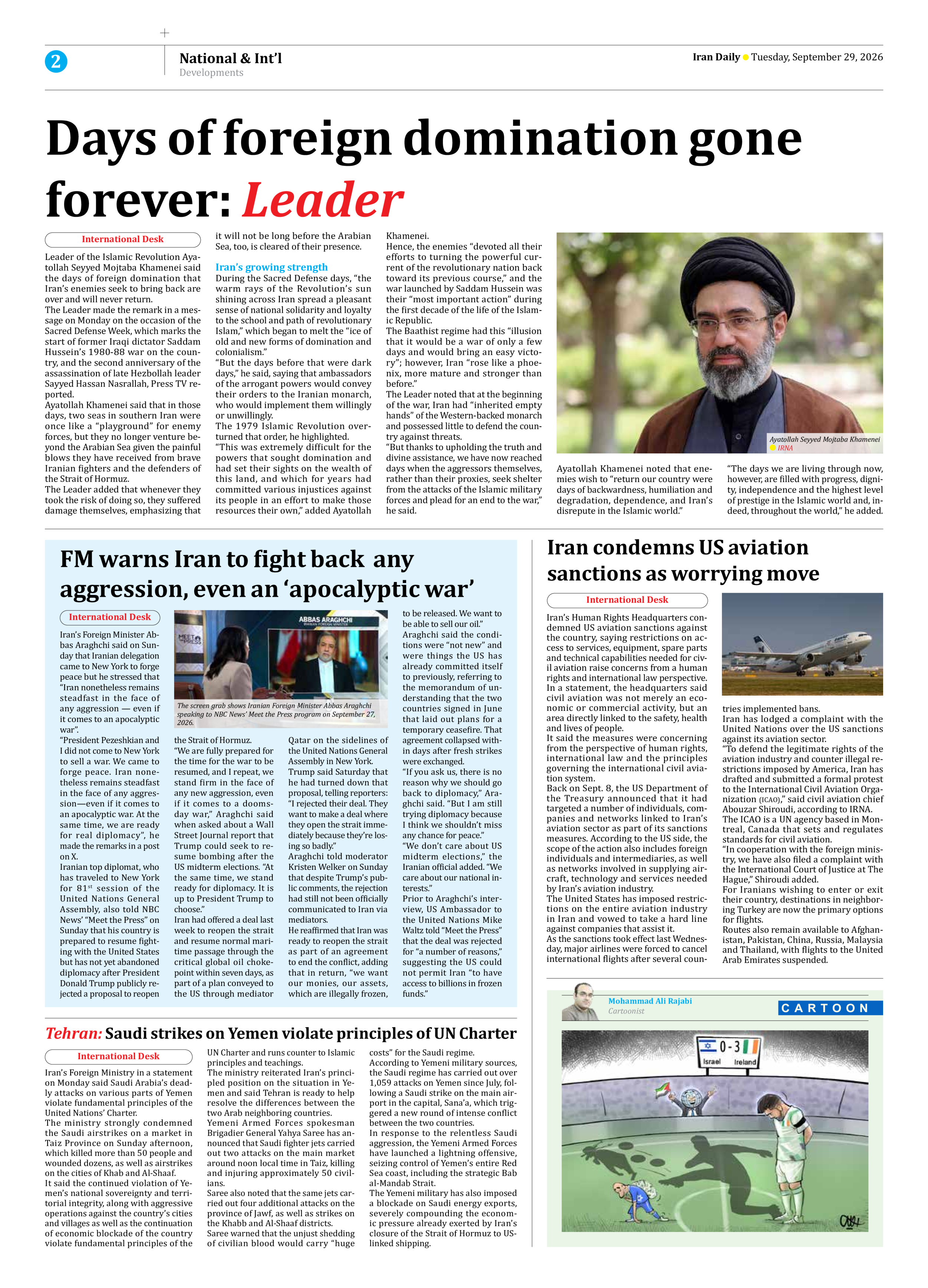
Iranian top diplomat, who has traveled to New York for 81st session of the United Nations General Assembly, also told NBC News’ “Meet the Press” on Sunday that his country is prepared to resume fighting with the United States but has not yet abandoned diplomacy after President Donald Trump publicly rejected a proposal to reopen the Strait of Hormuz.
“We are fully prepared for the time for the war to be resumed, and I repeat, we stand firm in the face of any new aggression, even if it comes to a doomsday war,” Araghchi said when asked about a Wall Street Journal report that Trump could seek to resume bombing after the US midterm elections. “At the same time, we stand ready for diplomacy. It is up to President Trump to choose.”
Iran had offered a deal last week to reopen the strait and resume normal maritime passage through the critical global oil chokepoint within seven days, as part of a plan conveyed to the US through mediator Qatar on the sidelines of the United Nations General Assembly in New York.
Trump said Saturday that he had turned down that proposal, telling reporters: “I rejected their deal. They want to make a deal where they open the strait immediately because they’re losing so badly.”
Araghchi told moderator Kristen Welker on Sunday that despite Trump’s public comments, the rejection had still not been officially communicated to Iran via mediators.
He reaffirmed that Iran was ready to reopen the strait as part of an agreement to end the conflict, adding that in return, “we want our monies, our assets, which are illegally frozen, to be released. We want to be able to sell our oil.”
Araghchi said the conditions were “not new” and were things the US has already committed itself to previously, referring to the memorandum of understanding that the two countries signed in June that laid out plans for a temporary ceasefire. That agreement collapsed within days after fresh strikes were exchanged.
“If you ask us, there is no reason why we should go back to diplomacy,” Araghchi said. “But I am still trying diplomacy because I think we shouldn’t miss any chance for peace.”
“We don’t care about US midterm elections,” the Iranian official added. “We care about our national interests.”
Prior to Araghchi’s interview, US Ambassador to the United Nations Mike Waltz told “Meet the Press” that the deal was rejected for “a number of reasons,” suggesting the US could not permit Iran “to have access to billions in frozen funds.”