







Lessons for Iran from inland Chinese hub
Chongqing: China’s little-known metropolis with global outlook
By Delaram Ahmadi
Staff writer
For many Iranians, China brings to mind cities such as Beijing, Shanghai, Shenzhen or Guangzhou. Chongqing, however, is unlikely to be among the first names that come to mind.
Yet the vast metropolis in southwestern China is difficult to overlook once you are there.
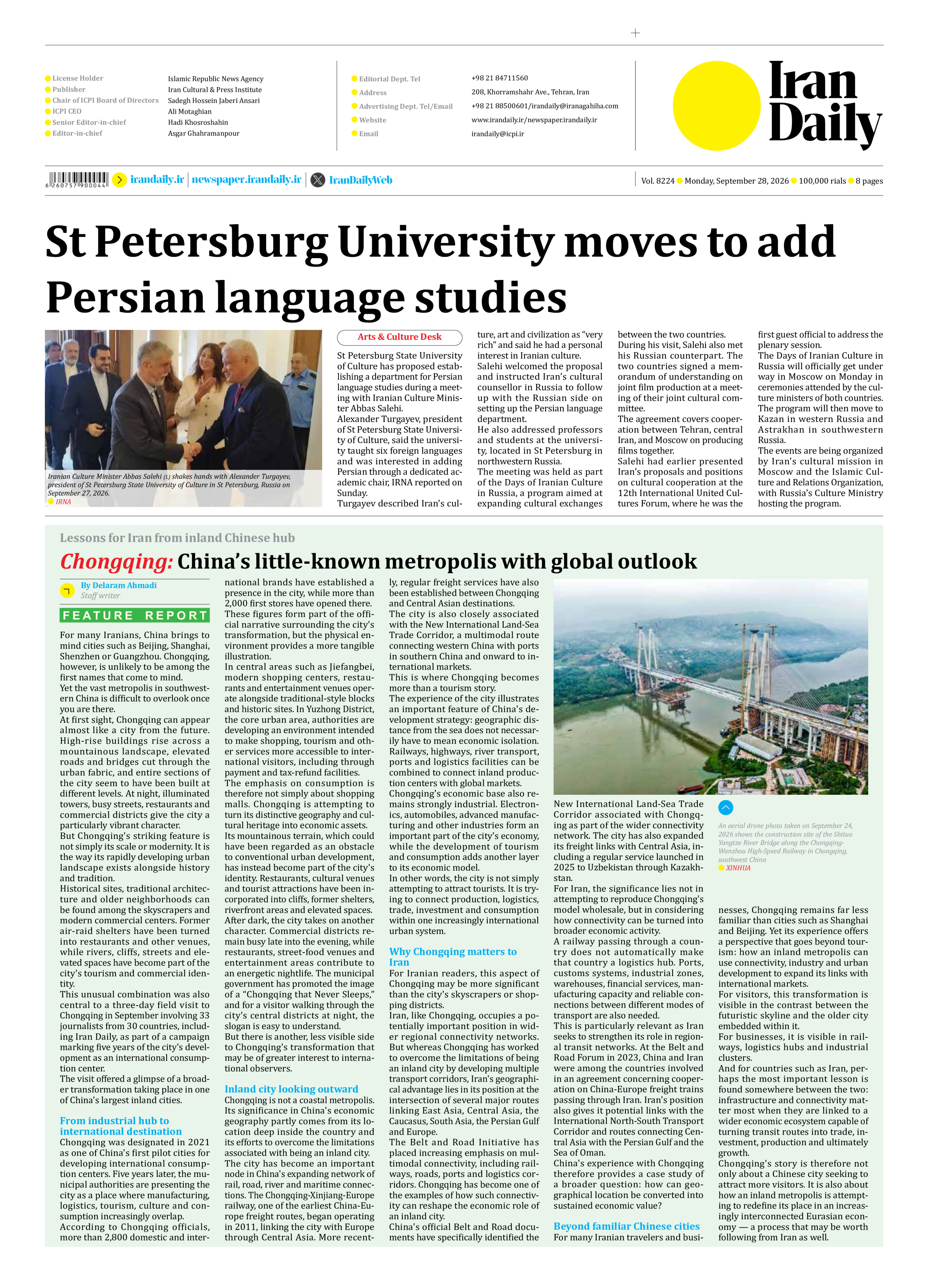
At first sight, Chongqing can appear almost like a city from the future. High-rise buildings rise across a mountainous landscape, elevated roads and bridges cut through the urban fabric, and entire sections of the city seem to have been built at different levels. At night, illuminated towers, busy streets, restaurants and commercial districts give the city a particularly vibrant character.
But Chongqing's striking feature is not simply its scale or modernity. It is the way its rapidly developing urban landscape exists alongside history and tradition.
Historical sites, traditional architecture and older neighborhoods can be found among the skyscrapers and modern commercial centers. Former air-raid shelters have been turned into restaurants and other venues, while rivers, cliffs, streets and elevated spaces have become part of the city's tourism and commercial identity.
This unusual combination was also central to a three-day field visit to Chongqing in September involving 33 journalists from 30 countries, including Iran Daily, as part of a campaign marking five years of the city's development as an international consumption center.
The visit offered a glimpse of a broader transformation taking place in one of China's largest inland cities.
From industrial hub to international destination
Chongqing was designated in 2021 as one of China's first pilot cities for developing international consumption centers. Five years later, the municipal authorities are presenting the city as a place where manufacturing, logistics, tourism, culture and consumption increasingly overlap.
According to Chongqing officials, more than 2,800 domestic and international brands have established a presence in the city, while more than 2,000 first stores have opened there.
These figures form part of the official narrative surrounding the city's transformation, but the physical environment provides a more tangible illustration.
In central areas such as Jiefangbei, modern shopping centers, restaurants and entertainment venues operate alongside traditional-style blocks and historic sites. In Yuzhong District, the core urban area, authorities are developing an environment intended to make shopping, tourism and other services more accessible to international visitors, including through payment and tax-refund facilities.
The emphasis on consumption is therefore not simply about shopping malls. Chongqing is attempting to turn its distinctive geography and cultural heritage into economic assets.
Its mountainous terrain, which could have been regarded as an obstacle to conventional urban development, has instead become part of the city's identity. Restaurants, cultural venues and tourist attractions have been incorporated into cliffs, former shelters, riverfront areas and elevated spaces.
After dark, the city takes on another character. Commercial districts remain busy late into the evening, while restaurants, street-food venues and entertainment areas contribute to an energetic nightlife. The municipal government has promoted the image of a “Chongqing that Never Sleeps,” and for a visitor walking through the city's central districts at night, the slogan is easy to understand.
But there is another, less visible side to Chongqing's transformation that may be of greater interest to international observers.
Inland city looking outward
Chongqing is not a coastal metropolis. Its significance in China's economic geography partly comes from its location deep inside the country and its efforts to overcome the limitations associated with being an inland city.
The city has become an important node in China's expanding network of rail, road, river and maritime connections. The Chongqing-Xinjiang-Europe railway, one of the earliest China-Europe freight routes, began operating in 2011, linking the city with Europe through Central Asia. More recently, regular freight services have also been established between Chongqing and Central Asian destinations.
The city is also closely associated with the New International Land-Sea Trade Corridor, a multimodal route connecting western China with ports in southern China and onward to international markets.
This is where Chongqing becomes more than a tourism story.
The experience of the city illustrates an important feature of China's development strategy: geographic distance from the sea does not necessarily have to mean economic isolation. Railways, highways, river transport, ports and logistics facilities can be combined to connect inland production centers with global markets.
Chongqing's economic base also remains strongly industrial. Electronics, automobiles, advanced manufacturing and other industries form an important part of the city's economy, while the development of tourism and consumption adds another layer to its economic model.
In other words, the city is not simply attempting to attract tourists. It is trying to connect production, logistics, trade, investment and consumption within one increasingly international urban system.
Why Chongqing matters to Iran
For Iranian readers, this aspect of Chongqing may be more significant than the city's skyscrapers or shopping districts.
Iran, like Chongqing, occupies a potentially important position in wider regional connectivity networks. But whereas Chongqing has worked to overcome the limitations of being an inland city by developing multiple transport corridors, Iran's geographical advantage lies in its position at the intersection of several major routes linking East Asia, Central Asia, the Caucasus, South Asia, the Persian Gulf and Europe.
The Belt and Road Initiative has placed increasing emphasis on multimodal connectivity, including railways, roads, ports and logistics corridors. Chongqing has become one of the examples of how such connectivity can reshape the economic role of an inland city.
China's official Belt and Road documents have specifically identified the New International Land-Sea Trade Corridor associated with Chongqing as part of the wider connectivity network. The city has also expanded its freight links with Central Asia, including a regular service launched in 2025 to Uzbekistan through Kazakhstan.
For Iran, the significance lies not in attempting to reproduce Chongqing's model wholesale, but in considering how connectivity can be turned into broader economic activity.
A railway passing through a country does not automatically make that country a logistics hub. Ports, customs systems, industrial zones, warehouses, financial services, manufacturing capacity and reliable connections between different modes of transport are also needed.
This is particularly relevant as Iran seeks to strengthen its role in regional transit networks. At the Belt and Road Forum in 2023, China and Iran were among the countries involved in an agreement concerning cooperation on China-Europe freight trains passing through Iran. Iran's position also gives it potential links with the International North-South Transport Corridor and routes connecting Central Asia with the Persian Gulf and the Sea of Oman.
China's experience with Chongqing therefore provides a case study of a broader question: how can geographical location be converted into sustained economic value?
Beyond familiar Chinese cities
For many Iranian travelers and businesses, Chongqing remains far less familiar than cities such as Shanghai and Beijing. Yet its experience offers a perspective that goes beyond tourism: how an inland metropolis can use connectivity, industry and urban development to expand its links with international markets.
For visitors, this transformation is visible in the contrast between the futuristic skyline and the older city embedded within it.
For businesses, it is visible in railways, logistics hubs and industrial clusters.
And for countries such as Iran, perhaps the most important lesson is found somewhere between the two: infrastructure and connectivity matter most when they are linked to a wider economic ecosystem capable of turning transit routes into trade, investment, production and ultimately growth.
Chongqing's story is therefore not only about a Chinese city seeking to attract more visitors. It is also about how an inland metropolis is attempting to redefine its place in an increasingly interconnected Eurasian economy — a process that may be worth following from Iran as well.