







Meyami’s caravanserais; echoes of Iran’s historic roads
Meyami, the easternmost part of Semnan Province, is one of the most important historical points along the Tehran–Mashhad route and the ancient roads of Iran. For centuries, the region has served as a passageway for caravans, travelers, and merchants. This strategic location led to the development of a valuable network of caravanserais. The caravanserais of Meyami, Miandasht, Abbasabad, and other historic structures in the region were not merely places where travelers stopped to rest; they were also an integral part of Iran’s broader history of commercial, cultural, and social connections.
The construction of facilities designed to provide travelers with comfort and security was one of the most important achievements in the history of travel and communication. Such structures were generally built along difficult routes, in hot and arid regions, and on major communication roads. Iranians were among the pioneers in constructing and developing these facilities. Over time, they evolved into what became known as caravanserais.
Throughout history, caravanserais served purposes beyond accommodation and rest. They helped meet the needs of caravans, promoted trade, facilitated connections between different regions, and encouraged social and cultural interaction. Each of these structures can therefore be regarded as part of the history of Iran’s roads — a history shaped along the Silk Road and the communication routes linking the eastern and western parts of the country.
A caravanserai can generally be described as a building designed to accommodate caravans and travelers, constructed according to their needs and adapted to the climatic and geographical conditions of the route.
The word “caravanserai” itself reflects the Iranian origins of these structures. The term “caravan” is derived from “karban,” and the word is rooted in the Parthian Middle Persian language. Its etymology demonstrates the close relationship between the concept of the caravanserai and trade and commerce. Caravans stopped at these establishments to rest, obtain daily necessities, conduct commercial exchanges, and seek protection from bandits and natural hazards.
Caravanserais, therefore, cannot be regarded merely as architectural structures. They formed part of a broader communication and economic system in which roads, trade, travel, security, and interaction among different communities were closely interconnected. During periods such as the Achaemenid, Parthian, Mongol, Seljuk, Ottoman, and Safavid eras, caravanserais expanded alongside the growth of trade and commerce and became important elements of the communication networks connecting different territories.
The origins of the caravanserai can be traced back to pre-Islamic Iran. The climatic conditions, vast geography, extensive territories of the Achaemenid Empire, and its wide-ranging contacts with other peoples contributed to the establishment of a network of postal stations and communication centers. These facilities can be regarded as precursors to the caravanserais of later periods. Iranians were among the first in world history to organize an extensive system of major long-distance roads. What is known today as the caravanserai evolved from the Achaemenid postal stations and the commercial and trading waystations of the Parthian and Sasanian periods along the Silk Road.
Meyami has historically enjoyed particular importance as a transportation and communication corridor because of its location on the Tehran–Mashhad route and its connections with Golestan, North Khorasan, and Khorasan Razavi provinces.
One of the most significant indications of this historical importance is the presence of numerous caravanserais throughout the region. The concentration of so many caravanserais demonstrates Meyami’s important role in historical commercial and communication networks and highlights its considerable potential for cultural and historical tourism.
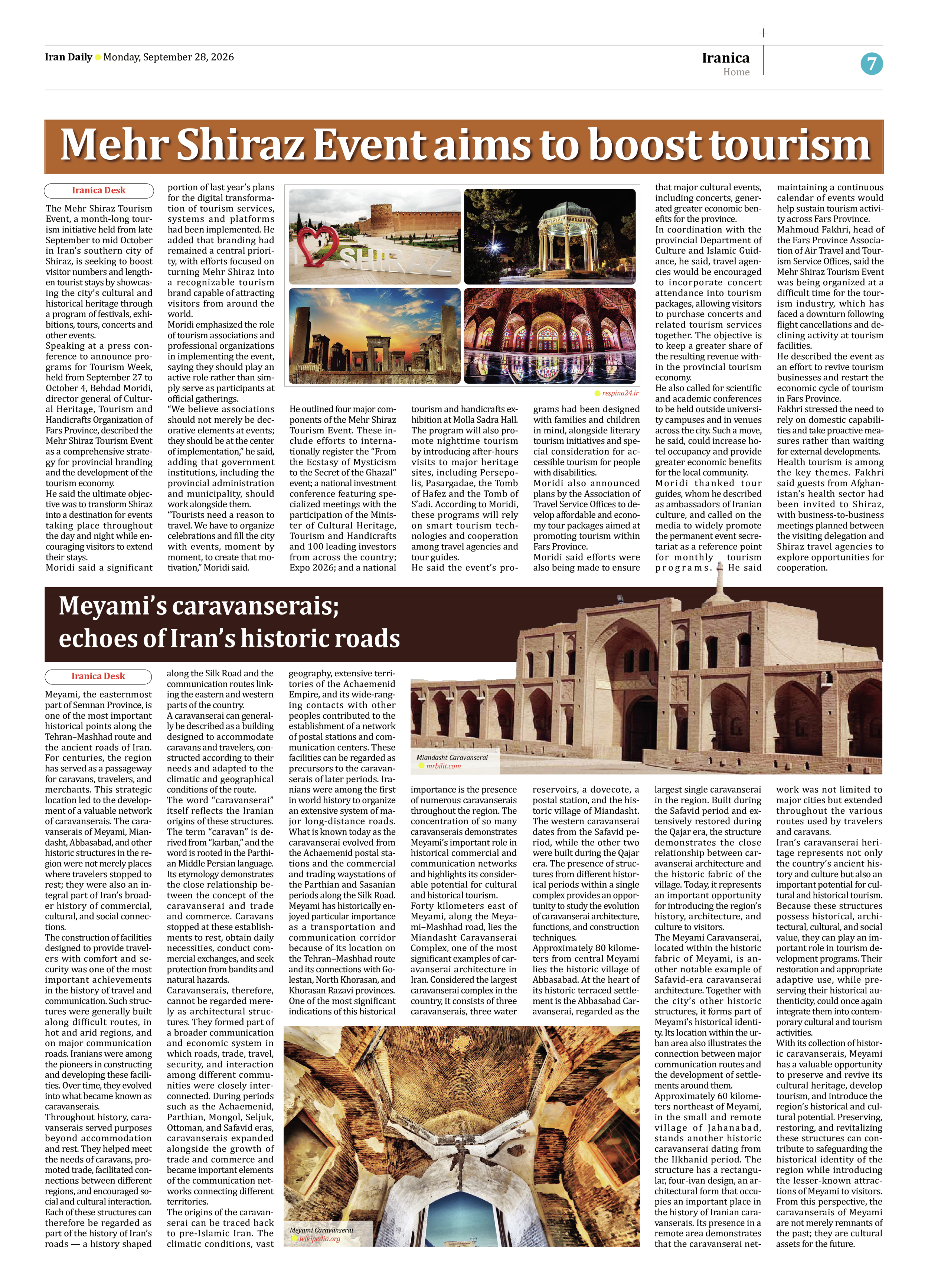
Forty kilometers east of Meyami, along the Meyami–Mashhad road, lies the Miandasht Caravanserai Complex, one of the most significant examples of caravanserai architecture in Iran. Considered the largest caravanserai complex in the country, it consists of three caravanserais, three water reservoirs, a dovecote, a postal station, and the historic village of Miandasht. The western caravanserai dates from the Safavid period, while the other two were built during the Qajar era. The presence of structures from different historical periods within a single complex provides an opportunity to study the evolution of caravanserai architecture, functions, and construction techniques.
Approximately 80 kilometers from central Meyami lies the historic village of Abbasabad. At the heart of its historic terraced settlement is the Abbasabad Caravanserai, regarded as the largest single caravanserai in the region. Built during the Safavid period and extensively restored during the Qajar era, the structure demonstrates the close relationship between caravanserai architecture and the historic fabric of the village. Today, it represents an important opportunity for introducing the region’s history, architecture, and culture to visitors.
The Meyami Caravanserai, located within the historic fabric of Meyami, is another notable example of Safavid-era caravanserai architecture. Together with the city’s other historic structures, it forms part of Meyami’s historical identity. Its location within the urban area also illustrates the connection between major communication routes and the development of settlements around them.
Approximately 60 kilometers northeast of Meyami, in the small and remote village of Jahanabad, stands another historic caravanserai dating from the Ilkhanid period. The structure has a rectangular, four-ivan design, an architectural form that occupies an important place in the history of Iranian caravanserais. Its presence in a remote area demonstrates that the caravanserai network was not limited to major cities but extended throughout the various routes used by travelers and caravans.
Iran’s caravanserai heritage represents not only the country’s ancient history and culture but also an important potential for cultural and historical tourism. Because these structures possess historical, architectural, cultural, and social value, they can play an important role in tourism development programs. Their restoration and appropriate adaptive use, while preserving their historical authenticity, could once again integrate them into contemporary cultural and tourism activities.
With its collection of historic caravanserais, Meyami has a valuable opportunity to preserve and revive its cultural heritage, develop tourism, and introduce the region’s historical and cultural potential. Preserving, restoring, and revitalizing these structures can contribute to safeguarding the historical identity of the region while introducing the lesser-known attractions of Meyami to visitors. From this perspective, the caravanserais of Meyami are not merely remnants of the past; they are cultural assets for the future.