





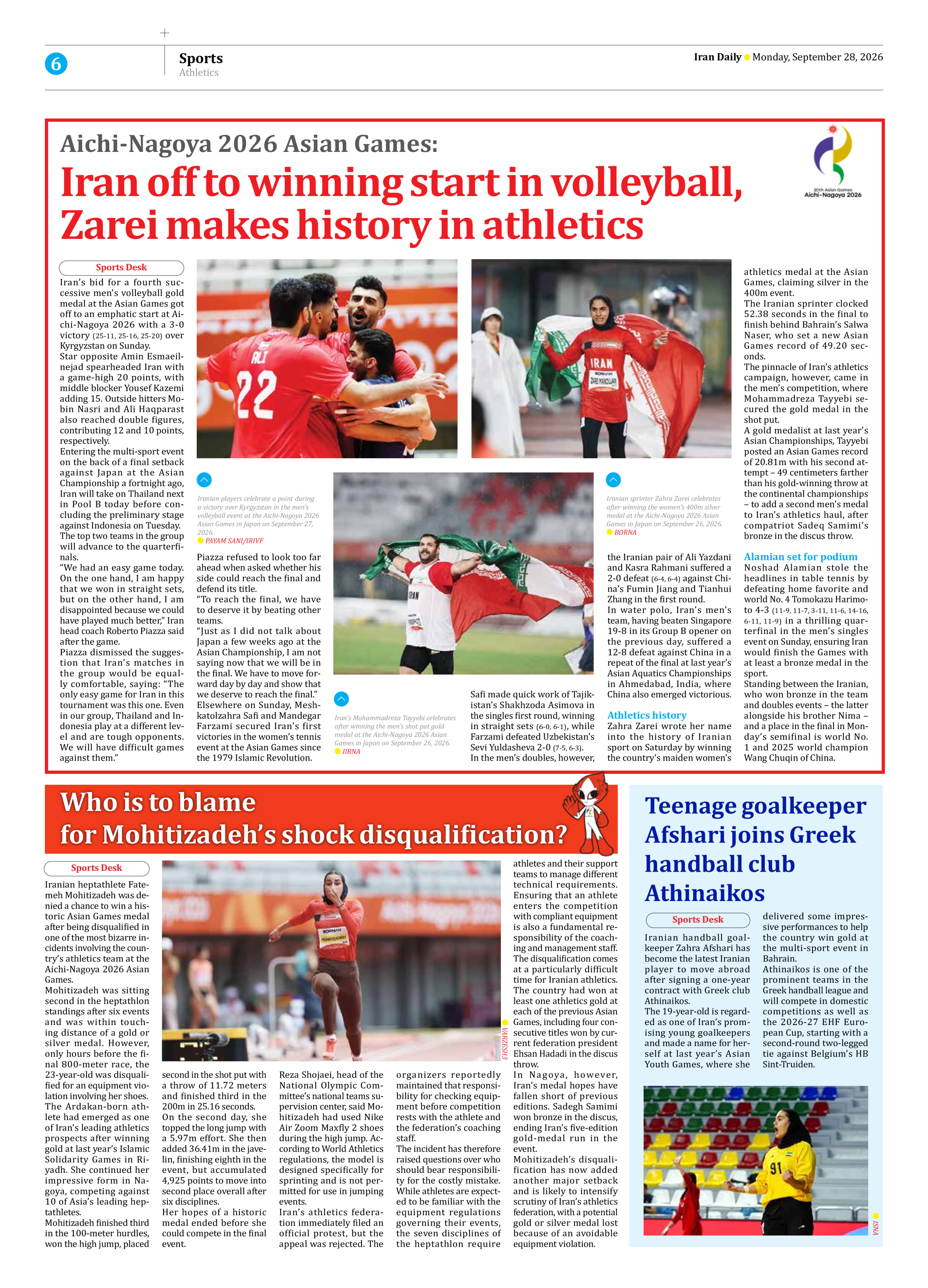


Who is to blame for Mohitizadeh’s shock disqualification?
Iranian heptathlete Fatemeh Mohitizadeh was denied a chance to win a historic Asian Games medal after being disqualified in one of the most bizarre incidents involving the country’s athletics team at the Aichi-Nagoya 2026 Asian Games.
Mohitizadeh was sitting second in the heptathlon standings after six events and was within touching distance of a gold or silver medal. However, only hours before the final 800-meter race, the 23-year-old was disqualified for an equipment violation involving her shoes.
The Ardakan-born athlete had emerged as one of Iran’s leading athletics prospects after winning gold at last year’s Islamic Solidarity Games in Riyadh. She continued her impressive form in Nagoya, competing against 10 of Asia’s leading heptathletes.
Mohitizadeh finished third in the 100-meter hurdles, won the high jump, placed second in the shot put with a throw of 11.72 meters and finished third in the 200m in 25.16 seconds.
On the second day, she topped the long jump with a 5.97m effort. She then added 36.41m in the javelin, finishing eighth in the event, but accumulated 4,925 points to move into second place overall after six disciplines.
Her hopes of a historic medal ended before she could compete in the final event.
Reza Shojaei, head of the National Olympic Committee’s national teams supervision center, said Mohitizadeh had used Nike Air Zoom Maxfly 2 shoes during the high jump. According to World Athletics regulations, the model is designed specifically for sprinting and is not permitted for use in jumping events.
Iran’s athletics federation immediately filed an official protest, but the appeal was rejected. The organizers reportedly maintained that responsibility for checking equipment before competition rests with the athlete and the federation’s coaching staff.
The incident has therefore raised questions over who should bear responsibility for the costly mistake. While athletes are expected to be familiar with the equipment regulations governing their events, the seven disciplines of the heptathlon require athletes and their support teams to manage different technical requirements. Ensuring that an athlete enters the competition with compliant equipment is also a fundamental responsibility of the coaching and management staff.
The disqualification comes at a particularly difficult time for Iranian athletics. The country had won at least one athletics gold at each of the previous Asian Games, including four consecutive titles won by current federation president Ehsan Hadadi in the discus throw.
In Nagoya, however, Iran’s medal hopes have fallen short of previous editions. Sadegh Samimi won bronze in the discus, ending Iran’s five-edition gold-medal run in the event.
Mohitizadeh’s disqualification has now added another major setback and is likely to intensify scrutiny of Iran’s athletics federation, with a potential gold or silver medal lost because of an avoidable equipment violation.