







Revisiting state of Iran’s Air Force during Iraqi-imposed
Technology alone not decisive in wars: Veteran pilot
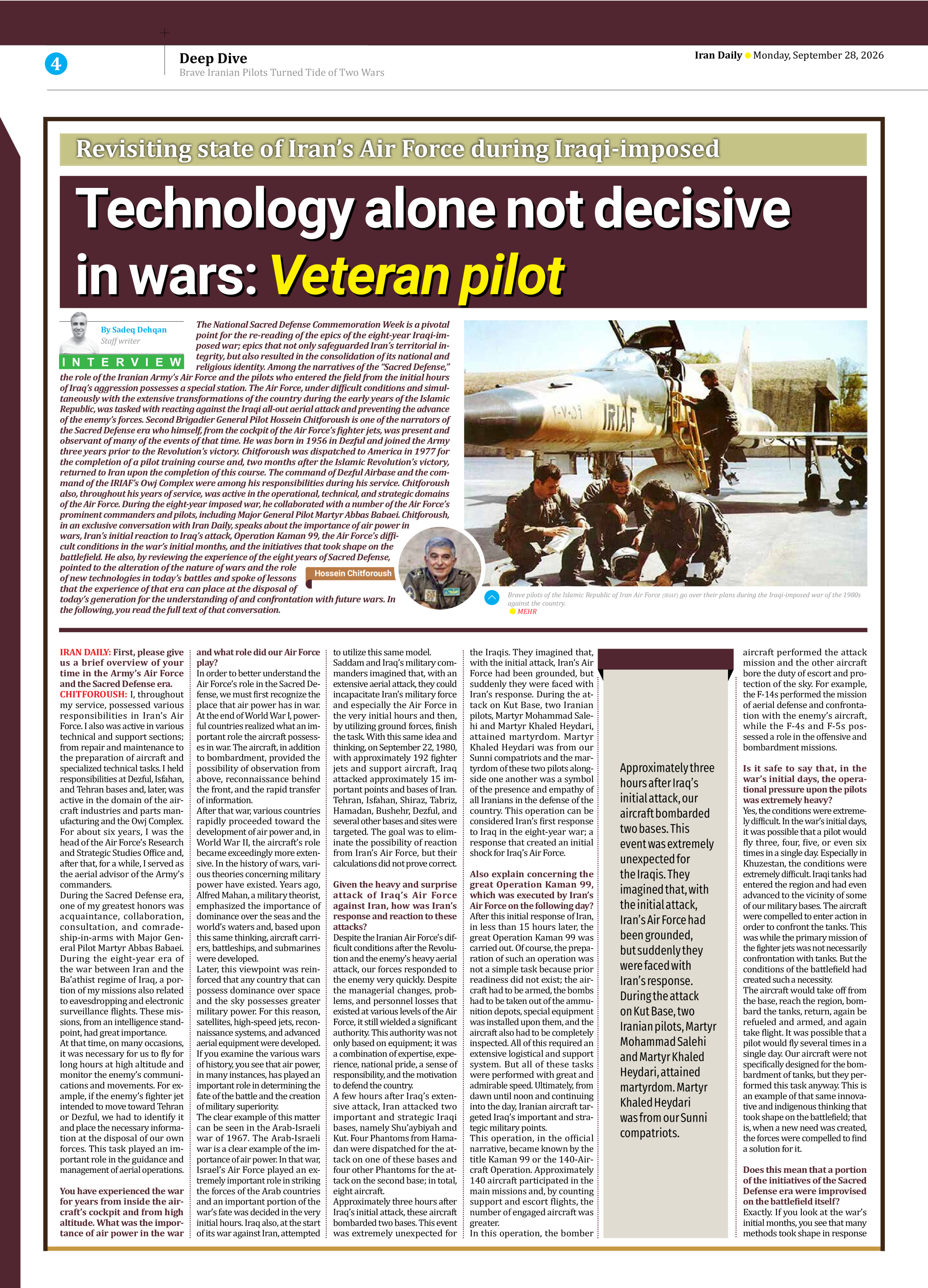
The National Sacred Defense Commemoration Week is a pivotal point for the re-reading of the epics of the eight-year Iraqi-imposed war; epics that not only safeguarded Iran’s territorial integrity, but also resulted in the consolidation of its national and religious identity. Among the narratives of the “Sacred Defense,” the role of the Iranian Army’s Air Force and the pilots who entered the field from the initial hours of Iraq’s aggression possesses a special station. The Air Force, under difficult conditions and simultaneously with the extensive transformations of the country during the early years of the Islamic Republic, was tasked with reacting against the Iraqi all-out aerial attack and preventing the advance of the enemy’s forces. Second Brigadier General Pilot Hossein Chitforoush is one of the narrators of the Sacred Defense era who himself, from the cockpit of the Air Force’s fighter jets, was present and observant of many of the events of that time. He was born in 1956 in Dezful and joined the Army three years prior to the Revolution’s victory. Chitforoush was dispatched to America in 1977 for the completion of a pilot training course and, two months after the Islamic Revolution’s victory, returned to Iran upon the completion of this course. The command of Dezful Airbase and the command of the IRIAF’s Owj Complex were among his responsibilities during his service. Chitforoush also, throughout his years of service, was active in the operational, technical, and strategic domains of the Air Force. During the eight-year imposed war, he collaborated with a number of the Air Force’s prominent commanders and pilots, including Major General Pilot Martyr Abbas Babaei. Chitforoush, in an exclusive conversation with Iran Daily, speaks about the importance of air power in wars, Iran’s initial reaction to Iraq’s attack, Operation Kaman 99, the Air Force’s difficult conditions in the war’s initial months, and the initiatives that took shape on the battlefield. He also, by reviewing the experience of the eight years of Sacred Defense, pointed to the alteration of the nature of wars and the role of new technologies in today’s battles and spoke of lessons that the experience of that era can place at the disposal of today’s generation for the understanding of and confrontation with future wars. In the following, you read the full text of that conversation.
By Sadeq Dehqan
Staff writer
IRAN DAILY: First, please give us a brief overview of your time in the Army’s Air Force and the Sacred Defense era.
CHITFOROUSH: I, throughout my service, possessed various responsibilities in Iran’s Air Force. I also was active in various technical and support sections; from repair and maintenance to the preparation of aircraft and specialized technical tasks. I held responsibilities at Dezful, Isfahan, and Tehran bases and, later, was active in the domain of the aircraft industries and parts manufacturing and the Owj Complex. For about six years, I was the head of the Air Force’s Research and Strategic Studies Office and, after that, for a while, I served as the aerial advisor of the Army’s commanders.
During the Sacred Defense era, one of my greatest honors was acquaintance, collaboration, consultation, and comradeship-in-arms with Major General Pilot Martyr Abbas Babaei. During the eight-year era of the war between Iran and the Ba’athist regime of Iraq, a portion of my missions also related to eavesdropping and electronic surveillance flights. These missions, from an intelligence standpoint, had great importance.
At that time, on many occasions, it was necessary for us to fly for long hours at high altitude and monitor the enemy’s communications and movements. For example, if the enemy’s fighter jet intended to move toward Tehran or Dezful, we had to identify it and place the necessary information at the disposal of our own forces. This task played an important role in the guidance and management of aerial operations.
You have experienced the war for years from inside the aircraft’s cockpit and from high altitude. What was the importance of air power in the war and what role did our Air Force play?
In order to better understand the Air Force’s role in the Sacred Defense, we must first recognize the place that air power has in war. At the end of World War I, powerful countries realized what an important role the aircraft possesses in war. The aircraft, in addition to bombardment, provided the possibility of observation from above, reconnaissance behind the front, and the rapid transfer of information.
After that war, various countries rapidly proceeded toward the development of air power and, in World War II, the aircraft’s role became exceedingly more extensive. In the history of wars, various theories concerning military power have existed. Years ago, Alfred Mahan, a military theorist, emphasized the importance of dominance over the seas and the world’s waters and, based upon this same thinking, aircraft carriers, battleships, and submarines were developed.
Later, this viewpoint was reinforced that any country that can possess dominance over space and the sky possesses greater military power. For this reason, satellites, high-speed jets, reconnaissance systems, and advanced aerial equipment were developed. If you examine the various wars of history, you see that air power, in many instances, has played an important role in determining the fate of the battle and the creation of military superiority.
The clear example of this matter can be seen in the Arab-Israeli war of 1967. The Arab-Israeli war is a clear example of the importance of air power. In that war, Israel’s Air Force played an extremely important role in striking the forces of the Arab countries and an important portion of the war’s fate was decided in the very initial hours. Iraq also, at the start of its war against Iran, attempted to utilize this same model.
Saddam and Iraq’s military commanders imagined that, with an extensive aerial attack, they could incapacitate Iran’s military force and especially the Air Force in the very initial hours and then, by utilizing ground forces, finish the task. With this same idea and thinking, on September 22, 1980, with approximately 192 fighter jets and support aircraft, Iraq attacked approximately 15 important points and bases of Iran. Tehran, Isfahan, Shiraz, Tabriz, Hamadan, Bushehr, Dezful, and several other bases and sites were targeted. The goal was to eliminate the possibility of reaction from Iran’s Air Force, but their calculations did not prove correct.
Given the heavy and surprise attack of Iraq’s Air Force against Iran, how was Iran’s response and reaction to these attacks?
Despite the Iranian Air Force’s difficult conditions after the Revolution and the enemy’s heavy aerial attack, our forces responded to the enemy very quickly. Despite the managerial changes, problems, and personnel losses that existed at various levels of the Air Force, it still wielded a significant authority. This authority was not only based on equipment; it was a combination of expertise, experience, national pride, a sense of responsibility, and the motivation to defend the country.
A few hours after Iraq’s extensive attack, Iran attacked two important and strategic Iraqi bases, namely Shu’aybiyah and Kut. Four Phantoms from Hamadan were dispatched for the attack on one of these bases and four other Phantoms for the attack on the second base; in total, eight aircraft.
Approximately three hours after Iraq’s initial attack, these aircraft bombarded two bases. This event was extremely unexpected for the Iraqis. They imagined that, with the initial attack, Iran’s Air Force had been grounded, but suddenly they were faced with Iran’s response. During the attack on Kut Base, two Iranian pilots, Martyr Mohammad Salehi and Martyr Khaled Heydari, attained martyrdom. Martyr Khaled Heydari was from our Sunni compatriots and the martyrdom of these two pilots alongside one another was a symbol of the presence and empathy of all Iranians in the defense of the country. This operation can be considered Iran’s first response to Iraq in the eight-year war; a response that created an initial shock for Iraq’s Air Force.
Also explain concerning the great Operation Kaman 99, which was executed by Iran’s Air Force on the following day?
After this initial response of Iran, in less than 15 hours later, the great Operation Kaman 99 was carried out. Of course, the preparation of such an operation was not a simple task because prior readiness did not exist; the aircraft had to be armed, the bombs had to be taken out of the ammunition depots, special equipment was installed upon them, and the aircraft also had to be completely inspected. All of this required an extensive logistical and support system. But all of these tasks were performed with great and admirable speed. Ultimately, from dawn until noon and continuing into the day, Iranian aircraft targeted Iraq’s important and strategic military points.
This operation, in the official narrative, became known by the title Kaman 99 or the 140-Aircraft Operation. Approximately 140 aircraft participated in the main missions and, by counting support and escort flights, the number of engaged aircraft was greater.
In this operation, the bomber aircraft performed the attack mission and the other aircraft bore the duty of escort and protection of the sky. For example, the F-14s performed the mission of aerial defense and confrontation with the enemy’s aircraft, while the F-4s and F-5s possessed a role in the offensive and bombardment missions.
Is it safe to say that, in the war’s initial days, the operational pressure upon the pilots was extremely heavy?
Yes, the conditions were extremely difficult. In the war’s initial days, it was possible that a pilot would fly three, four, five, or even six times in a single day. Especially in Khuzestan, the conditions were extremely difficult. Iraqi tanks had entered the region and had even advanced to the vicinity of some of our military bases. The aircraft were compelled to enter action in order to confront the tanks. This was while the primary mission of the fighter jets was not necessarily confrontation with tanks. But the conditions of the battlefield had created such a necessity.
The aircraft would take off from the base, reach the region, bombard the tanks, return, again be refueled and armed, and again take flight. It was possible that a pilot would fly several times in a single day. Our aircraft were not specifically designed for the bombardment of tanks, but they performed this task anyway. This is an example of that same innovative and indigenous thinking that took shape on the battlefield; that is, when a new need was created, the forces were compelled to find a solution for it.
Does this mean that a portion of the initiatives of the Sacred Defense era were improvised on the battlefield itself?
Exactly. If you look at the war’s initial months, you see that many methods took shape in response to the urgent needs of the battlefield. For example, under conditions in which the enemy’s tanks had come to the vicinity of the bases, there was no longer an opportunity for discussion concerning whether a certain aircraft was fundamentally designed for tank-hunting or not. The enemy’s advance had to be checked. Sometimes, by striking a few tanks, the rest of the tanks would retreat. If this task was not performed, the conditions in Khuzestan would have become exceedingly more difficult. This is the very thing that I refer to as innovative and indigenous thinking; that is, the battlefield creates a new need and the force must be able to find a solution at that very moment.
With these descriptions, is it correct that the Air Force, even though it was not in a great shape, played a considerable role in the war’s initial days in preventing the enemy’s advance?
Without any exaggeration, the Air Force in the war’s initial days and months possessed an extremely important and vital role. At that juncture, the only vehicle that could, with rapid reaction, reach the area and act against the enemy’s advance, was the Air Force’s fighter jets. Our infantry and ground forces needed time for organization, movement, and reaching the engagement area. The popular forces also had to be organized from various points of the country and reach the front, but a warplane could, in a short period, reach the battlefield and inflict a strike upon the enemy. For this reason, the Air Force entered action from the very initial hours and performed extremely heavy missions.
At some bases, the conditions had reached a point where, in order to prevent equipment from falling into enemy hands, an order for the relocation or even destruction of some equipment would be issued. At Dezful Base, like many others, a number of pilots and personnel swore that they would remain and defend the base until the last person. This spirit, at the war’s commencement and especially the war’s initial three months, was exceedingly prominent and effective.
One of the characteristics of the Sacred Defense was the indigenization and creative utilization of existing equipment. How did this take shape?
We, during the very war era, were charged with the design and testing of many plans for which, under normal conditions, perhaps years of time would have been necessary. For example, upon some aircraft, we tested designs that provided the possibility of carrying and utilizing bombs in different methods. That specific task required precise calculations: speed, altitude, distance, the aircraft’s power, the method of releasing the bomb, and the possibility of the aircraft’s return had to be examined. Martyr Babaei also played a role in this domain. We tested and evaluated these methods in order to see what capability the aircraft possesses and to what extent it can be utilized.
Many of these creativities were utilized during the war and some methods also, despite testing and evaluation, did not find operational opportunity with the war’s end, but the results and experiences of those days endured. This is one of the important lessons of the Sacred Defense; that we were not merely consumers of equipment and attempted, under difficult conditions, to also develop the technology and knowledge we needed.
You pointed out that F-14 fighter jets played an important role in aerial defense. What was the reason that they were not utilized in bombardment and the execution of operations in the enemy’s soil?
Every aircraft has been designed for a specific mission. One of the important characteristics of the F-14 is its powerful radar, which provides the possibility of identifying targets at great distance. Therefore, the F-14 possessed special importance for aerial defense and confrontation with the enemy’s fighter jets. In a mission, the F-4 can very well perform the offensive and bombardment mission and let the F-14 bear the duty of protecting the sky and confronting the enemy’s aircraft. This division of mission is performed based upon the capabilities of each aircraft.
If we proceed from the Sacred Defense to today’s wars, does the experience of the eight-year imposed war still possess applicability for us today?
Certainly. The technology of war has changed a lot, of course. Today, satellites, AWACS, advanced drones, reconnaissance systems, modern radars, and artificial intelligence have found a role in war, but alongside technology, there exists another extremely important factor and that is the will, initiative, and motivation of the forces and the people.
Iran’s geography is also an important factor of our power in war. Iran is a vast country and its geographical position, especially in the Persian Gulf region and the Strait of Hormuz, possesses extremely great importance. We must recognize these capacities precisely, plan for them, and utilize them. In new wars, one can no longer look at the battlefield merely with a traditional view. One must simultaneously see technology, geography, information, human force, and media.
What is the role of media war and the war of narratives in new wars, in your opinion?
Today, war is not only the war of aircraft and missiles. Media war and the war of narratives also exist. It is possible that a real event occurs, but if its narrative is not transferred correctly, a different image is shaped in public opinion. Media can provide the empathy and support of the people.
During the Sacred Defense era, the Iranians had an extremely important role. Our people, even under bombardment and missile barrages, did not leave the country and did not retreat. This same spirit, alongside military capability, caused the country to be able to resist against heavy pressure. Therefore, today also we must both recognize technology and understand the importance of public opinion, media, and narrative.
In the recent war of the United States and the Zionist regime against Iran, we also witnessed the extensive utilization of advanced military technologies. From the perspective of a pilot, what was the difference between this war and the Iraqi-imposed war of the 1980s?
Today, the level of technology has risen exceedingly, but the experience of the Sacred Defense has shown that technology alone is not decisive. In war, organization, initiative, recognition of geography, recognition of the enemy’s capabilities, and the ability to utilize existing facilities also possess great importance. In the Sacred Defense, many initiatives took shape due to the battlefield’s need. In new wars also, this same spirit must be preserved. We must take a lesson from every day of war and adapt ourselves to new conditions.
In the recent war, similar to the Sacred Defense era, we witnessed special aerial operations against some of America’s military bases in the region by the Iranian Air Force. From an operational perspective, how important and significant do you consider these operations?
We, due to security issues, cannot speak concerning all the details of these operations. But the essence of the matter is that we know an attack on America’s military bases, especially important operational and command bases, is not a simple mission. For example, Al-Udeid Base in Qatar is one of America’s important bases in the region and possesses an aerial command and control role. This base possesses radar equipment, command and control systems, and advanced facilities. Therefore, the execution of such a mission and our fighter jets’ return are, from an operational standpoint, important matters. When a pilot enters such a mission, he also knows there’s a probability of not returning. In the Air Force, this reality has always been recognized among us pilots that the flight suit is our burial shroud.
Some American officials, during the recent war, claimed that they had completely destroyed Iran’s Air Force. How should such a claim be evaluated?
If a country and its military equipment are bombarded many times, it does not mean that the aerial capability of that country has been completely obliterated. It is possible that a base’s runway is damaged or that facilities and hangars are attacked, but the runway is repaired again. In war, repair and reconstruction are also a portion of defensive capability.
Furthermore, defensive power is not only aircraft. Air defense, the navy, drones, communications, reconnaissance systems, and command are all a portion of military power. In the Sacred Defense also, it happened many times that the enemy attempted to weaken our forces, but our armed forces found a new method to confront it. This same spirit of initiative and creativity still exists in the country today.
In your statements, you emphasized Iran’s geography many times. What role does this geography possess in the country’s defensive power?
Iran’s geography is itself an important component of power. From Chabahar to Bandar Abbas, Bushehr, Qeshm, and other areas, extremely important capacities are at the country’s disposal. The Strait of Hormuz also possesses extremely great importance from a strategic standpoint. We must recognize these capacities and plan for them.
In the Sacred Defense also, Iran’s territorial vastness was an important factor. The enemy bombarded various regions of the country, but the expanse of Iran’s territory, alongside the people’s resistance and the armed forces’ performance, did not permit that, with a few aerial attacks, Iraq could shatter our nation’s will.
During the Sacred Defense era, we were not engaged in war with only one country. Similar to today, the enemy assailed us with the support of many countries, but ultimately, they did not succeed. What do you consider the secret of our combatants’ victory in confronting the enemy and its supporters?
At that time, from the very commencement of the war, some regional countries positioned themselves alongside Iraq’s Ba’athist regime. Saudi Arabia played an important role in financial support while countries such as Kuwait and the Emirates also backed Iraq. Of course, Syria was an exception to this rule.
Therefore, when we speak about the eight years of Sacred Defense, one must consider that Iran was not faced with only Iraq’s army; a large portion of the regional countries were behind Saddam’s forces and provided them with financial and equipment assistance. However, the culture and spirit of sacrifice and faith in Iran, the belief and conviction of our people and combatants, alongside the preservation of unity and cohesion, have been the secret of our victory during the Sacred Defense era as well as the recent war.
Given all these experiences, what is the most important lesson that we must take from the Sacred Defense today?
We must take a lesson from every single day of the eight-year war. Today, technology has become quite advanced. Drones, satellites, artificial intelligence, radar systems, and new equipment have entered the field and have altered the shape of war. Therefore, we must not imagine that today’s war is the same as the war of the past. But one principle remains constant: we must learn, progress, take initiative, and recognize our own capabilities and the enemy’s. The Sacred Defense was a great university. We must extract the experiences of that era and apply them to today’s conditions.