







Living tradition of Baloch embroidery
Baloch embroidery is woven into the history, myths, hardships and beauty of Iran’s Sistan and Baluchestan Province. Recognized through national and international seals of authenticity, the craft has brought prominence to a number of its practitioners. Today, this living, handmade tradition is moving beyond traditional clothing in an effort to secure a lasting share of national and international markets.
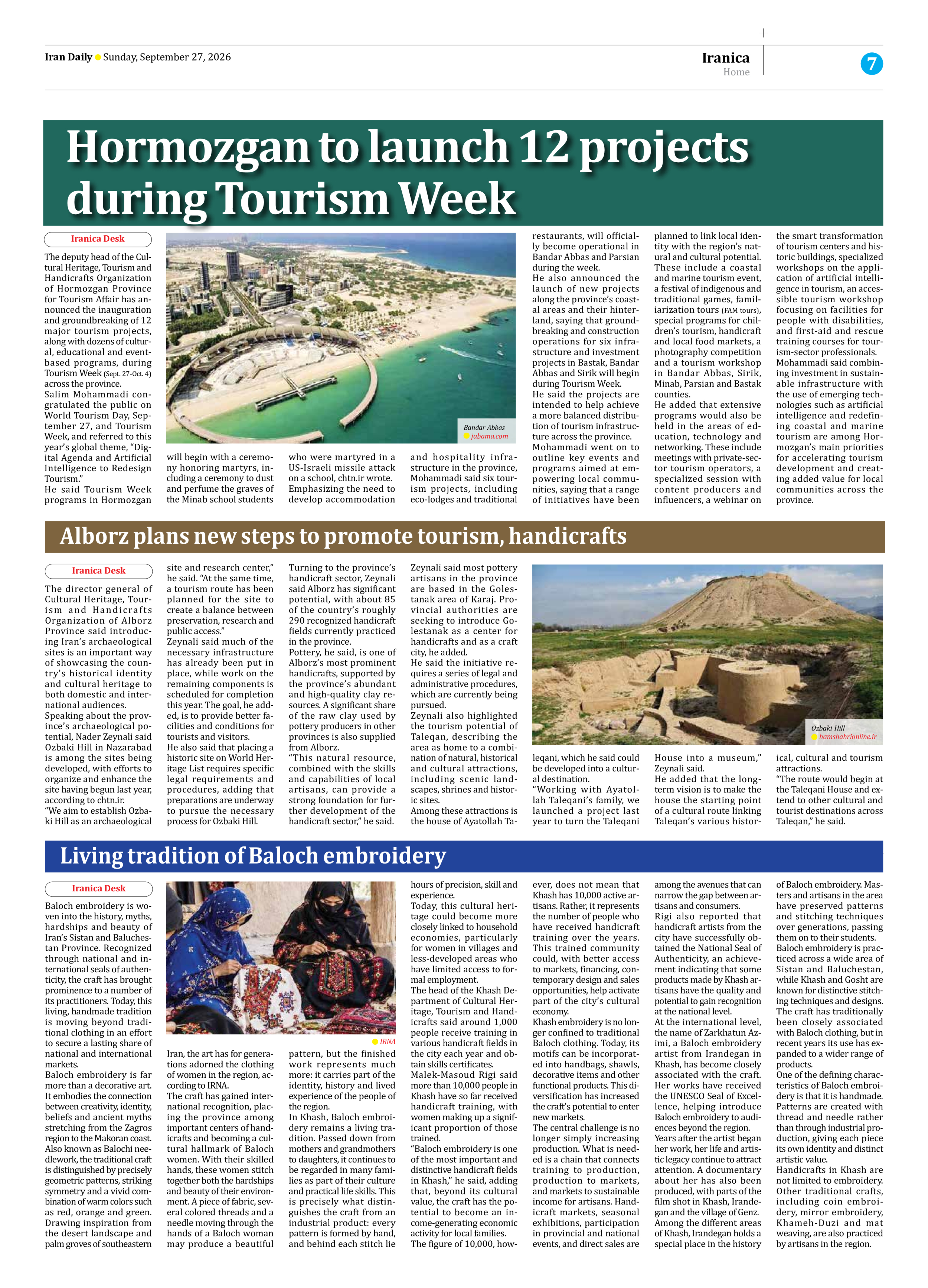
Baloch embroidery is far more than a decorative art. It embodies the connection between creativity, identity, beliefs and ancient myths stretching from the Zagros region to the Makoran coast. Also known as Balochi needlework, the traditional craft is distinguished by precisely geometric patterns, striking symmetry and a vivid combination of warm colors such as red, orange and green. Drawing inspiration from the desert landscape and palm groves of southeastern Iran, the art has for generations adorned the clothing of women in the region, according to IRNA.
The craft has gained international recognition, placing the province among important centers of handicrafts and becoming a cultural hallmark of Baloch women. With their skilled hands, these women stitch together both the hardships and beauty of their environment. A piece of fabric, several colored threads and a needle moving through the hands of a Baloch woman may produce a beautiful pattern, but the finished work represents much more: it carries part of the identity, history and lived experience of the people of the region.
In Khash, Baloch embroidery remains a living tradition. Passed down from mothers and grandmothers to daughters, it continues to be regarded in many families as part of their culture and practical life skills. This is precisely what distinguishes the craft from an industrial product: every pattern is formed by hand, and behind each stitch lie hours of precision, skill and experience.
Today, this cultural heritage could become more closely linked to household economies, particularly for women in villages and less-developed areas who have limited access to formal employment.
The head of the Khash Department of Cultural Heritage, Tourism and Handicrafts said around 1,000 people receive training in various handicraft fields in the city each year and obtain skills certificates.
Malek-Masoud Rigi said more than 10,000 people in Khash have so far received handicraft training, with women making up a significant proportion of those trained.
“Baloch embroidery is one of the most important and distinctive handicraft fields in Khash,” he said, adding that, beyond its cultural value, the craft has the potential to become an income-generating economic activity for local families.
The figure of 10,000, however, does not mean that Khash has 10,000 active artisans. Rather, it represents the number of people who have received handicraft training over the years. This trained community could, with better access to markets, financing, contemporary design and sales opportunities, help activate part of the city’s cultural economy.
Khash embroidery is no longer confined to traditional Baloch clothing. Today, its motifs can be incorporated into handbags, shawls, decorative items and other functional products. This diversification has increased the craft’s potential to enter new markets.
The central challenge is no longer simply increasing production. What is needed is a chain that connects training to production, production to markets, and markets to sustainable income for artisans. Handicraft markets, seasonal exhibitions, participation in provincial and national events, and direct sales are among the avenues that can narrow the gap between artisans and consumers.
Rigi also reported that handicraft artists from the city have successfully obtained the National Seal of Authenticity, an achievement indicating that some products made by Khash artisans have the quality and potential to gain recognition at the national level.
At the international level, the name of Zarkhatun Azimi, a Baloch embroidery artist from Irandegan in Khash, has become closely associated with the craft. Her works have received the UNESCO Seal of Excellence, helping introduce Baloch embroidery to audiences beyond the region.
Years after the artist began her work, her life and artistic legacy continue to attract attention. A documentary about her has also been produced, with parts of the film shot in Khash, Irandegan and the village of Genz.
Among the different areas of Khash, Irandegan holds a special place in the history of Baloch embroidery. Masters and artisans in the area have preserved patterns and stitching techniques over generations, passing them on to their students.
Baloch embroidery is practiced across a wide area of Sistan and Baluchestan, while Khash and Gosht are known for distinctive stitching techniques and designs. The craft has traditionally been closely associated with Baloch clothing, but in recent years its use has expanded to a wider range of products.
One of the defining characteristics of Baloch embroidery is that it is handmade. Patterns are created with thread and needle rather than through industrial production, giving each piece its own identity and distinct artistic value.
Handicrafts in Khash are not limited to embroidery. Other traditional crafts, including coin embroidery, mirror embroidery, Khameh-Duzi and mat weaving, are also practiced by artisans in the region.