







Tehran ready for talks with Washington but rejects ‘bullying’: Pezeshkian
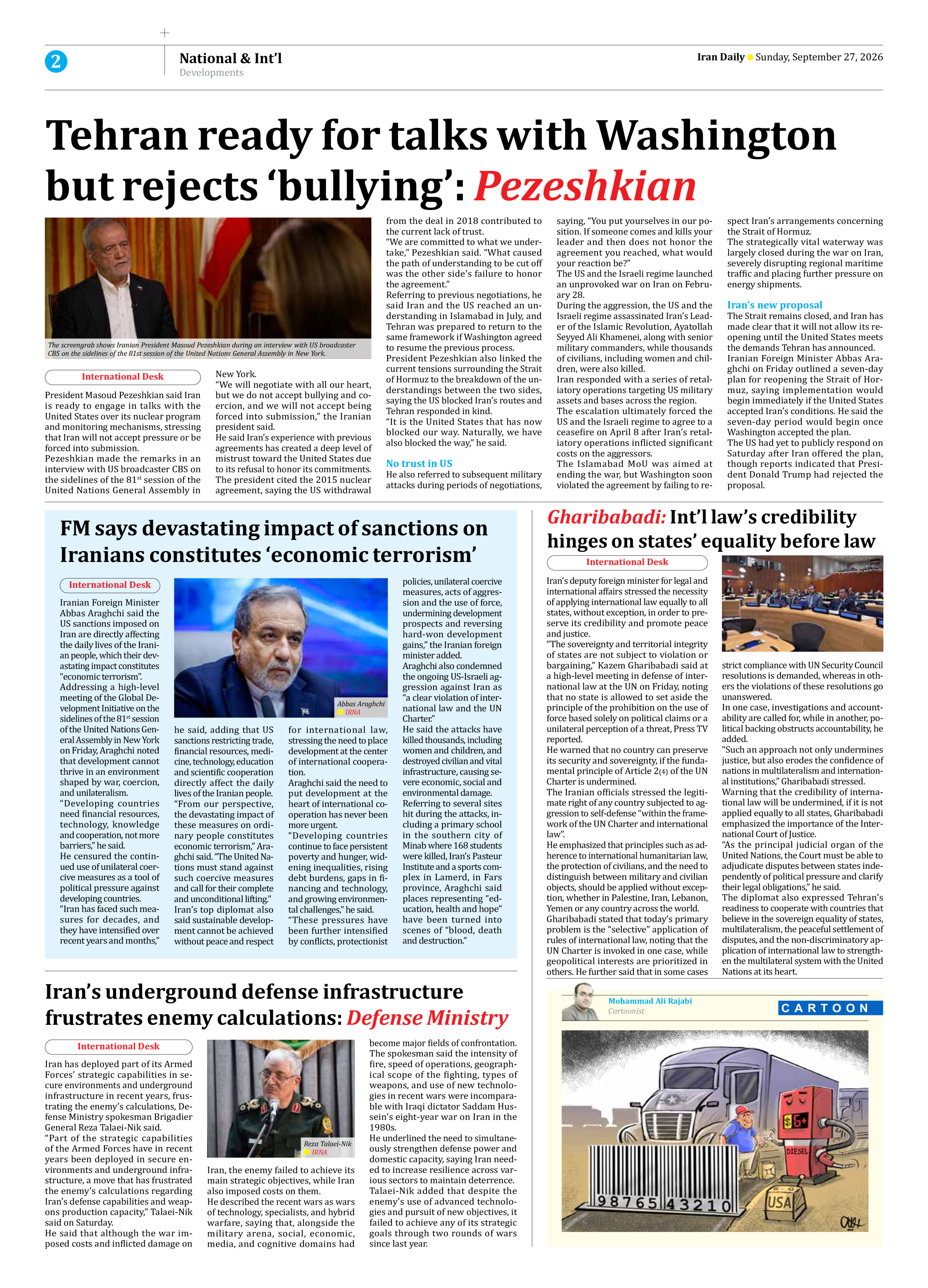
President Masoud Pezeshkian said Iran is ready to engage in talks with the United States over its nuclear program and monitoring mechanisms, stressing that Iran will not accept pressure or be forced into submission.
Pezeshkian made the remarks in an interview with US broadcaster CBS on the sidelines of the 81st session of the United Nations General Assembly in New York.
“We will negotiate with all our heart, but we do not accept bullying and coercion, and we will not accept being forced into submission,” the Iranian president said.
He said Iran’s experience with previous agreements has created a deep level of mistrust toward the United States due to its refusal to honor its commitments.
The president cited the 2015 nuclear agreement, saying the US withdrawal from the deal in 2018 contributed to the current lack of trust.
“We are committed to what we undertake,” Pezeshkian said. “What caused the path of understanding to be cut off was the other side’s failure to honor the agreement.”
Referring to previous negotiations, he said Iran and the US reached an understanding in Islamabad in July, and Tehran was prepared to return to the same framework if Washington agreed to resume the previous process.
President Pezeshkian also linked the current tensions surrounding the Strait of Hormuz to the breakdown of the understandings between the two sides, saying the US blocked Iran’s routes and Tehran responded in kind.
“It is the United States that has now blocked our way. Naturally, we have also blocked the way,” he said.
No trust in US
He also referred to subsequent military attacks during periods of negotiations, saying, “You put yourselves in our position. If someone comes and kills your leader and then does not honor the agreement you reached, what would your reaction be?”
The US and the Israeli regime launched an unprovoked war on Iran on February 28.
During the aggression, the US and the Israeli regime assassinated Iran’s Leader of the Islamic Revolution, Ayatollah Seyyed Ali Khamenei, along with senior military commanders, while thousands of civilians, including women and children, were also killed.
Iran responded with a series of retaliatory operations targeting US military assets and bases across the region.
The escalation ultimately forced the US and the Israeli regime to agree to a ceasefire on April 8 after Iran’s retaliatory operations inflicted significant costs on the aggressors.
The Islamabad MoU was aimed at ending the war, but Washington soon violated the agreement by failing to respect Iran’s arrangements concerning the Strait of Hormuz.
The strategically vital waterway was largely closed during the war on Iran, severely disrupting regional maritime traffic and placing further pressure on energy shipments.
Iran’s new proposal
The Strait remains closed, and Iran has made clear that it will not allow its reopening until the United States meets the demands Tehran has announced.
Iranian Foreign Minister Abbas Araghchi on Friday outlined a seven-day plan for reopening the Strait of Hormuz, saying implementation would begin immediately if the United States accepted Iran’s conditions. He said the seven-day period would begin once Washington accepted the plan.
The US had yet to publicly respond on Saturday after Iran offered the plan, though reports indicated that President Donald Trump had rejected the proposal.