







India, Iran look to traditional medicine for new health cooperation
By Sadeq Dehqan
Staff writer
India and Iran are looking to expand cooperation in traditional medicine alongside broader pharmaceutical ties, with the two countries seeking to draw on their shared heritage in herbal medicines and traditional treatments.
Indian Ambassador to Tehran Vishwesh Negi said the two sides had agreed to develop cooperation in traditional medicine on the sidelines of the 16th BRICS Health Ministers’ Meeting in Chandigarh, India, in July 2026.
A memorandum of understanding was signed between India’s Ministry of Ayush and Iran’s Ministry of Health and Medical Education to build on the countries’ shared heritage in herbal medicines and traditional treatments.
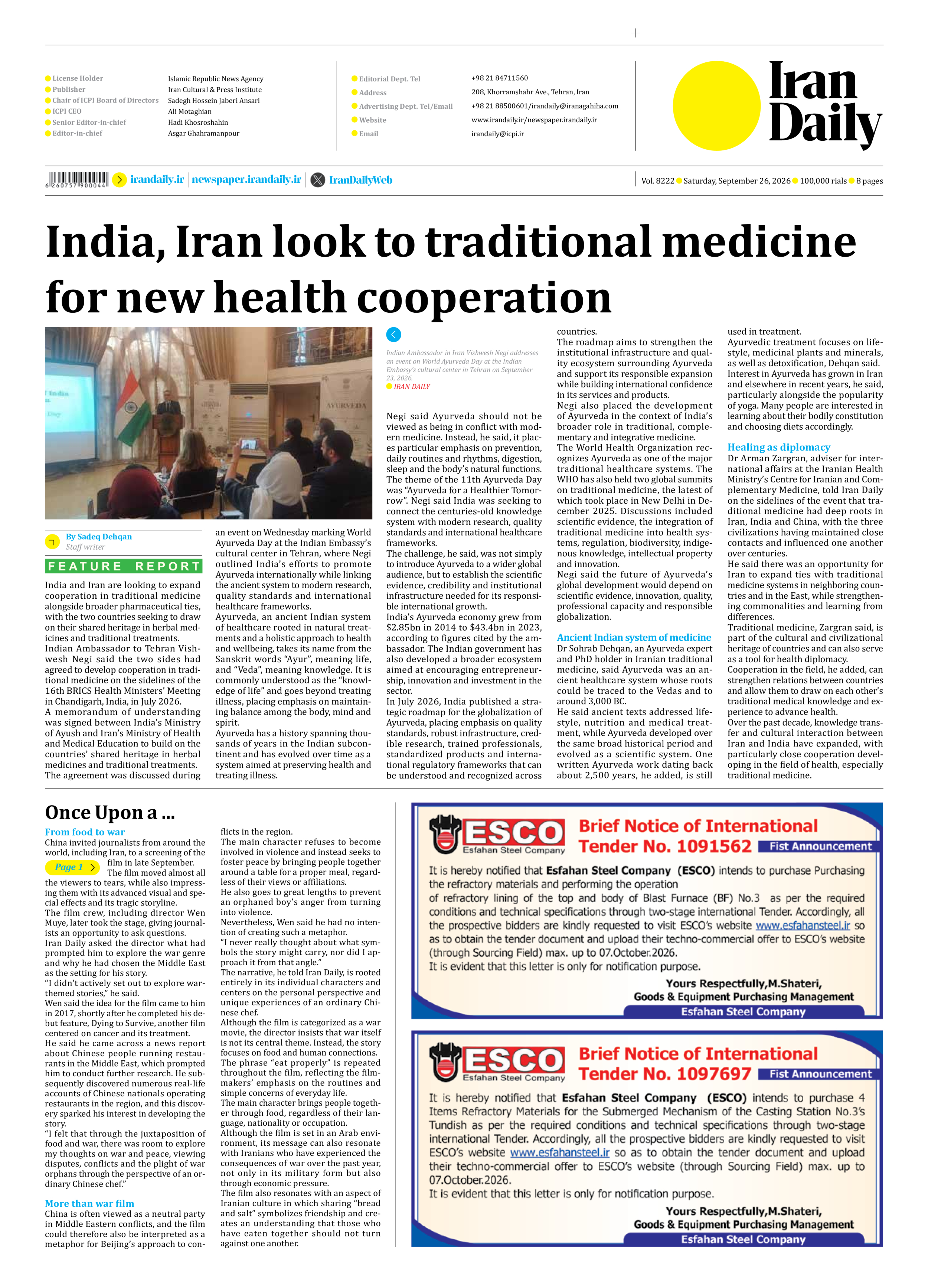
The agreement was discussed during an event on Wednesday marking World Ayurveda Day at the Indian Embassy’s cultural center in Tehran, where Negi outlined India’s efforts to promote Ayurveda internationally while linking the ancient system to modern research, quality standards and international healthcare frameworks.
Ayurveda, an ancient Indian system of healthcare rooted in natural treatments and a holistic approach to health and wellbeing, takes its name from the Sanskrit words “Ayur”, meaning life, and “Veda”, meaning knowledge. It is commonly understood as the “knowledge of life” and goes beyond treating illness, placing emphasis on maintaining balance among the body, mind and spirit.
Ayurveda has a history spanning thousands of years in the Indian subcontinent and has evolved over time as a system aimed at preserving health and treating illness.
Negi said Ayurveda should not be viewed as being in conflict with modern medicine. Instead, he said, it places particular emphasis on prevention, daily routines and rhythms, digestion, sleep and the body’s natural functions.
The theme of the 11th Ayurveda Day was “Ayurveda for a Healthier Tomorrow”. Negi said India was seeking to connect the centuries-old knowledge system with modern research, quality standards and international healthcare frameworks.
The challenge, he said, was not simply to introduce Ayurveda to a wider global audience, but to establish the scientific evidence, credibility and institutional infrastructure needed for its responsible international growth.
India’s Ayurveda economy grew from $2.85bn in 2014 to $43.4bn in 2023, according to figures cited by the ambassador. The Indian government has also developed a broader ecosystem aimed at encouraging entrepreneurship, innovation and investment in the sector.
In July 2026, India published a strategic roadmap for the globalization of Ayurveda, placing emphasis on quality standards, robust infrastructure, credible research, trained professionals, standardized products and international regulatory frameworks that can be understood and recognized across countries.
The roadmap aims to strengthen the institutional infrastructure and quality ecosystem surrounding Ayurveda and support its responsible expansion while building international confidence in its services and products.
Negi also placed the development of Ayurveda in the context of India’s broader role in traditional, complementary and integrative medicine.
The World Health Organization recognizes Ayurveda as one of the major traditional healthcare systems. The WHO has also held two global summits on traditional medicine, the latest of which took place in New Delhi in December 2025. Discussions included scientific evidence, the integration of traditional medicine into health systems, regulation, biodiversity, indigenous knowledge, intellectual property and innovation.
Negi said the future of Ayurveda’s global development would depend on scientific evidence, innovation, quality, professional capacity and responsible globalization.
Ancient Indian system of medicine
Dr Sohrab Dehqan, an Ayurveda expert and PhD holder in Iranian traditional medicine, said Ayurveda was an ancient healthcare system whose roots could be traced to the Vedas and to around 3,000 BC.
He said ancient texts addressed lifestyle, nutrition and medical treatment, while Ayurveda developed over the same broad historical period and evolved as a scientific system. One written Ayurveda work dating back about 2,500 years, he added, is still used in treatment.
Ayurvedic treatment focuses on lifestyle, medicinal plants and minerals, as well as detoxification, Dehqan said.
Interest in Ayurveda has grown in Iran and elsewhere in recent years, he said, particularly alongside the popularity of yoga. Many people are interested in learning about their bodily constitution and choosing diets accordingly.
Healing as diplomacy
Dr Arman Zargran, adviser for international affairs at the Iranian Health Ministry’s Centre for Iranian and Complementary Medicine, told Iran Daily on the sidelines of the event that traditional medicine had deep roots in Iran, India and China, with the three civilizations having maintained close contacts and influenced one another over centuries.
He said there was an opportunity for Iran to expand ties with traditional medicine systems in neighboring countries and in the East, while strengthening commonalities and learning from differences.
Traditional medicine, Zargran said, is part of the cultural and civilizational heritage of countries and can also serve as a tool for health diplomacy.
Cooperation in the field, he added, can strengthen relations between countries and allow them to draw on each other’s traditional medical knowledge and experience to advance health.
Over the past decade, knowledge transfer and cultural interaction between Iran and India have expanded, with particularly close cooperation developing in the field of health, especially traditional medicine.