





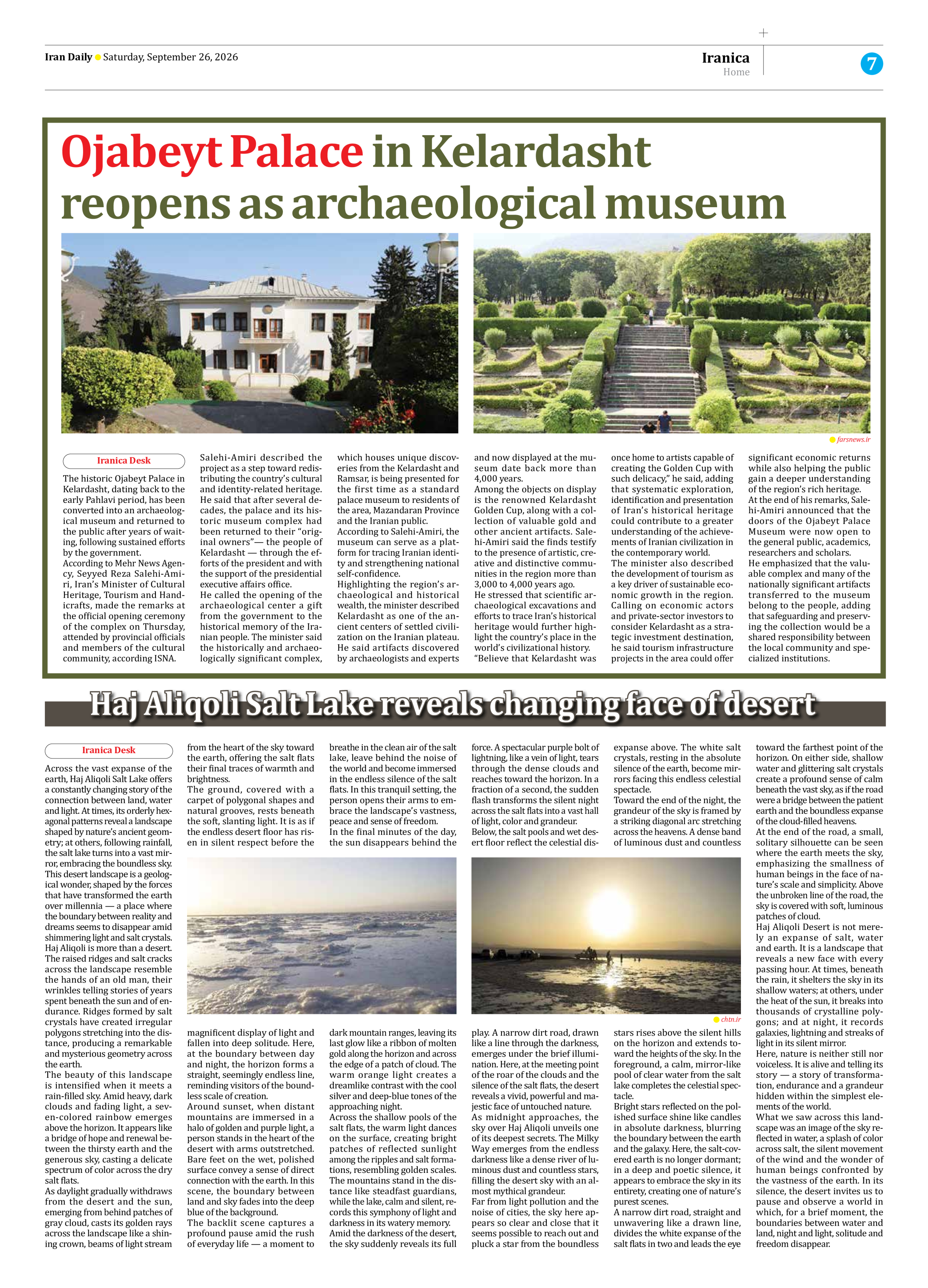


Ojabeyt Palace in Kelardasht reopens as archaeological museum
The historic Ojabeyt Palace in Kelardasht, dating back to the early Pahlavi period, has been converted into an archaeological museum and returned to the public after years of waiting, following sustained efforts by the government.
According to Mehr News Agency, Seyyed Reza Salehi-Amiri, Iran’s Minister of Cultural Heritage, Tourism and Handicrafts, made the remarks at the official opening ceremony of the complex on Thursday, attended by provincial officials and members of the cultural community, according ISNA.
Salehi-Amiri described the project as a step toward redistributing the country’s cultural and identity-related heritage. He said that after several decades, the palace and its historic museum complex had been returned to their “original owners”— the people of Kelardasht — through the efforts of the president and with the support of the presidential executive affairs office.
He called the opening of the archaeological center a gift from the government to the historical memory of the Iranian people. The minister said the historically and archaeologically significant complex, which houses unique discoveries from the Kelardasht and Ramsar, is being presented for the first time as a standard palace museum to residents of the area, Mazandaran Province and the Iranian public.
According to Salehi-Amiri, the museum can serve as a platform for tracing Iranian identity and strengthening national self-confidence.
Highlighting the region’s archaeological and historical wealth, the minister described Kelardasht as one of the ancient centers of settled civilization on the Iranian plateau. He said artifacts discovered by archaeologists and experts and now displayed at the museum date back more than 4,000 years.
Among the objects on display is the renowned Kelardasht Golden Cup, along with a collection of valuable gold and other ancient artifacts. Salehi-Amiri said the finds testify to the presence of artistic, creative and distinctive communities in the region more than 3,000 to 4,000 years ago.
He stressed that scientific archaeological excavations and efforts to trace Iran’s historical heritage would further highlight the country’s place in the world’s civilizational history.
“Believe that Kelardasht was once home to artists capable of creating the Golden Cup with such delicacy,” he said, adding that systematic exploration, identification and presentation of Iran’s historical heritage could contribute to a greater understanding of the achievements of Iranian civilization in the contemporary world.
The minister also described the development of tourism as a key driver of sustainable economic growth in the region. Calling on economic actors and private-sector investors to consider Kelardasht as a strategic investment destination, he said tourism infrastructure projects in the area could offer significant economic returns while also helping the public gain a deeper understanding of the region’s rich heritage.
At the end of his remarks, Salehi-Amiri announced that the doors of the Ojabeyt Palace Museum were now open to the general public, academics, researchers and scholars.
He emphasized that the valuable complex and many of the nationally significant artifacts transferred to the museum belong to the people, adding that safeguarding and preserving the collection would be a shared responsibility between the local community and specialized institutions.