





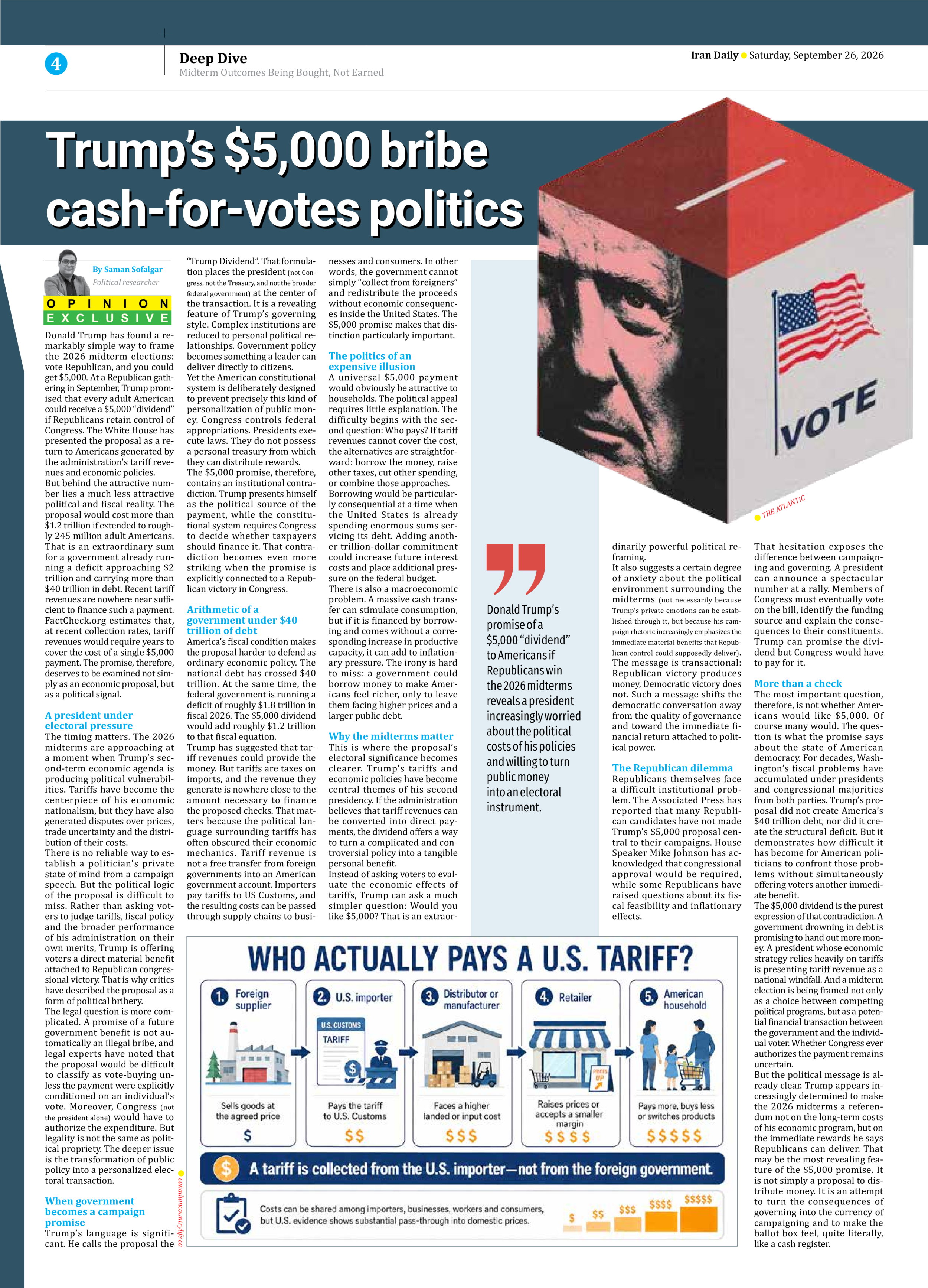


Trump’s $5,000 bribe cash-for-votes politics
By Saman Sofalgar
Political researcher
Donald Trump has found a remarkably simple way to frame the 2026 midterm elections: vote Republican, and you could get $5,000. At a Republican gathering in September, Trump promised that every adult American could receive a $5,000 “dividend” if Republicans retain control of Congress. The White House has presented the proposal as a return to Americans generated by the administration’s tariff revenues and economic policies.
But behind the attractive number lies a much less attractive political and fiscal reality. The proposal would cost more than $1.2 trillion if extended to roughly 245 million adult Americans. That is an extraordinary sum for a government already running a deficit approaching $2 trillion and carrying more than $40 trillion in debt. Recent tariff revenues are nowhere near sufficient to finance such a payment. FactCheck.org estimates that, at recent collection rates, tariff revenues would require years to cover the cost of a single $5,000 payment. The promise, therefore, deserves to be examined not simply as an economic proposal, but as a political signal.
A president under electoral pressure
The timing matters. The 2026 midterms are approaching at a moment when Trump’s second-term economic agenda is producing political vulnerabilities. Tariffs have become the centerpiece of his economic nationalism, but they have also generated disputes over prices, trade uncertainty and the distribution of their costs.
There is no reliable way to establish a politician’s private state of mind from a campaign speech. But the political logic of the proposal is difficult to miss. Rather than asking voters to judge tariffs, fiscal policy and the broader performance of his administration on their own merits, Trump is offering voters a direct material benefit attached to Republican congressional victory. That is why critics have described the proposal as a form of political bribery.
The legal question is more complicated. A promise of a future government benefit is not automatically an illegal bribe, and legal experts have noted that the proposal would be difficult to classify as vote-buying unless the payment were explicitly conditioned on an individual’s vote. Moreover, Congress (not the president alone) would have to authorize the expenditure. But legality is not the same as political propriety. The deeper issue is the transformation of public policy into a personalized electoral transaction.
When government becomes a campaign promise
Trump’s language is significant. He calls the proposal the “Trump Dividend”. That formulation places the president (not Congress, not the Treasury, and not the broader federal government) at the center of the transaction. It is a revealing feature of Trump’s governing style. Complex institutions are reduced to personal political relationships. Government policy becomes something a leader can deliver directly to citizens.
Yet the American constitutional system is deliberately designed to prevent precisely this kind of personalization of public money. Congress controls federal appropriations. Presidents execute laws. They do not possess a personal treasury from which they can distribute rewards.
The $5,000 promise, therefore, contains an institutional contradiction. Trump presents himself as the political source of the payment, while the constitutional system requires Congress to decide whether taxpayers should finance it. That contradiction becomes even more striking when the promise is explicitly connected to a Republican victory in Congress.
Arithmetic of a government under $40 trillion of debt
America’s fiscal condition makes the proposal harder to defend as ordinary economic policy. The national debt has crossed $40 trillion. At the same time, the federal government is running a deficit of roughly $1.8 trillion in fiscal 2026. The $5,000 dividend would add roughly $1.2 trillion to that fiscal equation.
Trump has suggested that tariff revenues could provide the money. But tariffs are taxes on imports, and the revenue they generate is nowhere close to the amount necessary to finance the proposed checks. That matters because the political language surrounding tariffs has often obscured their economic mechanics. Tariff revenue is not a free transfer from foreign governments into an American government account. Importers pay tariffs to US Customs, and the resulting costs can be passed through supply chains to businesses and consumers. In other words, the government cannot simply “collect from foreigners” and redistribute the proceeds without economic consequences inside the United States. The $5,000 promise makes that distinction particularly important.
The politics of an expensive illusion
A universal $5,000 payment would obviously be attractive to households. The political appeal requires little explanation. The difficulty begins with the second question: Who pays? If tariff revenues cannot cover the cost, the alternatives are straightforward: borrow the money, raise other taxes, cut other spending, or combine those approaches.
Borrowing would be particularly consequential at a time when the United States is already spending enormous sums servicing its debt. Adding another trillion-dollar commitment could increase future interest costs and place additional pressure on the federal budget.
There is also a macroeconomic problem. A massive cash transfer can stimulate consumption, but if it is financed by borrowing and comes without a corresponding increase in productive capacity, it can add to inflationary pressure. The irony is hard to miss: a government could borrow money to make Americans feel richer, only to leave them facing higher prices and a larger public debt.
Why the midterms matter
This is where the proposal’s electoral significance becomes clearer. Trump’s tariffs and economic policies have become central themes of his second presidency. If the administration believes that tariff revenues can be converted into direct payments, the dividend offers a way to turn a complicated and controversial policy into a tangible personal benefit.
Instead of asking voters to evaluate the economic effects of tariffs, Trump can ask a much simpler question: Would you like $5,000? That is an extraordinarily powerful political reframing.
It also suggests a certain degree of anxiety about the political environment surrounding the midterms (not necessarily because Trump’s private emotions can be established through it, but because his campaign rhetoric increasingly emphasizes the immediate material benefits that Republican control could supposedly deliver). The message is transactional: Republican victory produces money, Democratic victory does not. Such a message shifts the democratic conversation away from the quality of governance and toward the immediate financial return attached to political power.
The Republican dilemma
Republicans themselves face a difficult institutional problem. The Associated Press has reported that many Republican candidates have not made Trump’s $5,000 proposal central to their campaigns. House Speaker Mike Johnson has acknowledged that congressional approval would be required, while some Republicans have raised questions about its fiscal feasibility and inflationary effects.
That hesitation exposes the difference between campaigning and governing. A president can announce a spectacular number at a rally. Members of Congress must eventually vote on the bill, identify the funding source and explain the consequences to their constituents. Trump can promise the dividend but Congress would have to pay for it.
More than a check
The most important question, therefore, is not whether Americans would like $5,000. Of course many would. The question is what the promise says about the state of American democracy. For decades, Washington’s fiscal problems have accumulated under presidents and congressional majorities from both parties. Trump’s proposal did not create America’s $40 trillion debt, nor did it create the structural deficit. But it demonstrates how difficult it has become for American politicians to confront those problems without simultaneously offering voters another immediate benefit.
The $5,000 dividend is the purest expression of that contradiction. A government drowning in debt is promising to hand out more money. A president whose economic strategy relies heavily on tariffs is presenting tariff revenue as a national windfall. And a midterm election is being framed not only as a choice between competing political programs, but as a potential financial transaction between the government and the individual voter. Whether Congress ever authorizes the payment remains uncertain.
But the political message is already clear. Trump appears increasingly determined to make the 2026 midterms a referendum not on the long-term costs of his economic program, but on the immediate rewards he says Republicans can deliver. That may be the most revealing feature of the $5,000 promise. It is not simply a proposal to distribute money. It is an attempt to turn the consequences of governing into the currency of campaigning and to make the ballot box feel, quite literally, like a cash register.