







SATBA opens largest solar inverter plant as 1,700 MW of solar capacity comes online
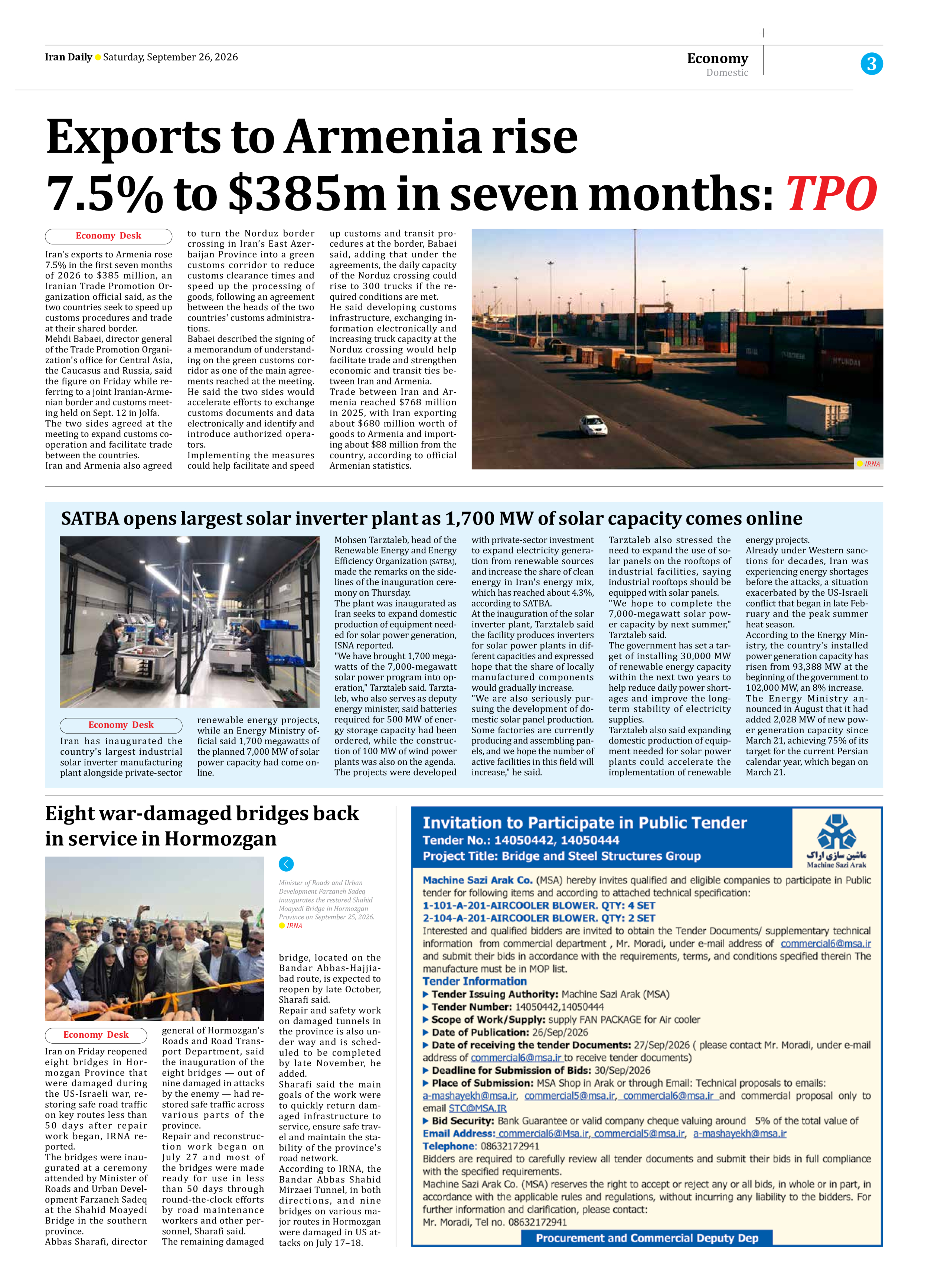
Iran has inaugurated the country's largest industrial solar inverter manufacturing plant alongside private-sector renewable energy projects, while an Energy Ministry official said 1,700 megawatts of the planned 7,000 MW of solar power capacity had come online.
Mohsen Tarztaleb, head of the Renewable Energy and Energy Efficiency Organization (SATBA), made the remarks on the sidelines of the inauguration ceremony on Thursday.
The plant was inaugurated as Iran seeks to expand domestic production of equipment needed for solar power generation, ISNA reported.
"We have brought 1,700 megawatts of the 7,000-megawatt solar power program into operation," Tarztaleb said. Tarztaleb, who also serves as deputy energy minister, said batteries required for 500 MW of energy storage capacity had been ordered, while the construction of 100 MW of wind power plants was also on the agenda.
The projects were developed with private-sector investment to expand electricity generation from renewable sources and increase the share of clean energy in Iran's energy mix, which has reached about 4.3%, according to SATBA.
At the inauguration of the solar inverter plant, Tarztaleb said the facility produces inverters for solar power plants in different capacities and expressed hope that the share of locally manufactured components would gradually increase.
"We are also seriously pursuing the development of domestic solar panel production. Some factories are currently producing and assembling panels, and we hope the number of active facilities in this field will increase," he said.
Tarztaleb also stressed the need to expand the use of solar panels on the rooftops of industrial facilities, saying industrial rooftops should be equipped with solar panels.
"We hope to complete the 7,000-megawatt solar power capacity by next summer," Tarztaleb said.
The government has set a target of installing 30,000 MW of renewable energy capacity within the next two years to help reduce daily power shortages and improve the long-term stability of electricity supplies.
Tarztaleb also said expanding domestic production of equipment needed for solar power plants could accelerate the implementation of renewable energy projects.
Already under Western sanctions for decades, Iran was experiencing energy shortages before the attacks, a situation exacerbated by the US-Israeli conflict that began in late February and the peak summer heat season.
According to the Energy Ministry, the country's installed power generation capacity has risen from 93,388 MW at the beginning of the government to 102,000 MW, an 8% increase.
The Energy Ministry announced in August that it had added 2,028 MW of new power generation capacity since March 21, achieving 75% of its target for the current Persian calendar year, which began on March 21.