





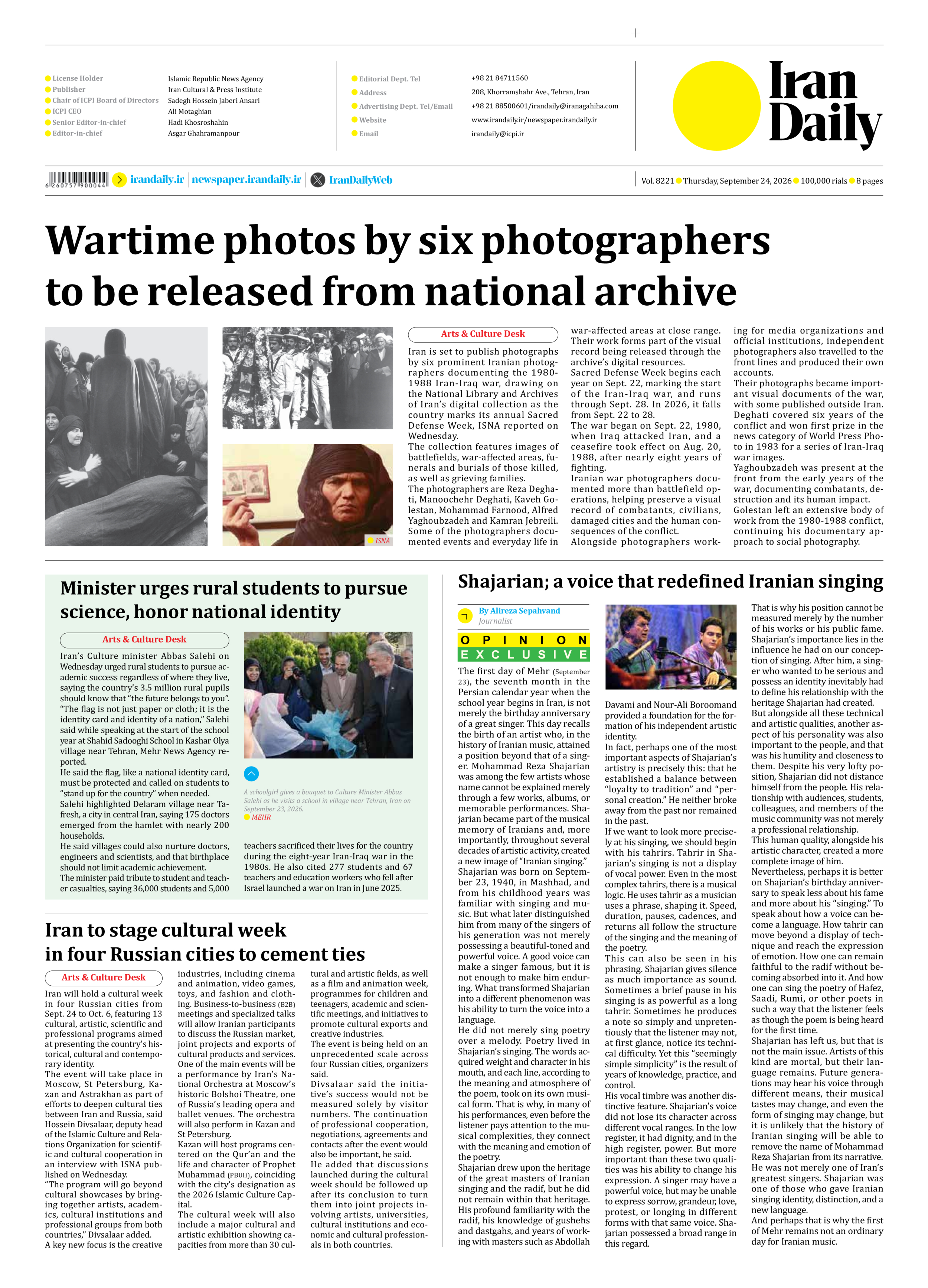


Shajarian; a voice that redefined Iranian singing
By Alireza Sepahvand
Journalist
The first day of Mehr (September 23), the seventh month in the Persian calendar year when the school year begins in Iran, is not merely the birthday anniversary of a great singer. This day recalls the birth of an artist who, in the history of Iranian music, attained a position beyond that of a singer. Mohammad Reza Shajarian was among the few artists whose name cannot be explained merely through a few works, albums, or memorable performances. Shajarian became part of the musical memory of Iranians and, more importantly, throughout several decades of artistic activity, created a new image of “Iranian singing.”
Shajarian was born on September 23, 1940, in Mashhad, and from his childhood years was familiar with singing and music. But what later distinguished him from many of the singers of his generation was not merely possessing a beautiful-toned and powerful voice. A good voice can make a singer famous, but it is not enough to make him enduring. What transformed Shajarian into a different phenomenon was his ability to turn the voice into a language.
He did not merely sing poetry over a melody. Poetry lived in Shajarian’s singing. The words acquired weight and character in his mouth, and each line, according to the meaning and atmosphere of the poem, took on its own musical form. That is why, in many of his performances, even before the listener pays attention to the musical complexities, they connect with the meaning and emotion of the poetry.
Shajarian drew upon the heritage of the great masters of Iranian singing and the radif, but he did not remain within that heritage. His profound familiarity with the radif, his knowledge of gushehs and dastgahs, and years of working with masters such as Abdollah Davami and Nour-Ali Boroomand provided a foundation for the formation of his independent artistic identity.
In fact, perhaps one of the most important aspects of Shajarian’s artistry is precisely this: that he established a balance between “loyalty to tradition” and “personal creation.” He neither broke away from the past nor remained in the past.
If we want to look more precisely at his singing, we should begin with his tahrirs. Tahrir in Shajarian’s singing is not a display of vocal power. Even in the most complex tahrirs, there is a musical logic. He uses tahrir as a musician uses a phrase, shaping it. Speed, duration, pauses, cadences, and returns all follow the structure of the singing and the meaning of the poetry.
This can also be seen in his phrasing. Shajarian gives silence as much importance as sound. Sometimes a brief pause in his singing is as powerful as a long tahrir. Sometimes he produces a note so simply and unpretentiously that the listener may not, at first glance, notice its technical difficulty. Yet this “seemingly simple simplicity” is the result of years of knowledge, practice, and control.
His vocal timbre was another distinctive feature. Shajarian’s voice did not lose its character across different vocal ranges. In the low register, it had dignity, and in the high register, power. But more important than these two qualities was his ability to change his expression. A singer may have a powerful voice, but may be unable to express sorrow, grandeur, love, protest, or longing in different forms with that same voice. Shajarian possessed a broad range in this regard.
That is why his position cannot be measured merely by the number of his works or his public fame. Shajarian’s importance lies in the influence he had on our conception of singing. After him, a singer who wanted to be serious and possess an identity inevitably had to define his relationship with the heritage Shajarian had created.
But alongside all these technical and artistic qualities, another aspect of his personality was also important to the people, and that was his humility and closeness to them. Despite his very lofty position, Shajarian did not distance himself from the people. His relationship with audiences, students, colleagues, and members of the music community was not merely a professional relationship.
This human quality, alongside his artistic character, created a more complete image of him.
Nevertheless, perhaps it is better on Shajarian’s birthday anniversary to speak less about his fame and more about his “singing.” To speak about how a voice can become a language. How tahrir can move beyond a display of technique and reach the expression of emotion. How one can remain faithful to the radif without becoming absorbed into it. And how one can sing the poetry of Hafez, Saadi, Rumi, or other poets in such a way that the listener feels as though the poem is being heard for the first time.
Shajarian has left us, but that is not the main issue. Artists of this kind are mortal, but their language remains. Future generations may hear his voice through different means, their musical tastes may change, and even the form of singing may change, but it is unlikely that the history of Iranian singing will be able to remove the name of Mohammad Reza Shajarian from its narrative.
He was not merely one of Iran’s greatest singers. Shajarian was one of those who gave Iranian singing identity, distinction, and a new language.
And perhaps that is why the first of Mehr remains not an ordinary day for Iranian music.