







Persian Gulf Arab states urge reset with Iran as conflict drags on
Strategic pivot of Iran’s Arab neighbors toward Tehran: Waning of security reliance on US
Following the experience of the US-Israeli imposed war on Iran, the Arab states of the Persian Gulf have come to realize that regional security cannot be sustained without Iran's participation and satisfaction.
The UAE, Qatar, and Saudi Arabia—acknowledging their vulnerability to the war's consequences and the erosion of US credibility—are now calling for dialogue, a shared security framework, and a non-aggression pact with Iran. This strategic shift presents the Islamic Republic of Iran with an opportunity to leverage its deterrence power and geographic position to steer its neighbors away from security dependence on the US and toward an independent, multilateral regional order based on shared interests.
Persian Gulf Arab states are now calling for a reset on Iran, with the United Arab Emirates urging a “new mindset” and Qatar advocating for a regional “security framework” with Tehran after the war exposed their vulnerability to Iranian attack and tarnished the US’s credibility in the Middle East.
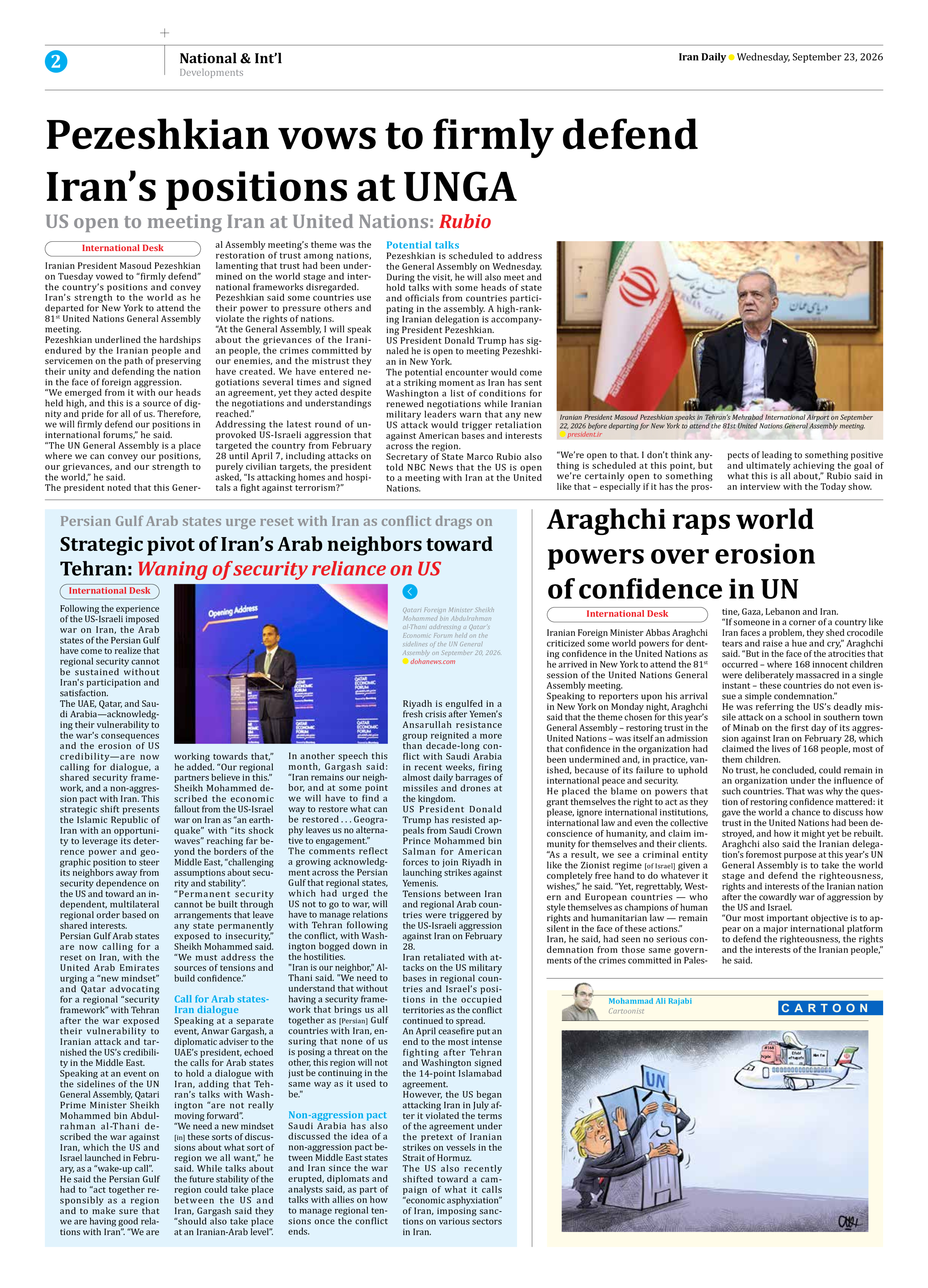
Speaking at an event on the sidelines of the UN General Assembly, Qatari Prime Minister Sheikh Mohammed bin Abdulrahman al-Thani described the war against Iran, which the US and Israel launched in February, as a “wake-up call”.
He said the Persian Gulf had to “act together responsibly as a region and to make sure that we are having good relations with Iran”. “We are working towards that,” he added. “Our regional partners believe in this.”
Sheikh Mohammed described the economic fallout from the US-Israel war on Iran as “an earthquake” with “its shock waves” reaching far beyond the borders of the Middle East, “challenging assumptions about security and stability”.
“Permanent security cannot be built through arrangements that leave any state permanently exposed to insecurity,” Sheikh Mohammed said. “We must address the sources of tensions and build confidence.”
Call for Arab states-Iran dialogue
Speaking at a separate event, Anwar Gargash, a diplomatic adviser to the UAE’s president, echoed the calls for Arab states to hold a dialogue with Iran, adding that Tehran’s talks with Washington “are not really moving forward”.
“We need a new mindset [in] these sorts of discussions about what sort of region we all want,” he said. While talks about the future stability of the region could take place between the US and Iran, Gargash said they “should also take place at an Iranian-Arab level”.
In another speech this month, Gargash said: “Iran remains our neighbor, and at some point we will have to find a way to restore what can be restored . . . Geography leaves us no alternative to engagement.”
The comments reflect a growing acknowledgment across the Persian Gulf that regional states, which had urged the US not to go to war, will have to manage relations with Tehran following the conflict, with Washington bogged down in the hostilities.
"Iran is our neighbor," Al-Thani said. "We need to understand that without having a security framework that brings us all together as [Persian] Gulf countries with Iran, ensuring that none of us is posing a threat on the other, this region will not just be continuing in the same way as it used to be."
Non-aggression pact
Saudi Arabia has also discussed the idea of a non-aggression pact between Middle East states and Iran since the war erupted, diplomats and analysts said, as part of talks with allies on how to manage regional tensions once the conflict ends.
Riyadh is engulfed in a fresh crisis after Yemen’s Ansarullah resistance group reignited a more than decade-long conflict with Saudi Arabia in recent weeks, firing almost daily barrages of missiles and drones at the kingdom.
US President Donald Trump has resisted appeals from Saudi Crown Prince Mohammed bin Salman for American forces to join Riyadh in launching strikes against Yemenis.
Tensions between Iran and regional Arab countries were triggered by the US-Israeli aggression against Iran on February 28.
Iran retaliated with attacks on the US military bases in regional countries and Israel’s positions in the occupied territories as the conflict continued to spread.
An April ceasefire put an end to the most intense fighting after Tehran and Washington signed the 14-point Islamabad agreement.
However, the US began attacking Iran in July after it violated the terms of the agreement under the pretext of Iranian strikes on vessels in the Strait of Hormuz.
The US also recently shifted toward a campaign of what it calls “economic asphyxiation” of Iran, imposing sanctions on various sectors in Iran.