







Wartime experience remains key to Iran’s air defense, veteran pilot says
No pilot emerged unscathed from eight-year war
By Sadeq Dehqan
Staff writer
Sacred Defense Week offers an opportunity to revisit the eight-year war and hear from those who experienced it firsthand. For these men, defending their country was not an abstract concept but a reality they confronted every day on the battlefield. Among them were Air Force pilots, who carried out reconnaissance, bombing and air support missions from the earliest days of the war until its end.
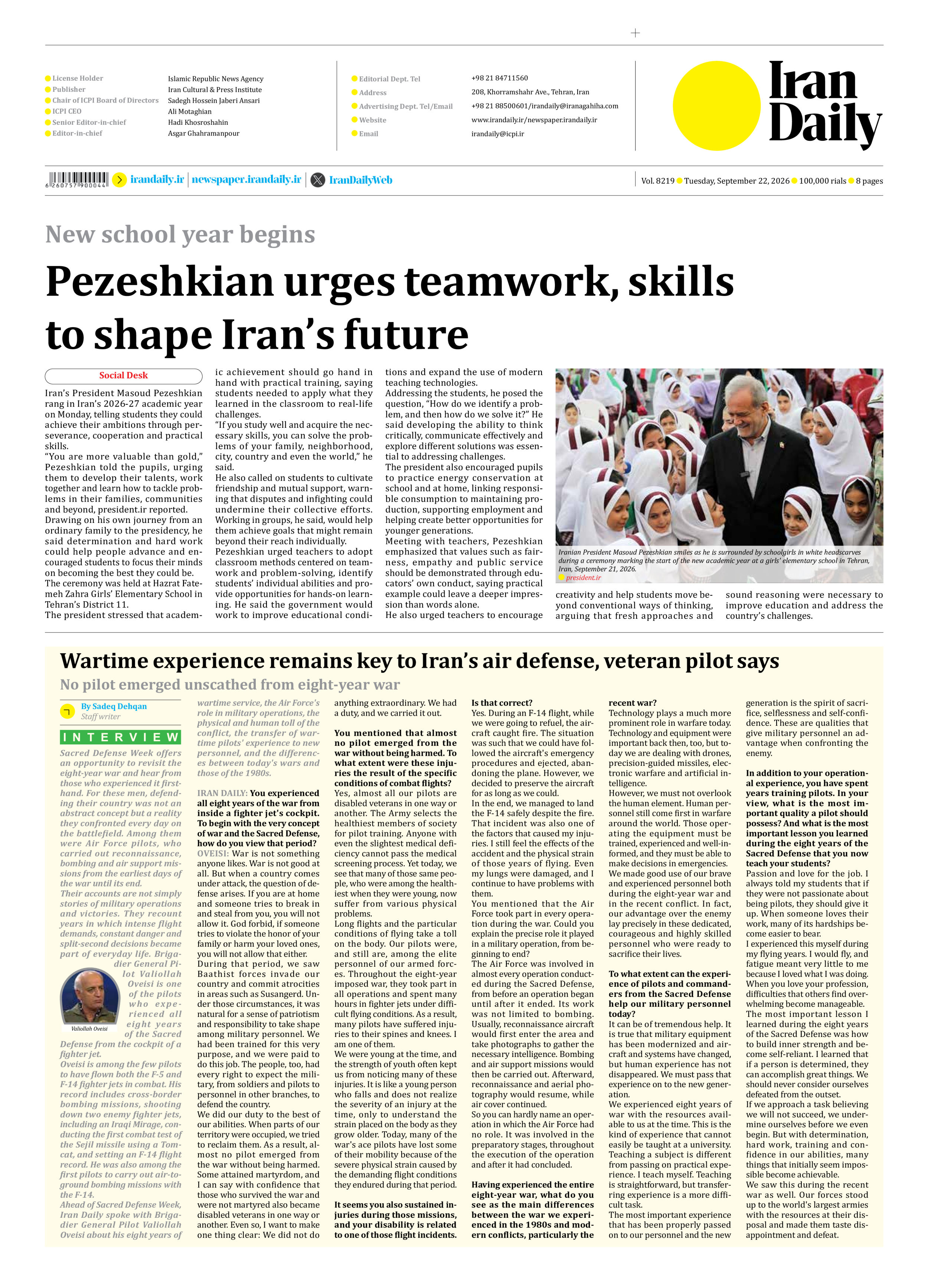
Their accounts are not simply stories of military operations and victories. They recount years in which intense flight demands, constant danger and split-second decisions became part of everyday life. Brigadier General Pilot Valiollah Oveisi is one of the pilots who experienced all eight years of the Sacred Defense from the cockpit of a fighter jet.
Oveisi is among the few pilots to have flown both the F-5 and F-14 fighter jets in combat. His record includes cross-border bombing missions, shooting down two enemy fighter jets, including an Iraqi Mirage, conducting the first combat test of the Sejil missile using a Tomcat, and setting an F-14 flight record. He was also among the first pilots to carry out air-to-ground bombing missions with the F-14.
Ahead of Sacred Defense Week, Iran Daily spoke with Brigadier General Pilot Valiollah Oveisi about his eight years of wartime service, the Air Force's role in military operations, the physical and human toll of the conflict, the transfer of wartime pilots' experience to new personnel, and the differences between today's wars and those of the 1980s.
IRAN DAILY: You experienced all eight years of the war from inside a fighter jet's cockpit. To begin with the very concept of war and the Sacred Defense, how do you view that period?
OVEISI: War is not something anyone likes. War is not good at all. But when a country comes under attack, the question of defense arises. If you are at home and someone tries to break in and steal from you, you will not allow it. God forbid, if someone tries to violate the honor of your family or harm your loved ones, you will not allow that either.
During that period, we saw Baathist forces invade our country and commit atrocities in areas such as Susangerd. Under those circumstances, it was natural for a sense of patriotism and responsibility to take shape among military personnel. We had been trained for this very purpose, and we were paid to do this job. The people, too, had every right to expect the military, from soldiers and pilots to personnel in other branches, to defend the country.
We did our duty to the best of our abilities. When parts of our territory were occupied, we tried to reclaim them. As a result, almost no pilot emerged from the war without being harmed. Some attained martyrdom, and I can say with confidence that those who survived the war and were not martyred also became disabled veterans in one way or another. Even so, I want to make one thing clear: We did not do anything extraordinary. We had a duty, and we carried it out.
You mentioned that almost no pilot emerged from the war without being harmed. To what extent were these injuries the result of the specific conditions of combat flights?
Yes, almost all our pilots are disabled veterans in one way or another. The Army selects the healthiest members of society for pilot training. Anyone with even the slightest medical deficiency cannot pass the medical screening process. Yet today, we see that many of those same people, who were among the healthiest when they were young, now suffer from various physical problems.
Long flights and the particular conditions of flying take a toll on the body. Our pilots were, and still are, among the elite personnel of our armed forces. Throughout the eight-year imposed war, they took part in all operations and spent many hours in fighter jets under difficult flying conditions. As a result, many pilots have suffered injuries to their spines and knees. I am one of them.
We were young at the time, and the strength of youth often kept us from noticing many of these injuries. It is like a young person who falls and does not realize the severity of an injury at the time, only to understand the strain placed on the body as they grow older. Today, many of the war's ace pilots have lost some of their mobility because of the severe physical strain caused by the demanding flight conditions they endured during that period.
It seems you also sustained injuries during those missions, and your disability is related to one of those flight incidents. Is that correct?
Yes. During an F-14 flight, while we were going to refuel, the aircraft caught fire. The situation was such that we could have followed the aircraft's emergency procedures and ejected, abandoning the plane. However, we decided to preserve the aircraft for as long as we could.
In the end, we managed to land the F-14 safely despite the fire. That incident was also one of the factors that caused my injuries. I still feel the effects of the accident and the physical strain of those years of flying. Even my lungs were damaged, and I continue to have problems with them.
You mentioned that the Air Force took part in every operation during the war. Could you explain the precise role it played in a military operation, from beginning to end?
The Air Force was involved in almost every operation conducted during the Sacred Defense, from before an operation began until after it ended. Its work was not limited to bombing. Usually, reconnaissance aircraft would first enter the area and take photographs to gather the necessary intelligence. Bombing and air support missions would then be carried out. Afterward, reconnaissance and aerial photography would resume, while air cover continued.
So you can hardly name an operation in which the Air Force had no role. It was involved in the preparatory stages, throughout the execution of the operation and after it had concluded.
Having experienced the entire eight-year war, what do you see as the main differences between the war we experienced in the 1980s and modern conflicts, particularly the recent war?
Technology plays a much more prominent role in warfare today. Technology and equipment were important back then, too, but today we are dealing with drones, precision-guided missiles, electronic warfare and artificial intelligence.
However, we must not overlook the human element. Human personnel still come first in warfare around the world. Those operating the equipment must be trained, experienced and well-informed, and they must be able to make decisions in emergencies.
We made good use of our brave and experienced personnel both during the eight-year war and in the recent conflict. In fact, our advantage over the enemy lay precisely in these dedicated, courageous and highly skilled personnel who were ready to sacrifice their lives.
To what extent can the experience of pilots and commanders from the Sacred Defense help our military personnel today?
It can be of tremendous help. It is true that military equipment has been modernized and aircraft and systems have changed, but human experience has not disappeared. We must pass that experience on to the new generation.
We experienced eight years of war with the resources available to us at the time. This is the kind of experience that cannot easily be taught at a university. Teaching a subject is different from passing on practical experience. I teach myself. Teaching is straightforward, but transferring experience is a more difficult task.
The most important experience that has been properly passed on to our personnel and the new generation is the spirit of sacrifice, selflessness and self-confidence. These are qualities that give military personnel an advantage when confronting the enemy.
In addition to your operational experience, you have spent years training pilots. In your view, what is the most important quality a pilot should possess? And what is the most important lesson you learned during the eight years of the Sacred Defense that you now teach your students?
Passion and love for the job. I always told my students that if they were not passionate about being pilots, they should give it up. When someone loves their work, many of its hardships become easier to bear.
I experienced this myself during my flying years. I would fly, and fatigue meant very little to me because I loved what I was doing. When you love your profession, difficulties that others find overwhelming become manageable.
The most important lesson I learned during the eight years of the Sacred Defense was how to build inner strength and become self-reliant. I learned that if a person is determined, they can accomplish great things. We should never consider ourselves defeated from the outset.
If we approach a task believing we will not succeed, we undermine ourselves before we even begin. But with determination, hard work, training and confidence in our abilities, many things that initially seem impossible become achievable.
We saw this during the recent war as well. Our forces stood up to the world's largest armies with the resources at their disposal and made them taste disappointment and defeat.