





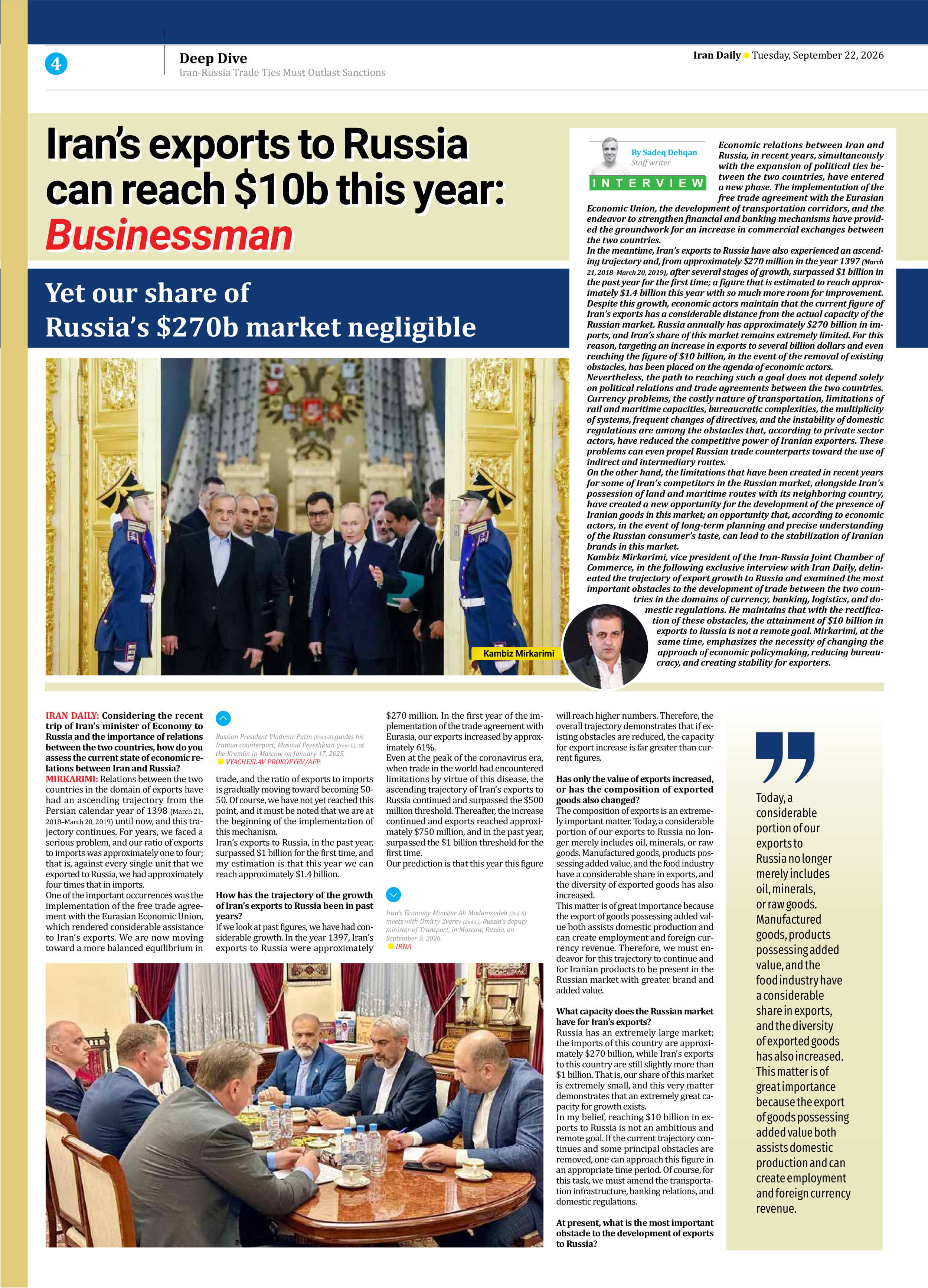


Iran’s exports to Russia can reach $10b this year: Businessman
Economic relations between Iran and Russia, in recent years, simultaneously with the expansion of political ties between the two countries, have entered a new phase. The implementation of the free trade agreement with the Eurasian Economic Union, the development of transportation corridors, and the endeavor to strengthen financial and banking mechanisms have provided the groundwork for an increase in commercial exchanges between the two countries. In the meantime, Iran’s exports to Russia have also experienced an ascending trajectory and, from approximately $270 million in the year 1397 (March 21, 2018–March 20, 2019), after several stages of growth, surpassed $1 billion in the past year for the first time; a figure that is estimated to reach approximately $1.4 billion this year with so much more room for improvement. Despite this growth, economic actors maintain that the current figure of Iran’s exports has a considerable distance from the actual capacity of the Russian market. Russia annually has approximately $270 billion in imports, and Iran’s share of this market remains extremely limited. For this reason, targeting an increase in exports to several billion dollars and even reaching the figure of $10 billion, in the event of the removal of existing obstacles, has been placed on the agenda of economic actors. Nevertheless, the path to reaching such a goal does not depend solely on political relations and trade agreements between the two countries. Currency problems, the costly nature of transportation, limitations of rail and maritime capacities, bureaucratic complexities, the multiplicity of systems, frequent changes of directives, and the instability of domestic regulations are among the obstacles that, according to private sector actors, have reduced the competitive power of Iranian exporters. These problems can even propel Russian trade counterparts toward the use of indirect and intermediary routes. On the other hand, the limitations that have been created in recent years for some of Iran’s competitors in the Russian market, alongside Iran’s possession of land and maritime routes with its neighboring country, have created a new opportunity for the development of the presence of Iranian goods in this market; an opportunity that, according to economic actors, in the event of long-term planning and precise understanding of the Russian consumer’s taste, can lead to the stabilization of Iranian brands in this market. Kambiz Mirkarimi, vice president of the Iran-Russia Joint Chamber of Commerce, in the following exclusive interview with Iran Daily, delineated the trajectory of export growth to Russia and examined the most important obstacles to the development of trade between the two countries in the domains of currency, banking, logistics, and domestic regulations. He maintains that with the rectification of these obstacles, the attainment of $10 billion in exports to Russia is not a remote goal. Mirkarimi, at the same time, emphasizes the necessity of changing the approach of economic policymaking, reducing bureaucracy, and creating stability for exporters.
By Sadeq Dehqan
Staff writer
IRAN DAILY: Considering the recent trip of Iran’s minister of Economy to Russia and the importance of relations between the two countries, how do you assess the current state of economic relations between Iran and Russia?
MIRKARIMI: Relations between the two countries in the domain of exports have had an ascending trajectory from the Persian calendar year of 1398 (March 21, 2018–March 20, 2019) until now, and this trajectory continues. For years, we faced a serious problem, and our ratio of exports to imports was approximately one to four; that is, against every single unit that we exported to Russia, we had approximately four times that in imports.
One of the important occurrences was the implementation of the free trade agreement with the Eurasian Economic Union, which rendered considerable assistance to Iran’s exports. We are now moving toward a more balanced equilibrium in trade, and the ratio of exports to imports is gradually moving toward becoming 50-50. Of course, we have not yet reached this point, and it must be noted that we are at the beginning of the implementation of this mechanism.
Iran’s exports to Russia, in the past year, surpassed $1 billion for the first time, and my estimation is that this year we can reach approximately $1.4 billion.
How has the trajectory of the growth of Iran’s exports to Russia been in past years?
If we look at past figures, we have had considerable growth. In the year 1397, Iran’s exports to Russia were approximately $270 million. In the first year of the implementation of the trade agreement with Eurasia, our exports increased by approximately 61%.
Even at the peak of the coronavirus era, when trade in the world had encountered limitations by virtue of this disease, the ascending trajectory of Iran’s exports to Russia continued and surpassed the $500 million threshold. Thereafter, the increase continued and exports reached approximately $750 million, and in the past year, surpassed the $1 billion threshold for the first time.
Our prediction is that this year this figure will reach higher numbers. Therefore, the overall trajectory demonstrates that if existing obstacles are reduced, the capacity for export increase is far greater than current figures.
Has only the value of exports increased, or has the composition of exported goods also changed?
The composition of exports is an extremely important matter. Today, a considerable portion of our exports to Russia no longer merely includes oil, minerals, or raw goods. Manufactured goods, products possessing added value, and the food industry have a considerable share in exports, and the diversity of exported goods has also increased.
This matter is of great importance because the export of goods possessing added value both assists domestic production and can create employment and foreign currency revenue. Therefore, we must endeavor for this trajectory to continue and for Iranian products to be present in the Russian market with greater brand and added value.
What capacity does the Russian market have for Iran’s exports?
Russia has an extremely large market; the imports of this country are approximately $270 billion, while Iran’s exports to this country are still slightly more than $1 billion. That is, our share of this market is extremely small, and this very matter demonstrates that an extremely great capacity for growth exists.
In my belief, reaching $10 billion in exports to Russia is not an ambitious and remote goal. If the current trajectory continues and some principal obstacles are removed, one can approach this figure in an appropriate time period. Of course, for this task, we must amend the transportation infrastructure, banking relations, and domestic regulations.
At present, what is the most important obstacle to the development of exports to Russia?
We have two fundamental matters; one is the issue of currency and the other is logistics. In the domain of logistics, the cost of transportation between Iran and Russia is extremely high. We use trucks for the transfer of goods, and various types of trucks, from ordinary trucks to refrigerated trucks, traverse this route, but the existing capacity does not respond to the volume of trade that we can have with Russia.
The railway has good capacity and can play an important role in the trade of the two countries, but its capacity is also limited and cannot alone respond to the need. In the maritime domain, we also have capacities in the Caspian Sea, but this capacity has not yet been utilized sufficiently. In the east of the Caspian Sea, there are also five countries, and the bureaucracies existing in these routes have caused a portion of the logistical capacity of the region to remain unused.
Do these limitations also have a political aspect?
No. We do not have a serious political problem in relations with our northern neighbors. On the contrary, by virtue of the good relations that exist between the countries, in many instances efforts are made for obstacles to be removed.
The principal problem is that our logistical capacity is insufficient for the volume of trade that can take shape. Greater investment must be undertaken in the development of transportation infrastructure, particularly maritime and rail transportation.
If these obstacles are removed, to what extent will it affect the capacity of Iran’s exports to Russia?
As I stated, $10 billion in exports is attainable and is not an unrealistic figure. Of course, to reach it, serious measures must be undertaken. One of the most important measures is the development of maritime transportation. Although, in future years, we can increase exports, with the current infrastructure we will encounter ceilings. Therefore, the development of the fleet and transportation capacities must be pursued simultaneously with the increase in exports.
Alongside logistical problems, what role do domestic regulations play in limiting trade with Russia?
An important portion of our problems is domestic. Between Iran and Russia, good understandings have been reached, and the parties have also endeavored for the development of economic relations. However, within our country, we face regulations disruptive to business, parallel systems, the multi-tiered nature of the currency, and numerous directives.
An economic actor cannot have long-term planning under such conditions. Suppose an Iranian exporter wishes to conclude a long-term contract with a Russian merchant. When the Iranian producer faces daily changes in price, a new directive, or a change in regulations, how can he guarantee the price and conditions of a long-term contract? This instability causes the exporter and even the foreign counterpart to lack the necessary confidence for long-term contracts.
Do such instabilities also cause the
formation of informal routes in trade?
Yes. When regulations and prices are not appropriately adjusted, informal routes take shape. Even Russian counterparts have seen these problems. For example, a Russian company may undertake the purchase of Iranian goods through informal routes or by way of intermediary companies, and the goods end up cheaper and less troublesome for it than purchasing directly from the official representative of that very company. These deviations arise from incorrect policies and price controls.
At a juncture, the use of single-use cards increased so that certain laws might be circumvented. A single-use commercial card is, in reality, the commercial card of an individual that, temporarily and in exchange for a specified amount, is placed at the disposal of third parties. In other words, the principal holder of the card, for various reasons, leases it to other individuals and, in exchange, receives an amount. This method causes individuals, without undergoing the complicated and time-consuming procedures of obtaining an official commercial card, to be able to engage in international trade. But this task, from a legal standpoint, possesses serious problems and risks.
Later, efforts were made for these routes to be closed, but when we only close the route and do not rectify the root of the problem, a portion of exports may also be damaged.
What is the current state of banking relations between Iran and Russia?
At present, the possibility of conducting banking exchanges between the two countries exists, and companies can work with rubles and rials. But the principal problem is the distrust arising from past experiences.
For example, there has been a precedent where an Iranian company concluded an export contract with a Russian company, announced its rial account, and the Russian counterpart was ready to pay. But at the time of transferring the currency, the conversion of currency was performed at a different rate, and afterward it became clear that this matter was by order of the Central Bank.
These types of occurrences cause the economic actor to not possess complete confidence in the banking system. Consequently, the Russian counterpart or the Iranian exporter may prefer to conduct a portion of the exchanges through intermediary companies and accounts in Dubai or Turkey. This matter both increases the risk of transactions and causes financial resources to exit from the official banking route.
What countries are Iran’s competitors in the Russian market?
We have serious competitors in the Russian market. China, India, and Turkey have an extremely extensive presence in this market. Of course, some European countries, due to limitations arising from existing conditions, have encountered problems for trade with Russia. In the banking domain, they also have limitations.
Iran, due to its neighboring status with Russia, its possession of several land and maritime routes, and favorable political relations, has advantages that we must utilize. These conditions are an important opportunity for the development of trade.
Can the current conditions assist Iran in capturing the Russian market for the long term?
Yes, but our perspective must not be merely short-term. The goal must not be that we export goods only under conditions in which some competitors face limitations. We must understand the taste of the Russian market and produce our products based on the needs of that market.
Some Iranian producers have undertaken measures in this domain; they have produced their products in accordance with the Russian market, changed the packaging, and endeavored to stabilize their brand there. This task must be undertaken on a broader scale so that even if international conditions change, the Russian consumer still chooses the Iranian good and brand.
For the realization of this goal, what measures must be undertaken?
The chambers of commerce and the Trade Promotion Organization must strengthen the presence of Iranian companies in Russian exhibitions. This presence must not be only in Moscow; exhibitions and trade events are also held in various cities of Russia. Since the cost of presence in international exhibitions is high, the provision of exhibition subsidies and facilities to Iranian companies can assist their greater presence.
On the other hand, the Iranian producer must not constantly have the concern of the currency rate and changes in directives. When the manager of a company is supposed to participate in a foreign exhibition, but, at the same time, his mind is occupied with what the currency rate will become tomorrow or what directive will be issued, he cannot enter the international market with focus.
Is the free trade agreement with
Eurasia alone sufficient?
No. The free trade agreement is a great and important step, but the necessary conditions for its utilization must also be provided within the country. We cannot, on one hand, have a free trade agreement with a country or economic bloc and, on the other hand, limit commercial activity with domestic regulations.
For neighboring countries, mechanisms for trade facilitation must be taken more seriously. The chambers of commerce, also, due to their connection with the parliament and decision-making bodies, must endeavor more for the rectification of disruptive laws and regulations.
Ultimately, for the utilization of Russia’s capacity, what change in Iran’s economic policy is necessary?
We require a change of approach. In many domains, the same past approaches continue, while the economic conditions of the country have changed. Foreign trade must be facilitated for the private sector. The producer and exporter of the private sector, if supported, both creates employment and generates foreign currency.
The decision-making authorities of trade are multiple, and sometimes even the economic bodies know what task must be undertaken, but existing laws and regulations have bound their hands. This very polyphony and intense bureaucracy cause decisions to not reach the desired outcome. We must first resolve our own domestic obstacles and then expect the trade counterpart countries to remove other problems.
The Russian market is an important opportunity for Iran, but the utilization of this opportunity requires stability of regulations, rectification of currency policies, development of logistics, facilitation of banking relations, and reduction of bureaucracy. If these amendments are undertaken, the increase of exports to Russia from the current level and movement toward multi-billion-dollar figures will be entirely imaginable.