





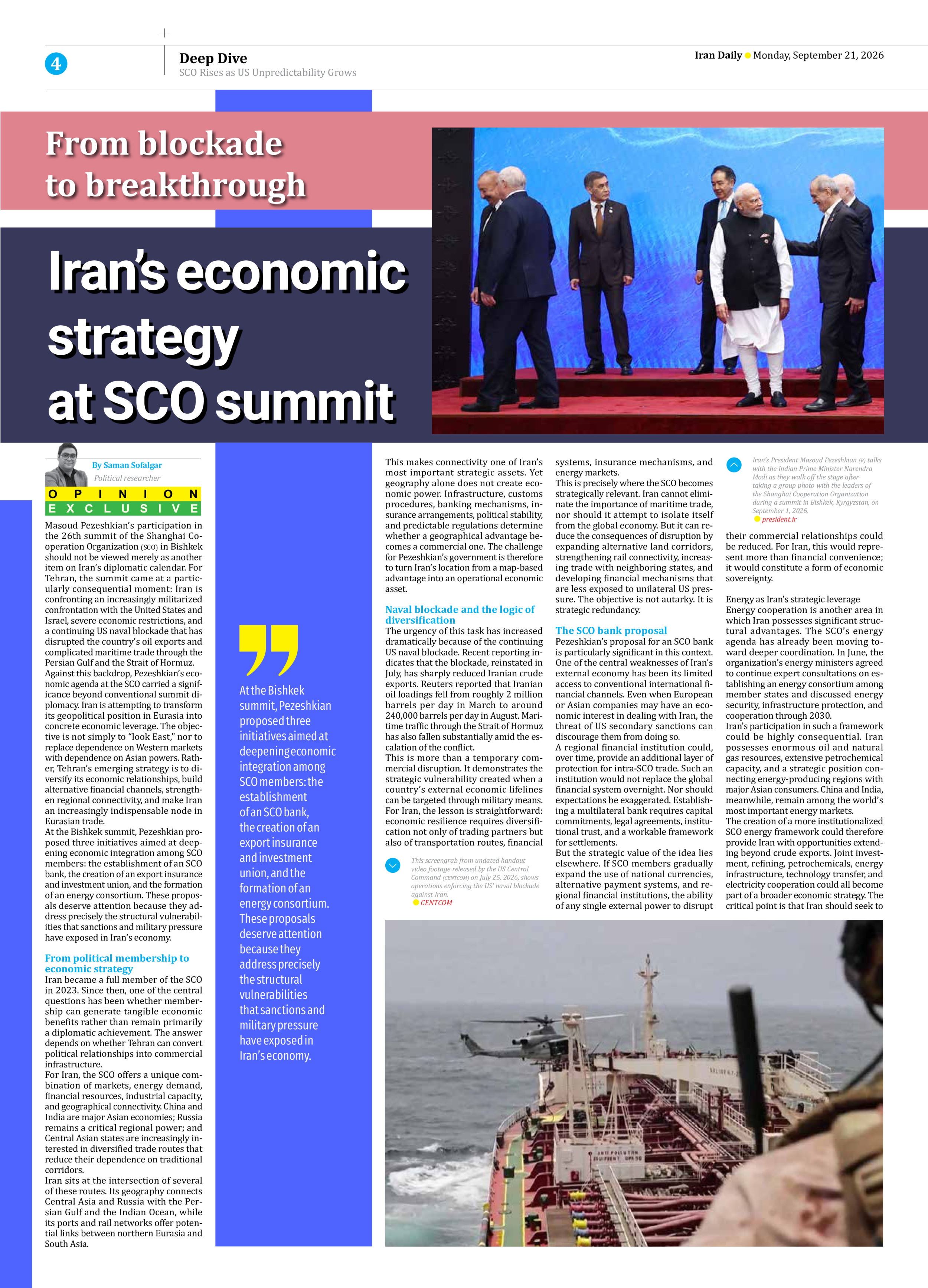


From blockade to breakthrough
Iran’s economic strategy at SCO summit
Political researcher
Masoud Pezeshkian’s participation in the 26th summit of the Shanghai Cooperation Organization (SCO) in Bishkek should not be viewed merely as another item on Iran’s diplomatic calendar. For Tehran, the summit came at a particularly consequential moment: Iran is confronting an increasingly militarized confrontation with the United States and Israel, severe economic restrictions, and a continuing US naval blockade that has disrupted the country’s oil exports and complicated maritime trade through the Persian Gulf and the Strait of Hormuz.
Against this backdrop, Pezeshkian’s economic agenda at the SCO carried a significance beyond conventional summit diplomacy. Iran is attempting to transform its geopolitical position in Eurasia into concrete economic leverage. The objective is not simply to “look East,” nor to replace dependence on Western markets with dependence on Asian powers. Rather, Tehran’s emerging strategy is to diversify its economic relationships, build alternative financial channels, strengthen regional connectivity, and make Iran an increasingly indispensable node in Eurasian trade.
At the Bishkek summit, Pezeshkian proposed three initiatives aimed at deepening economic integration among SCO members: the establishment of an SCO bank, the creation of an export insurance and investment union, and the formation of an energy consortium. These proposals deserve attention because they address precisely the structural vulnerabilities that sanctions and military pressure have exposed in Iran’s economy.
From political membership to economic strategy
Iran became a full member of the SCO in 2023. Since then, one of the central questions has been whether membership can generate tangible economic benefits rather than remain primarily a diplomatic achievement. The answer depends on whether Tehran can convert political relationships into commercial infrastructure.
For Iran, the SCO offers a unique combination of markets, energy demand, financial resources, industrial capacity, and geographical connectivity. China and India are major Asian economies; Russia remains a critical regional power; and Central Asian states are increasingly interested in diversified trade routes that reduce their dependence on traditional corridors.
Iran sits at the intersection of several of these routes. Its geography connects Central Asia and Russia with the Persian Gulf and the Indian Ocean, while its ports and rail networks offer potential links between northern Eurasia and South Asia.
This makes connectivity one of Iran’s most important strategic assets. Yet geography alone does not create economic power. Infrastructure, customs procedures, banking mechanisms, insurance arrangements, political stability, and predictable regulations determine whether a geographical advantage becomes a commercial one. The challenge for Pezeshkian’s government is therefore to turn Iran’s location from a map-based advantage into an operational economic asset.
Naval blockade and the logic of diversification
The urgency of this task has increased dramatically because of the continuing US naval blockade. Recent reporting indicates that the blockade, reinstated in July, has sharply reduced Iranian crude exports. Reuters reported that Iranian oil loadings fell from roughly 2 million barrels per day in March to around 240,000 barrels per day in August. Maritime traffic through the Strait of Hormuz has also fallen substantially amid the escalation of the conflict.
This is more than a temporary commercial disruption. It demonstrates the strategic vulnerability created when a country’s external economic lifelines can be targeted through military means. For Iran, the lesson is straightforward: economic resilience requires diversification not only of trading partners but also of transportation routes, financial systems, insurance mechanisms, and energy markets.
This is precisely where the SCO becomes strategically relevant. Iran cannot eliminate the importance of maritime trade, nor should it attempt to isolate itself from the global economy. But it can reduce the consequences of disruption by expanding alternative land corridors, strengthening rail connectivity, increasing trade with neighboring states, and developing financial mechanisms that are less exposed to unilateral US pressure. The objective is not autarky. It is strategic redundancy.
The SCO bank proposal
Pezeshkian’s proposal for an SCO bank is particularly significant in this context. One of the central weaknesses of Iran’s external economy has been its limited access to conventional international financial channels. Even when European or Asian companies may have an economic interest in dealing with Iran, the threat of US secondary sanctions can discourage them from doing so.
A regional financial institution could, over time, provide an additional layer of protection for intra-SCO trade. Such an institution would not replace the global financial system overnight. Nor should expectations be exaggerated. Establishing a multilateral bank requires capital commitments, legal agreements, institutional trust, and a workable framework for settlements.
But the strategic value of the idea lies elsewhere. If SCO members gradually expand the use of national currencies, alternative payment systems, and regional financial institutions, the ability of any single external power to disrupt their commercial relationships could be reduced. For Iran, this would represent more than financial convenience; it would constitute a form of economic sovereignty.
Energy as Iran’s strategic leverage
Energy cooperation is another area in which Iran possesses significant structural advantages. The SCO’s energy agenda has already been moving toward deeper coordination. In June, the organization’s energy ministers agreed to continue expert consultations on establishing an energy consortium among member states and discussed energy security, infrastructure protection, and cooperation through 2030.
Iran’s participation in such a framework could be highly consequential. Iran possesses enormous oil and natural gas resources, extensive petrochemical capacity, and a strategic position connecting energy-producing regions with major Asian consumers. China and India, meanwhile, remain among the world’s most important energy markets.
The creation of a more institutionalized SCO energy framework could therefore provide Iran with opportunities extending beyond crude exports. Joint investment, refining, petrochemicals, energy infrastructure, technology transfer, and electricity cooperation could all become part of a broader economic strategy. The critical point is that Iran should seek to become more than a commodity supplier. Its long-term objective should be integration into regional energy value chains.
War has changed the meaning of economic diplomacy
The current US-Israeli conflict with Iran has also changed the meaning of economic diplomacy. Under ordinary circumstances, economic diplomacy is largely about attracting investment, increasing exports, and opening markets. Under conditions of military confrontation and blockade, it also becomes a component of national resilience.
The SCO summit therefore provided Tehran with an opportunity to make a broader argument: economic connectivity can itself become a security instrument. The Bishkek declaration condemned military strikes on Iran and reaffirmed members’ support for Iran’s peaceful nuclear rights. It also emphasised economic cooperation, financial coordination, energy security, and the implementation of the SCO’s economic and energy strategies through 2030.
This political support should not be confused with a guarantee of unlimited economic assistance. China, Russia, India, and the Central Asian states have their own national interests and calculations. None of them should be assumed to act simply as extensions of Iranian policy. But this is precisely why economic diplomacy matters. Iran does not need patronage. It needs mutually beneficial interdependence.
Corridors as an economic counterweight
Perhaps Iran’s most underutilized strategic asset is its position as a transit country. If maritime routes remain vulnerable because of conflict around the Strait of Hormuz, land-based and multimodal corridors become more valuable. Iran can strengthen north-south connectivity toward Russia and Central Asia while simultaneously developing east-west routes connecting Asian markets to the Middle East.
Such infrastructure would serve two purposes. First, it would generate direct economic benefits through transit revenues, logistics, investment, and employment. Second, it would create constituencies in other countries with a material interest in maintaining Iran’s economic connectivity. This distinction is important. A country becomes harder to isolate when other countries have something substantial to lose from its isolation. That is perhaps the deeper logic behind Iran’s economic diplomacy at the SCO.
Beyond the ‘Look East’ debate
Iran’s engagement with the SCO should not be reduced to the simplistic binary of “East versus West”. A sophisticated foreign economic policy should preserve room for engagement with all major economic centers where national interests permit. But diversification becomes particularly important when one external actor possesses the ability to impose disproportionate costs through sanctions, financial restrictions, and military power.
Iran’s objective should therefore be strategic diversification rather than geopolitical exclusivity. The East is not a substitute for the entire world. But neither should Western financial and political structures remain the only gateways through which Iran can access international trade. The SCO offers an opportunity to build additional gateways.
From summit diplomacy to implementation
The real test of Pezeshkian’s economic diplomacy will begin after the summit. Iran has no shortage of memoranda, declarations, and diplomatic agreements. What it needs now is implementation. The proposed SCO bank must move toward serious institutional discussions. The export insurance mechanism needs a concrete framework. Energy cooperation requires investment projects rather than political declarations. Railways, ports, customs systems, payment mechanisms, and digital trade infrastructure must all be developed in parallel.
The private sector must also become a central participant. Economic diplomacy cannot succeed if Iranian exporters and investors remain trapped by domestic regulatory obstacles while diplomats negotiate new markets abroad. The government therefore faces a dual task: expand external economic opportunities while simultaneously removing internal barriers to using them.
A strategic opening for Iran
Pezeshkian’s appearance in Bishkek ultimately represented more than Iran’s participation in another multilateral summit. It reflected an attempt to redefine economic diplomacy as an instrument of strategic resilience.
Iran is facing military confrontation, sanctions, restrictions on oil exports, and a continuing US naval blockade that has disrupted maritime trade. Yet the same pressures that seek to isolate Iran have also increased the strategic value of alternative economic networks. The opportunity presented by the SCO is therefore real, but it is not automatic. Iran must convert political relationships into infrastructure, infrastructure into trade, trade into investment, and investment into long-term interdependence.
The strategic calculation is simple. If Washington seeks to constrain Iran by controlling its financial and maritime access, Tehran’s most effective response is not economic isolation of its own. It is the construction of multiple alternative channels through which Iranian goods, energy, capital, and commerce can move.
In that sense, the SCO may become important not because it offers Iran an escape from the global economy, but because it can help Tehran negotiate its place in that economy on more diversified and less vulnerable terms. For Iran, this is the real promise of economic diplomacy: not merely surviving pressure, but turning geography, energy, connectivity, and regional partnerships into sources of national leverage.