







Copy in clipboard...
Araghchi calls for global shift from military intervention
Wars never create security, lasting peace
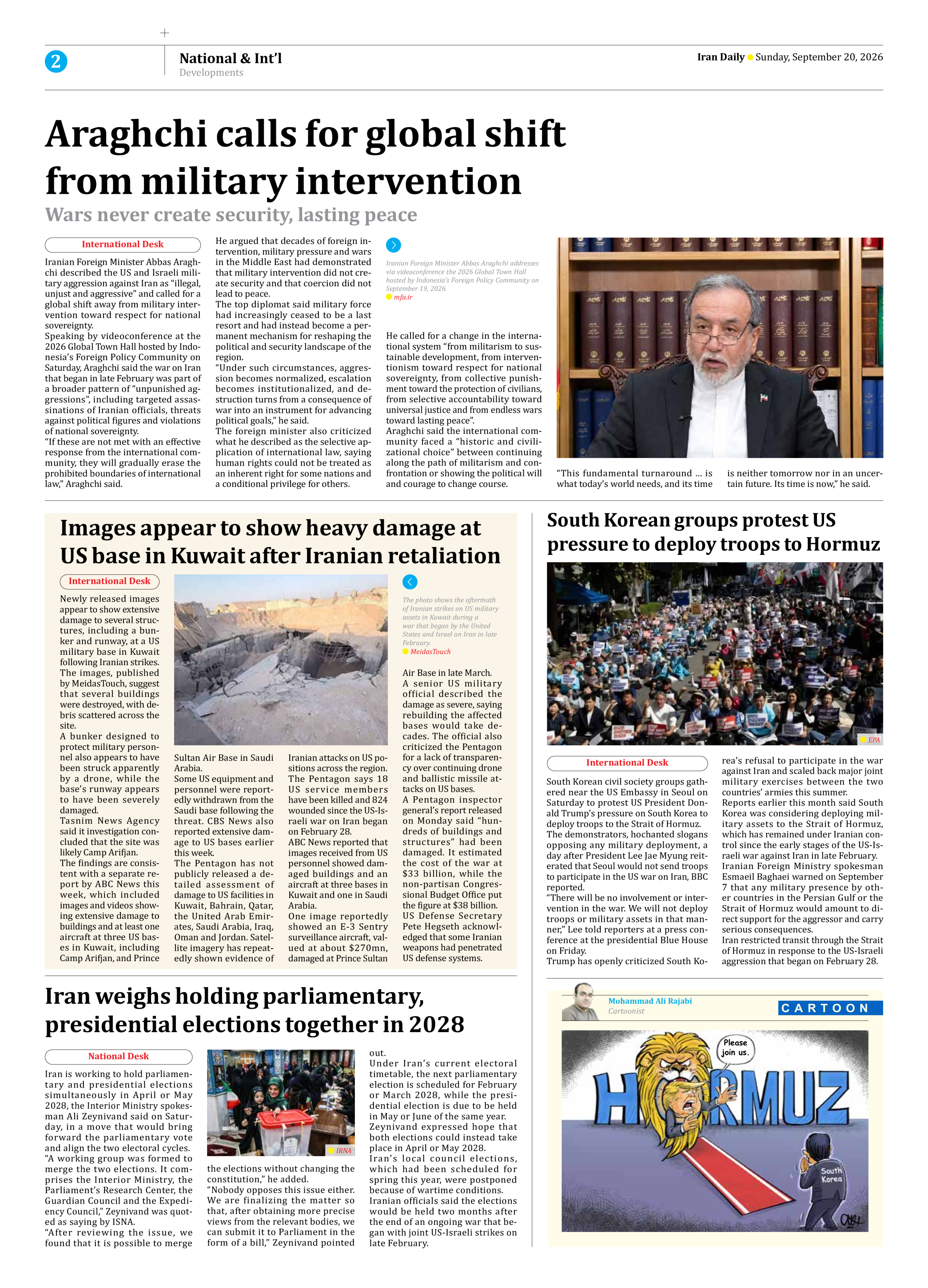
Iranian Foreign Minister Abbas Araghchi described the US and Israeli military aggression against Iran as “illegal, unjust and aggressive” and called for a global shift away from military intervention toward respect for national sovereignty.
Speaking by videoconference at the 2026 Global Town Hall hosted by Indonesia’s Foreign Policy Community on Saturday, Araghchi said the war on Iran that began in late February was part of a broader pattern of “unpunished aggressions”, including targeted assassinations of Iranian officials, threats against political figures and violations of national sovereignty.
“If these are not met with an effective response from the international community, they will gradually erase the prohibited boundaries of international law,” Araghchi said.
He argued that decades of foreign intervention, military pressure and wars in the Middle East had demonstrated that military intervention did not create security and that coercion did not lead to peace.
The top diplomat said military force had increasingly ceased to be a last resort and had instead become a permanent mechanism for reshaping the political and security landscape of the region.
“Under such circumstances, aggression becomes normalized, escalation becomes institutionalized, and destruction turns from a consequence of war into an instrument for advancing political goals,” he said.
The foreign minister also criticized what he described as the selective application of international law, saying human rights could not be treated as an inherent right for some nations and a conditional privilege for others.
He called for a change in the international system “from militarism to sustainable development, from interventionism toward respect for national sovereignty, from collective punishment toward the protection of civilians, from selective accountability toward universal justice and from endless wars toward lasting peace”.
Araghchi said the international community faced a “historic and civilizational choice” between continuing along the path of militarism and confrontation or showing the political will and courage to change course.
“This fundamental turnaround ... is what today’s world needs, and its time is neither tomorrow nor in an uncertain future. Its time is now,” he said.