





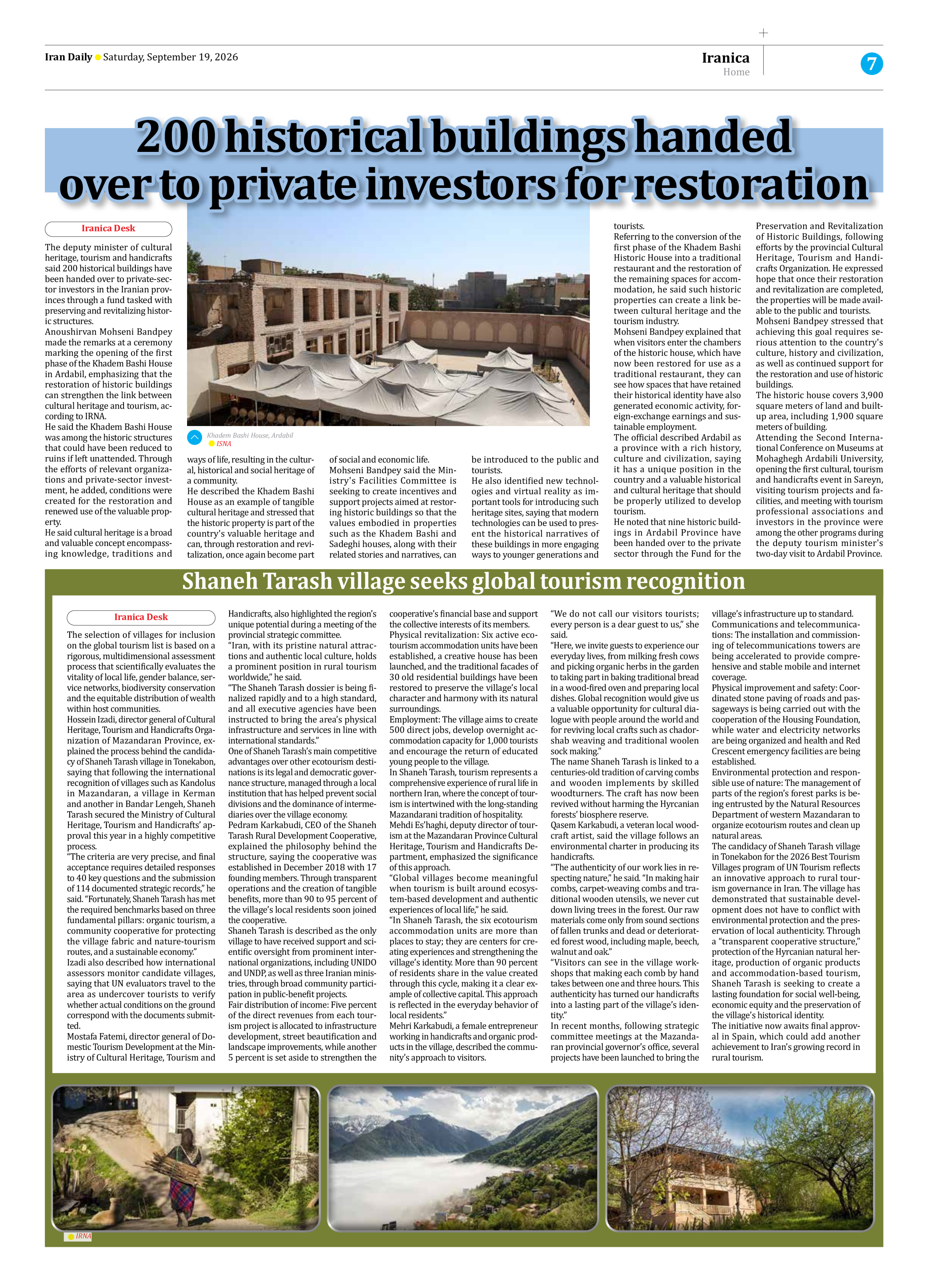


Shaneh Tarash village seeks global tourism recognition
The selection of villages for inclusion on the global tourism list is based on a rigorous, multidimensional assessment process that scientifically evaluates the vitality of local life, gender balance, service networks, biodiversity conservation and the equitable distribution of wealth within host communities.
Hossein Izadi, director general of Cultural Heritage, Tourism and Handicrafts Organization of Mazandaran Province, explained the process behind the candidacy of Shaneh Tarash village in Tonekabon, saying that following the international recognition of villages such as Kandolus in Mazandaran, a village in Kerman and another in Bandar Lengeh, Shaneh Tarash secured the Ministry of Cultural Heritage, Tourism and Handicrafts’ approval this year in a highly competitive process.
“The criteria are very precise, and final acceptance requires detailed responses to 40 key questions and the submission of 114 documented strategic records,” he said. “Fortunately, Shaneh Tarash has met the required benchmarks based on three fundamental pillars: organic tourism, a community cooperative for protecting the village fabric and nature-tourism routes, and a sustainable economy.”
Izadi also described how international assessors monitor candidate villages, saying that UN evaluators travel to the area as undercover tourists to verify whether actual conditions on the ground correspond with the documents submitted.
Mostafa Fatemi, director general of Domestic Tourism Development at the Ministry of Cultural Heritage, Tourism and Handicrafts, also highlighted the region’s unique potential during a meeting of the provincial strategic committee.
“Iran, with its pristine natural attractions and authentic local culture, holds a prominent position in rural tourism worldwide,” he said.
“The Shaneh Tarash dossier is being finalized rapidly and to a high standard, and all executive agencies have been instructed to bring the area’s physical infrastructure and services in line with international standards.”
One of Shaneh Tarash’s main competitive advantages over other ecotourism destinations is its legal and democratic governance structure, managed through a local institution that has helped prevent social divisions and the dominance of intermediaries over the village economy.
Pedram Karkabudi, CEO of the Shaneh Tarash Rural Development Cooperative, explained the philosophy behind the structure, saying the cooperative was established in December 2018 with 17 founding members. Through transparent operations and the creation of tangible benefits, more than 90 to 95 percent of the village’s local residents soon joined the cooperative.
Shaneh Tarash is described as the only village to have received support and scientific oversight from prominent international organizations, including UNIDO and UNDP, as well as three Iranian ministries, through broad community participation in public-benefit projects.
Fair distribution of income: Five percent of the direct revenues from each tourism project is allocated to infrastructure development, street beautification and landscape improvements, while another 5 percent is set aside to strengthen the cooperative’s financial base and support the collective interests of its members.
Physical revitalization: Six active ecotourism accommodation units have been established, a creative house has been launched, and the traditional facades of 30 old residential buildings have been restored to preserve the village’s local character and harmony with its natural surroundings.
Employment: The village aims to create 500 direct jobs, develop overnight accommodation capacity for 1,000 tourists and encourage the return of educated young people to the village.
In Shaneh Tarash, tourism represents a comprehensive experience of rural life in northern Iran, where the concept of tourism is intertwined with the long-standing Mazandarani tradition of hospitality.
Mehdi Es’haghi, deputy director of tourism at the Mazandaran Province Cultural Heritage, Tourism and Handicrafts Department, emphasized the significance of this approach.
“Global villages become meaningful when tourism is built around ecosystem-based development and authentic experiences of local life,” he said.
“In Shaneh Tarash, the six ecotourism accommodation units are more than places to stay; they are centers for creating experiences and strengthening the village’s identity. More than 90 percent of residents share in the value created through this cycle, making it a clear example of collective capital. This approach is reflected in the everyday behavior of local residents.”
Mehri Karkabudi, a female entrepreneur working in handicrafts and organic products in the village, described the community’s approach to visitors.
“We do not call our visitors tourists; every person is a dear guest to us,” she said.
“Here, we invite guests to experience our everyday lives, from milking fresh cows and picking organic herbs in the garden to taking part in baking traditional bread in a wood-fired oven and preparing local dishes. Global recognition would give us a valuable opportunity for cultural dialogue with people around the world and for reviving local crafts such as chador-shab weaving and traditional woolen sock making.”
The name Shaneh Tarash is linked to a centuries-old tradition of carving combs and wooden implements by skilled woodturners. The craft has now been revived without harming the Hyrcanian forests’ biosphere reserve.
Qasem Karkabudi, a veteran local woodcraft artist, said the village follows an environmental charter in producing its handicrafts.
“The authenticity of our work lies in respecting nature,” he said. “In making hair combs, carpet-weaving combs and traditional wooden utensils, we never cut down living trees in the forest. Our raw materials come only from sound sections of fallen trunks and dead or deteriorated forest wood, including maple, beech, walnut and oak.”
“Visitors can see in the village workshops that making each comb by hand takes between one and three hours. This authenticity has turned our handicrafts into a lasting part of the village’s identity.”
In recent months, following strategic committee meetings at the Mazandaran provincial governor’s office, several projects have been launched to bring the village’s infrastructure up to standard.
Communications and telecommunications: The installation and commissioning of telecommunications towers are being accelerated to provide comprehensive and stable mobile and internet coverage.
Physical improvement and safety: Coordinated stone paving of roads and passageways is being carried out with the cooperation of the Housing Foundation, while water and electricity networks are being organized and health and Red Crescent emergency facilities are being established.
Environmental protection and responsible use of nature: The management of parts of the region’s forest parks is being entrusted by the Natural Resources Department of western Mazandaran to organize ecotourism routes and clean up natural areas.
The candidacy of Shaneh Tarash village in Tonekabon for the 2026 Best Tourism Villages program of UN Tourism reflects an innovative approach to rural tourism governance in Iran. The village has demonstrated that sustainable development does not have to conflict with environmental protection and the preservation of local authenticity. Through a “transparent cooperative structure,” protection of the Hyrcanian natural heritage, production of organic products and accommodation-based tourism, Shaneh Tarash is seeking to create a lasting foundation for social well-being, economic equity and the preservation of the village’s historical identity.
The initiative now awaits final approval in Spain, which could add another achievement to Iran’s growing record in rural tourism.