







Ansarullah’s strategic gains in Yemen
By Saman Sofalgar
Political researcher
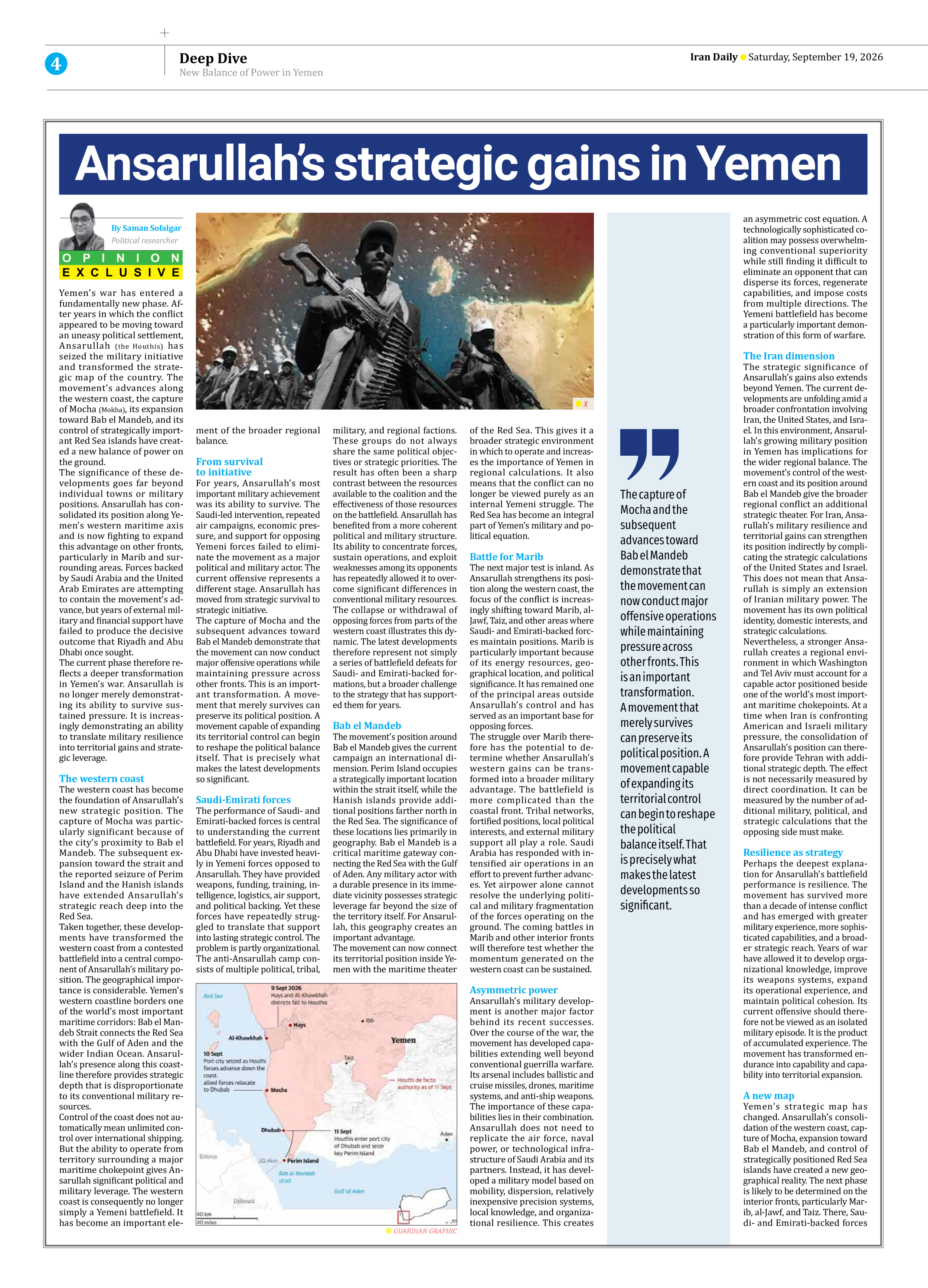
Yemen’s war has entered a fundamentally new phase. After years in which the conflict appeared to be moving toward an uneasy political settlement, Ansarullah (the Houthis) has seized the military initiative and transformed the strategic map of the country. The movement’s advances along the western coast, the capture of Mocha (Mokha), its expansion toward Bab el Mandeb, and its control of strategically important Red Sea islands have created a new balance of power on the ground.
The significance of these developments goes far beyond individual towns or military positions. Ansarullah has consolidated its position along Yemen’s western maritime axis and is now fighting to expand this advantage on other fronts, particularly in Marib and surrounding areas. Forces backed by Saudi Arabia and the United Arab Emirates are attempting to contain the movement’s advance, but years of external military and financial support have failed to produce the decisive outcome that Riyadh and Abu Dhabi once sought.
The current phase therefore reflects a deeper transformation in Yemen’s war. Ansarullah is no longer merely demonstrating its ability to survive sustained pressure. It is increasingly demonstrating an ability to translate military resilience into territorial gains and strategic leverage.
The western coast
The western coast has become the foundation of Ansarullah’s new strategic position. The capture of Mocha was particularly significant because of the city’s proximity to Bab el Mandeb. The subsequent expansion toward the strait and the reported seizure of Perim Island and the Hanish islands have extended Ansarullah’s strategic reach deep into the Red Sea.
Taken together, these developments have transformed the western coast from a contested battlefield into a central component of Ansarullah’s military position. The geographical importance is considerable. Yemen’s western coastline borders one of the world’s most important maritime corridors: Bab el Mandeb Strait connects the Red Sea with the Gulf of Aden and the wider Indian Ocean. Ansarullah’s presence along this coastline therefore provides strategic depth that is disproportionate to its conventional military resources.
Control of the coast does not automatically mean unlimited control over international shipping. But the ability to operate from territory surrounding a major maritime chokepoint gives Ansarullah significant political and military leverage. The western coast is consequently no longer simply a Yemeni battlefield. It has become an important element of the broader regional balance.
From survival
to initiative
For years, Ansarullah’s most important military achievement was its ability to survive. The Saudi-led intervention, repeated air campaigns, economic pressure, and support for opposing Yemeni forces failed to eliminate the movement as a major political and military actor. The current offensive represents a different stage. Ansarullah has moved from strategic survival to strategic initiative.
The capture of Mocha and the subsequent advances toward Bab el Mandeb demonstrate that the movement can now conduct major offensive operations while maintaining pressure across other fronts. This is an important transformation. A movement that merely survives can preserve its political position. A movement capable of expanding its territorial control can begin to reshape the political balance itself. That is precisely what makes the latest developments so significant.
Saudi-Emirati forces
The performance of Saudi- and Emirati-backed forces is central to understanding the current battlefield. For years, Riyadh and Abu Dhabi have invested heavily in Yemeni forces opposed to Ansarullah. They have provided weapons, funding, training, intelligence, logistics, air support, and political backing. Yet these forces have repeatedly struggled to translate that support into lasting strategic control. The problem is partly organizational.
The anti-Ansarullah camp consists of multiple political, tribal, military, and regional factions. These groups do not always share the same political objectives or strategic priorities. The result has often been a sharp contrast between the resources available to the coalition and the effectiveness of those resources on the battlefield. Ansarullah has benefited from a more coherent political and military structure. Its ability to concentrate forces, sustain operations, and exploit weaknesses among its opponents has repeatedly allowed it to overcome significant differences in conventional military resources. The collapse or withdrawal of opposing forces from parts of the western coast illustrates this dynamic. The latest developments therefore represent not simply a series of battlefield defeats for Saudi- and Emirati-backed formations, but a broader challenge to the strategy that has supported them for years.
Bab el Mandeb
The movement’s position around Bab el Mandeb gives the current campaign an international dimension. Perim Island occupies a strategically important location within the strait itself, while the Hanish islands provide additional positions farther north in the Red Sea. The significance of these locations lies primarily in geography. Bab el Mandeb is a critical maritime gateway connecting the Red Sea with the Gulf of Aden. Any military actor with a durable presence in its immediate vicinity possesses strategic leverage far beyond the size of the territory itself. For Ansarullah, this geography creates an important advantage.
The movement can now connect its territorial position inside Yemen with the maritime theater of the Red Sea. This gives it a broader strategic environment in which to operate and increases the importance of Yemen in regional calculations. It also means that the conflict can no longer be viewed purely as an internal Yemeni struggle. The Red Sea has become an integral part of Yemen’s military and political equation.
Battle for Marib
The next major test is inland. As Ansarullah strengthens its position along the western coast, the focus of the conflict is increasingly shifting toward Marib, al-Jawf, Taiz, and other areas where Saudi- and Emirati-backed forces maintain positions. Marib is particularly important because of its energy resources, geographical location, and political significance. It has remained one of the principal areas outside Ansarullah’s control and has served as an important base for opposing forces.
The struggle over Marib therefore has the potential to determine whether Ansarullah’s western gains can be transformed into a broader military advantage. The battlefield is more complicated than the coastal front. Tribal networks, fortified positions, local political interests, and external military support all play a role. Saudi Arabia has responded with intensified air operations in an effort to prevent further advances. Yet airpower alone cannot resolve the underlying political and military fragmentation of the forces operating on the ground. The coming battles in Marib and other interior fronts will therefore test whether the momentum generated on the western coast can be sustained.
Asymmetric power
Ansarullah’s military development is another major factor behind its recent successes. Over the course of the war, the movement has developed capabilities extending well beyond conventional guerrilla warfare. Its arsenal includes ballistic and cruise missiles, drones, maritime systems, and anti-ship weapons. The importance of these capabilities lies in their combination.
Ansarullah does not need to replicate the air force, naval power, or technological infrastructure of Saudi Arabia and its partners. Instead, it has developed a military model based on mobility, dispersion, relatively inexpensive precision systems, local knowledge, and organizational resilience. This creates an asymmetric cost equation. A technologically sophisticated coalition may possess overwhelming conventional superiority while still finding it difficult to eliminate an opponent that can disperse its forces, regenerate capabilities, and impose costs from multiple directions. The Yemeni battlefield has become a particularly important demonstration of this form of warfare.
The Iran dimension
The strategic significance of Ansarullah’s gains also extends beyond Yemen. The current developments are unfolding amid a broader confrontation involving Iran, the United States, and Israel. In this environment, Ansarullah’s growing military position in Yemen has implications for the wider regional balance. The movement’s control of the western coast and its position around Bab el Mandeb give the broader regional conflict an additional strategic theater. For Iran, Ansarullah’s military resilience and territorial gains can strengthen its position indirectly by complicating the strategic calculations of the United States and Israel. This does not mean that Ansarullah is simply an extension of Iranian military power. The movement has its own political identity, domestic interests, and strategic calculations.
Nevertheless, a stronger Ansarullah creates a regional environment in which Washington and Tel Aviv must account for a capable actor positioned beside one of the world’s most important maritime chokepoints. At a time when Iran is confronting American and Israeli military pressure, the consolidation of Ansarullah’s position can therefore provide Tehran with additional strategic depth. The effect is not necessarily measured by direct coordination. It can be measured by the number of additional military, political, and strategic calculations that the opposing side must make.
Resilience as strategy
Perhaps the deepest explanation for Ansarullah’s battlefield performance is resilience. The movement has survived more than a decade of intense conflict and has emerged with greater military experience, more sophisticated capabilities, and a broader strategic reach. Years of war have allowed it to develop organizational knowledge, improve its weapons systems, expand its operational experience, and maintain political cohesion. Its current offensive should therefore not be viewed as an isolated military episode. It is the product of accumulated experience. The movement has transformed endurance into capability and capability into territorial expansion.
A new map
Yemen’s strategic map has changed. Ansarullah’s consolidation of the western coast, capture of Mocha, expansion toward Bab el Mandeb, and control of strategically positioned Red Sea islands have created a new geographical reality. The next phase is likely to be determined on the interior fronts, particularly Marib, al-Jawf, and Taiz. There, Saudi- and Emirati-backed forces continue to resist, supported by substantial external resources. But the fundamental strategic question has changed.
For years, the central question was whether Ansarullah could withstand external pressure. It has demonstrated that it can. The question now is whether it can transform its new territorial and military position into a durable political advantage across Yemen. The humanitarian consequences of renewed warfare remain severe, and continued fighting will impose further costs on the Yemeni population. Any assessment of the military balance must therefore recognize the human consequences of the conflict. Yet from a strategic perspective, the direction of the war has changed.
Ansarullah has moved from defending its established position to reshaping Yemen’s military geography. The western coast, Mocha, Bab el Mandeb, and the Red Sea islands have become interconnected elements of that transformation. The battles now unfolding in Marib and other parts of Yemen will determine whether this transformation continues. At the regional level, the implications are even broader.
A stronger Ansarullah gives Iran an additional strategic variable in its confrontation with the United States and Israel, while forcing Saudi Arabia and its partners to reconsider a strategy that has failed to produce decisive results despite years of substantial investment. Yemen is therefore entering a new strategic era. The balance of power is no longer defined simply by the number of aircraft, missiles, or financial resources available to each side. It is increasingly determined by who can sustain pressure, maintain organizational cohesion, exploit geography, and convert battlefield resilience into lasting political leverage. By those measures, Ansarullah has fundamentally altered the trajectory of Yemen’s war.