







Freight, passenger transit back to normal at Iraqi borders: Businessman
By Sadeq Dehqan
Staff writer
The temporary closure of certain border crossings between Iran and Iraq following a security incident created concerns in recent days regarding the process of trade exchanges between the two countries, particularly the transfer of perishable goods. The Shalamcheh border, which is considered among the most important land gateways for trade between Iran and Iraq, faced restrictions and a halt in activity for approximately two days; a matter that caused congestion in the border area and the stoppage of a number of consignments. Concurrent with the dissemination of news regarding the closure of the Shalamcheh and Chazzabeh borders, speculations and rumors were also raised concerning the cause of this closure, and some even attributed it to political decisions and regional developments.
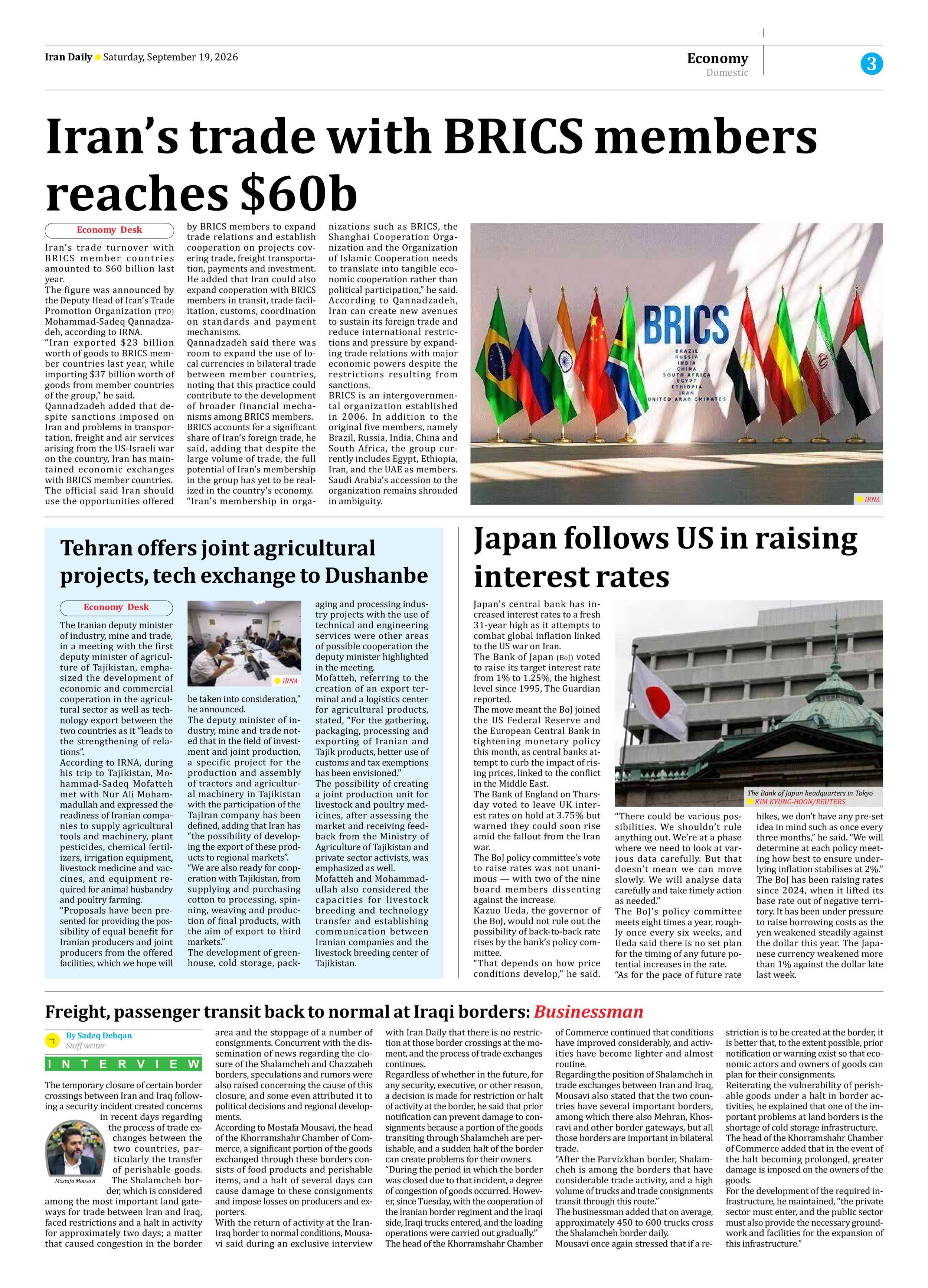
According to Mostafa Mousavi, the head of the Khorramshahr Chamber of Commerce, a significant portion of the goods exchanged through these borders consists of food products and perishable items, and a halt of several days can cause damage to these consignments and impose losses on producers and exporters.
With the return of activity at the Iran-Iraq border to normal conditions, Mousavi said during an exclusive interview with Iran Daily that there is no restriction at those border crossings at the moment, and the process of trade exchanges continues.
Regardless of whether in the future, for any security, executive, or other reason, a decision is made for restriction or halt of activity at the border, he said that prior notification can prevent damage to consignments because a portion of the goods transiting through Shalamcheh are perishable, and a sudden halt of the border can create problems for their owners.
“During the period in which the border was closed due to that incident, a degree of congestion of goods occurred. However, since Tuesday, with the cooperation of the Iranian border regiment and the Iraqi side, Iraqi trucks entered, and the loading operations were carried out gradually.”
The head of the Khorramshahr Chamber of Commerce continued that conditions have improved considerably, and activities have become lighter and almost routine.
Regarding the position of Shalamcheh in trade exchanges between Iran and Iraq, Mousavi also stated that the two countries have several important borders, among which there also Mehran, Khosravi and other border gateways, but all those borders are important in bilateral trade.
“After the Parvizkhan border, Shalamcheh is among the borders that have considerable trade activity, and a high volume of trucks and trade consignments transit through this route.”
The businessman added that on average, approximately 450 to 600 trucks cross the Shalamcheh border daily.
Mousavi once again stressed that if a restriction is to be created at the border, it is better that, to the extent possible, prior notification or warning exist so that economic actors and owners of goods can plan for their consignments.
Reiterating the vulnerability of perishable goods under a halt in border activities, he explained that one of the important problems at land borders is the shortage of cold storage infrastructure.
The head of the Khorramshahr Chamber of Commerce added that in the event of the halt becoming prolonged, greater damage is imposed on the owners of the goods.
For the development of the required infrastructure, he maintained, “the private sector must enter, and the public sector must also provide the necessary groundwork and facilities for the expansion of this infrastructure.”