







US cannot escape responsibility for war crimes by leaving UN rights council: Deputy FM
Iran’s Deputy Foreign Minister for Legal and International Affairs Kazem Gharibabadi said on Friday the US cannot evade responsibility for war crimes it committed during its war on Iran by withdrawing from the UN Human Rights Council.
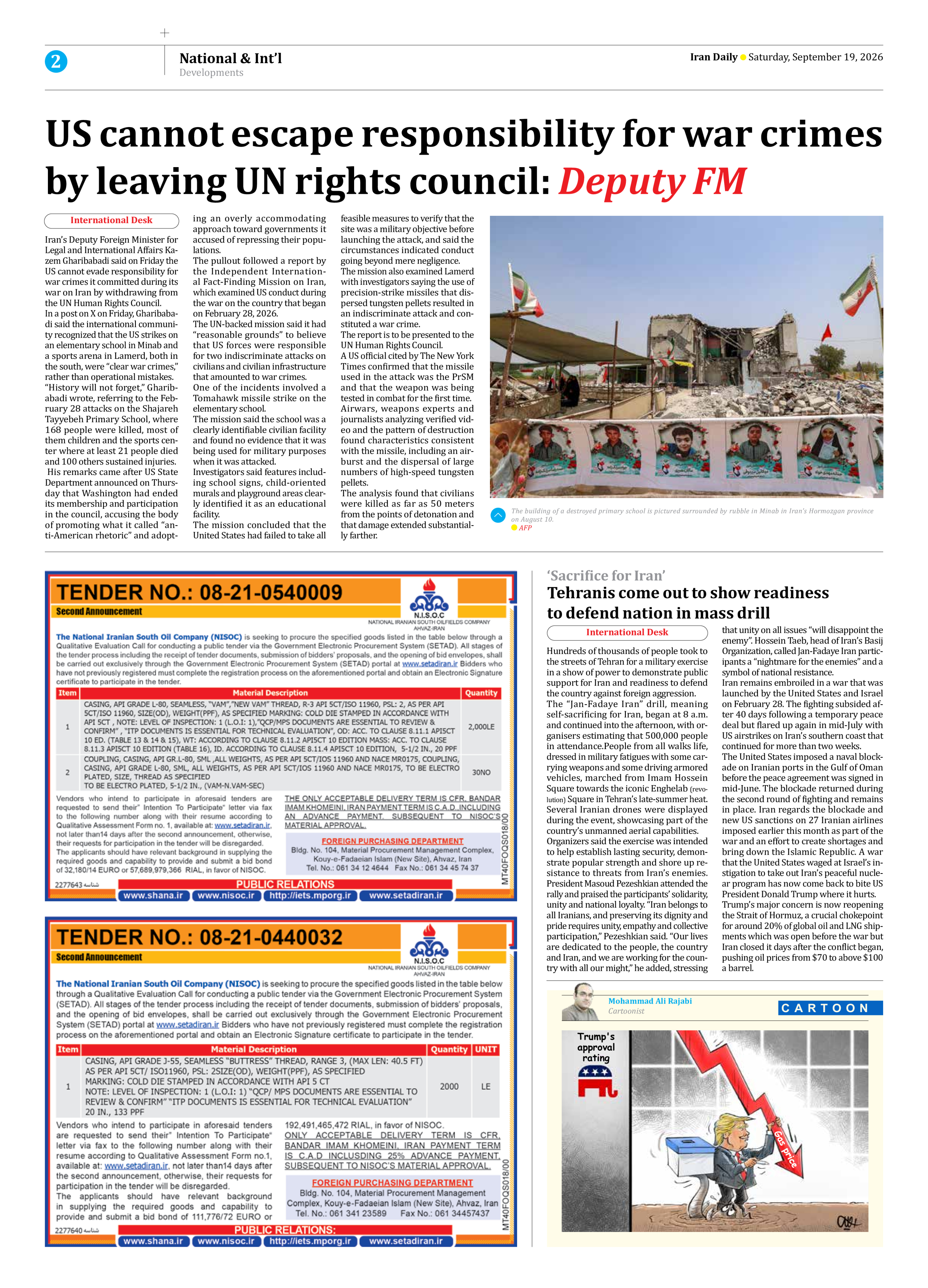
In a post on X on Friday, Gharibabadi said the international community recognized that the US strikes on an elementary school in Minab and a sports arena in Lamerd, both in the south, were “clear war crimes,” rather than operational mistakes.
“History will not forget,” Gharibabadi wrote, referring to the February 28 attacks on the Shajareh Tayyebeh Primary School, where 168 people were killed, most of them children and the sports center where at least 21 people died and 100 others sustained injuries.
His remarks came after US State Department announced on Thursday that Washington had ended its membership and participation in the council, accusing the body of promoting what it called “anti-American rhetoric” and adopting an overly accommodating approach toward governments it accused of repressing their populations.
The pullout followed a report by the Independent International Fact-Finding Mission on Iran, which examined US conduct during the war on the country that began on February 28, 2026.
The UN-backed mission said it had “reasonable grounds” to believe that US forces were responsible for two indiscriminate attacks on civilians and civilian infrastructure that amounted to war crimes.
One of the incidents involved a Tomahawk missile strike on the elementary school.
The mission said the school was a clearly identifiable civilian facility and found no evidence that it was being used for military purposes when it was attacked.
Investigators said features including school signs, child-oriented murals and playground areas clearly identified it as an educational facility.
The mission concluded that the United States had failed to take all feasible measures to verify that the site was a military objective before launching the attack, and said the circumstances indicated conduct going beyond mere negligence.
The mission also examined Lamerd with investigators saying the use of precision-strike missiles that dispersed tungsten pellets resulted in an indiscriminate attack and constituted a war crime.
The report is to be presented to the UN Human Rights Council.
A US official cited by The New York Times confirmed that the missile used in the attack was the PrSM and that the weapon was being tested in combat for the first time.
Airwars, weapons experts and journalists analyzing verified video and the pattern of destruction found characteristics consistent with the missile, including an airburst and the dispersal of large numbers of high-speed tungsten pellets.
The analysis found that civilians were killed as far as 50 meters from the points of detonation and that damage extended substantially farther.