







Iran needs to leverage BRICS membership for economic resilience
Membership alone cannot shield Iran from sanctions
By Delaram Ahmadi
Staff writer
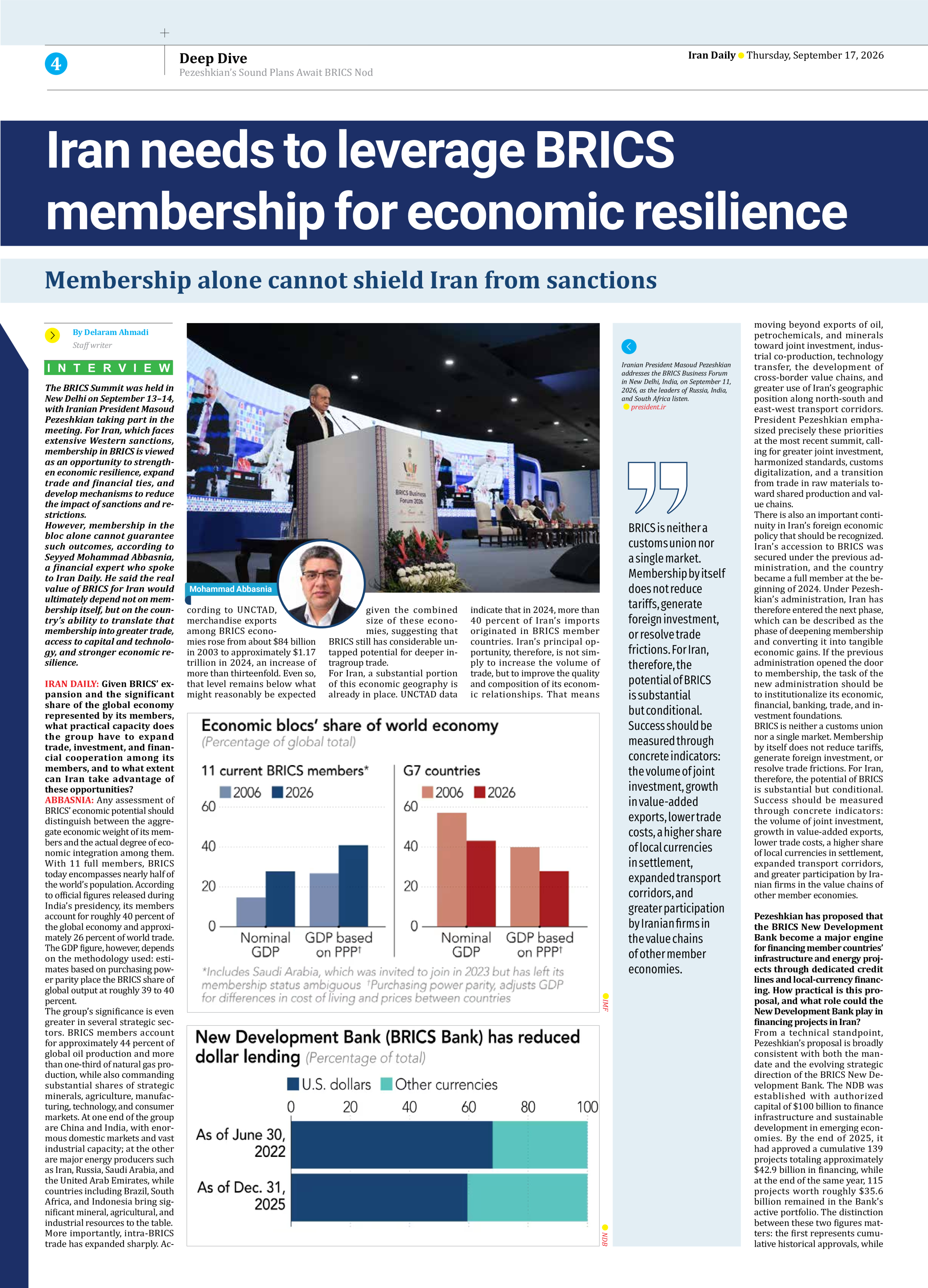
The BRICS Summit was held in New Delhi on September 13–14, with Iranian President Masoud Pezeshkian taking part in the meeting. For Iran, which faces extensive Western sanctions, membership in BRICS is viewed as an opportunity to strengthen economic resilience, expand trade and financial ties, and develop mechanisms to reduce the impact of sanctions and restrictions.
However, membership in the bloc alone cannot guarantee such outcomes, according to Seyyed Mohammad Abbasnia, a financial expert who spoke to Iran Daily. He said the real value of BRICS for Iran would ultimately depend not on membership itself, but on the country’s ability to translate that membership into greater trade, access to capital and technology, and stronger economic resilience.
IRAN DAILY: Given BRICS’ expansion and the significant share of the global economy represented by its members, what practical capacity does the group have to expand trade, investment, and financial cooperation among its members, and to what extent can Iran take advantage of these opportunities?
ABBASNIA: Any assessment of BRICS’ economic potential should distinguish between the aggregate economic weight of its members and the actual degree of economic integration among them. With 11 full members, BRICS today encompasses nearly half of the world’s population. According to official figures released during India’s presidency, its members account for roughly 40 percent of the global economy and approximately 26 percent of world trade. The GDP figure, however, depends on the methodology used: estimates based on purchasing power parity place the BRICS share of global output at roughly 39 to 40 percent.
The group’s significance is even greater in several strategic sectors. BRICS members account for approximately 44 percent of global oil production and more than one-third of natural gas production, while also commanding substantial shares of strategic minerals, agriculture, manufacturing, technology, and consumer markets. At one end of the group are China and India, with enormous domestic markets and vast industrial capacity; at the other are major energy producers such as Iran, Russia, Saudi Arabia, and the United Arab Emirates, while countries including Brazil, South Africa, and Indonesia bring significant mineral, agricultural, and industrial resources to the table.
More importantly, intra-BRICS trade has expanded sharply. According to UNCTAD, merchandise exports among BRICS economies rose from about $84 billion in 2003 to approximately $1.17 trillion in 2024, an increase of more than thirteenfold. Even so, that level remains below what might reasonably be expected given the combined size of these economies, suggesting that BRICS still has considerable untapped potential for deeper intragroup trade.
For Iran, a substantial portion of this economic geography is already in place. UNCTAD data indicate that in 2024, more than 40 percent of Iran’s imports originated in BRICS member countries. Iran’s principal opportunity, therefore, is not simply to increase the volume of trade, but to improve the quality and composition of its economic relationships. That means moving beyond exports of oil, petrochemicals, and minerals toward joint investment, industrial co-production, technology transfer, the development of cross-border value chains, and greater use of Iran’s geographic position along north-south and east-west transport corridors. President Pezeshkian emphasized precisely these priorities at the most recent summit, calling for greater joint investment, harmonized standards, customs digitalization, and a transition from trade in raw materials toward shared production and value chains.
There is also an important continuity in Iran’s foreign economic policy that should be recognized. Iran’s accession to BRICS was secured under the previous administration, and the country became a full member at the beginning of 2024. Under Pezeshkian’s administration, Iran has therefore entered the next phase, which can be described as the phase of deepening membership and converting it into tangible economic gains. If the previous administration opened the door to membership, the task of the new administration should be to institutionalize its economic, financial, banking, trade, and investment foundations.
BRICS is neither a customs union nor a single market. Membership by itself does not reduce tariffs, generate foreign investment, or resolve trade frictions. For Iran, therefore, the potential of BRICS is substantial but conditional. Success should be measured through concrete indicators: the volume of joint investment, growth in value-added exports, lower trade costs, a higher share of local currencies in settlement, expanded transport corridors, and greater participation by Iranian firms in the value chains of other member economies.
Pezeshkian has proposed that the BRICS New Development Bank become a major engine for financing member countries’ infrastructure and energy projects through dedicated credit lines and local-currency financing. How practical is this proposal, and what role could the New Development Bank play in financing projects in Iran?
From a technical standpoint, Pezeshkian’s proposal is broadly consistent with both the mandate and the evolving strategic direction of the BRICS New Development Bank. The NDB was established with authorized capital of $100 billion to finance infrastructure and sustainable development in emerging economies. By the end of 2025, it had approved a cumulative 139 projects totaling approximately $42.9 billion in financing, while at the end of the same year, 115 projects worth roughly $35.6 billion remained in the Bank’s active portfolio. The distinction between these two figures matters: the first represents cumulative historical approvals, while the second reflects the size of the active portfolio.
One of the NDB’s most important strategic priorities has been the expansion of local-currency financing. Under its 2022–2026 strategy, the Bank set a target of 30 percent for local-currency financing, while discussions surrounding the next strategic period have contemplated raising that share to the 40–50 percent range.
This matters significantly for developing economies because one of the central risks in infrastructure finance is currency mismatch between project revenues and debt obligations. If a project generates revenue in domestic currency while its debt is denominated in US dollars, a depreciation of the domestic currency can dramatically increase the real burden of debt service; by contrast, financing in renminbi, rupees, or other local currencies that are better aligned with a project’s revenue structure can mitigate part of that risk. The New Development Bank itself raises funds in domestic capital markets, and its issuance of bonds denominated in renminbi and other currencies demonstrates that local-currency financing is not merely a theoretical aspiration but an operating feature of the institution.
For Iran, however, there is a fundamental institutional issue: BRICS membership does not automatically confer membership in the New Development Bank, and Iran has not yet been included on the NDB’s official membership list. Completing this institutional link should therefore be one of the Pezeshkian administration’s priorities. This is a clear example of the second phase of Iran’s BRICS strategy: political membership was achieved under the previous administration, while the current administration must now expand Iran’s access to the financial institutions surrounding the BRICS framework.
Even after membership in the NDB, access to financing would not be automatic. Iran would need to prepare a credible pipeline of bankable projects with rigorous feasibility studies, clearly defined cash flows, transparent legal structures, appropriate environmental and social assessments, and a defensible repayment capacity. Rail networks and international corridors, ports, power grids, renewable energy, energy-efficiency projects, water management, digital infrastructure, and urban transportation would all be plausible candidates.
At the same time, the New Development Bank should not be viewed as an anti-sanctions bank. To preserve its credit standing and maintain access to global capital markets, the NDB must comply with established risk-management and regulatory standards. It could therefore help Iran diversify its sources of capital, currencies, and financing channels, but it cannot by itself eliminate all constraints arising from sanctions.
The real value of Pezeshkian’s proposal lies in the possibility that, if BRICS develops dedicated credit lines, local-currency lending, guarantees, and co-financing mechanisms, member states could finance a larger share of their development projects with less dependence on the traditional dollar-centered financing architecture. Iran, provided it completes the NDB membership process and develops a professionally structured pipeline of bankable projects, could benefit meaningfully from that capacity.
One of Iran’s most important challenges under sanctions is restricted access to international payment networks and financial resources. To what extent can BRICS financial mechanisms, including the use of local currencies and the interconnection of member countries’ payment systems, reduce these constraints?
Any discussion of BRICS financial mechanisms should distinguish among three separate issues: the currency in which a transaction is denominated, the network through which financial messages are transmitted, and the mechanism through which final settlement takes place.
In recent years, BRICS has focused less on the immediate creation of a common currency and more on developing a multi-channel architecture for cross-border payments. The BRICS Cross-Border Payments Initiative, the BRICS Payment Task Force, and discussions on interoperability among national payment systems all reflect efforts to reduce transaction costs, shorten settlement times, and limit dependence on multiple financial intermediaries.
During India’s 2026 BRICS presidency, this agenda has received greater attention, including discussions about the possible interconnection of member countries’ central bank digital currencies and the interoperability of fast-payment systems. For Iran, such arrangements could offer several important advantages: fewer intermediary banks, reduced reliance on the US dollar for a portion of trade, lower settlement costs, alternative channels when one network is disrupted, and greater capacity for direct trade with major economic partners.
That said, the concept of de-dollarization should not be overstated. The dollar still accounts for more than half of global official foreign-exchange reserves, while the international role of China’s renminbi remains considerably smaller. Neither the rapid displacement of the dollar from the global economy nor the claim that BRICS has already created a unified operational alternative to SWIFT would be realistic. What is feasible is a gradual reduction in dependence on a single currency and a single financial channel.
Another issue is trade imbalance. If Iran exports heavily to a particular BRICS member but imports relatively little from that country, and transactions are settled in the partner’s national currency, Iran could accumulate significant balances in a currency that has limited convertibility or limited domestic usefulness. Successful use of local currencies therefore requires supporting infrastructure: central-bank swap arrangements, functioning foreign-exchange markets, mechanisms for investing surplus currency balances, correspondent banking relationships, and instruments for hedging exchange-rate risk.
Likewise, the technical interconnection of payment systems does not by itself eliminate sanctions risk. A foreign bank may be technologically capable of processing a transaction but still choose not to participate because of secondary-sanctions exposure or because of its broader commercial interests in US and European markets. The financial potential of BRICS should therefore be assessed in terms of strengthening Iran’s financial resilience, not eliminating sanctions altogether.
Meaningful progress would require Iran and key BRICS partners to establish a combination of bilateral and multilateral arrangements involving local currencies, swap lines, financial messaging, correspondent accounts, and interoperable payment systems. The appropriate objective for Iran is not to remove the dollar entirely from foreign trade. It is to ensure that every cross-border payment does not depend on a single currency, a single correspondent bank, and a single financial network. That kind of diversification can raise the economic cost of imposing restrictions on Iran while giving the country greater flexibility in conducting external trade.
Pezeshkian has proposed the creation of a joint BRICS reinsurance company with initial capital of $10 billion to cover risks associated with major infrastructure and energy projects. What effect could such a mechanism have on investment in member countries, particularly Iran, and what financial and operational obstacles would it face?
Pezeshkian’s proposal to establish a joint BRICS reinsurance company with initial capital of $10 billion is financially significant because one of the less visible but critical elements of large-project finance is the ability to insure, absorb, and distribute risk. Banks and investors do not look solely at the expected rate of return on a power plant, port, railway, mining venture, or energy project; they must also assess how construction risk, accidents, physical damage, transportation risk, business interruption, liability, and catastrophic events will be insured.
A primary insurer is generally unable to retain the full risk of a multibillion-dollar project on its own balance sheet and therefore transfers part of that exposure to the reinsurance market. If access to international reinsurance capacity becomes restricted or prohibitively expensive, even an economically viable project can lose its bankability.
A BRICS reinsurance company could expand risk-bearing capacity, distribute project risks across a larger number of countries, reduce members’ dependence on a relatively concentrated global reinsurance market, and improve the overall bankability of major projects. Nor is this proposal entirely disconnected from earlier BRICS initiatives. Members have previously placed the expansion of insurance and reinsurance capacity, as well as project-guarantee mechanisms, on their agenda. A $10 billion institution could therefore move this cooperation beyond working groups and policy coordination toward a financial institution with a meaningful balance sheet of its own.
For Iran, such an institution could be particularly important given sanctions, political risk, regional instability, and the restricted access of certain projects to major international reinsurance markets. If adequately capitalized and supported by a strong credit rating, such an institution could also contribute to lowering the cost of capital.
Several important questions remain unresolved, however. No final details have yet been published regarding the precise nature of the proposed $10 billion capitalization: whether it would represent paid-in, subscribed, or authorized capital; how contributions would be allocated among members; where the institution would be headquartered; which regulatory regime would govern it; how ownership would be structured; or how reserves would be managed. These issues would need to be resolved in the institution’s design. A BRICS reinsurer must also avoid becoming a repository for excessively risky projects. If a disproportionate share of its exposure were concentrated in conflict-prone regions or in projects that private reinsurance markets had declined to cover, excessive risk concentration could undermine the institution’s financial strength.
Pricing would also need to remain professional and actuarially sound. Artificially suppressing premiums for political reasons could rapidly erode the company’s capital following several large claims. A credible credit rating, managerial independence, geographic diversification of the portfolio, a robust solvency framework, effective claims-transfer mechanisms, and access to BRICS payment networks would all be essential to the institution’s success.
Pezeshkian’s proposal therefore has considerable economic merit in principle, but its success would depend on ensuring that the proposed institution operates as a professional multinational reinsurer rather than as a politically driven risk fund. If those conditions are met, it could become, alongside the New Development Bank, project-guarantee mechanisms, and cross-border payment networks, an important component of the future BRICS financial architecture.
Overall, Iran’s relationship with BRICS has now entered a new phase. Iran’s membership created an important political and economic opportunity for the country. Today, however, the central challenge is no longer achieving membership; it is strengthening the foundations of that membership and converting political access into measurable economic benefits. At the recent summit, Pezeshkian focused precisely on the issues that define this second phase: project finance, the use of local currencies, payment-system interoperability, the development of shared production chains, and the creation of reinsurance capacity. The next step is to establish an operational plan and measurable performance indicators for each of these areas.
Iran’s BRICS membership should ultimately be judged by whether it produces growth in value-added trade, attracts investment, finances infrastructure projects, lowers the cost of cross-border payments, expands transport corridors, and increases the participation of Iranian firms in regional and global value chains. The ultimate value of BRICS for Iran will not be determined by membership itself, but by the country’s ability to convert that membership into trade, capital, technology, and greater economic resilience.