







Geoeconomic competition and new wealth of nations
On 250th anniversary of Adam Smith’s Wealth of Nations
By George Yeo
Singapore’s former minister for foreign affairs
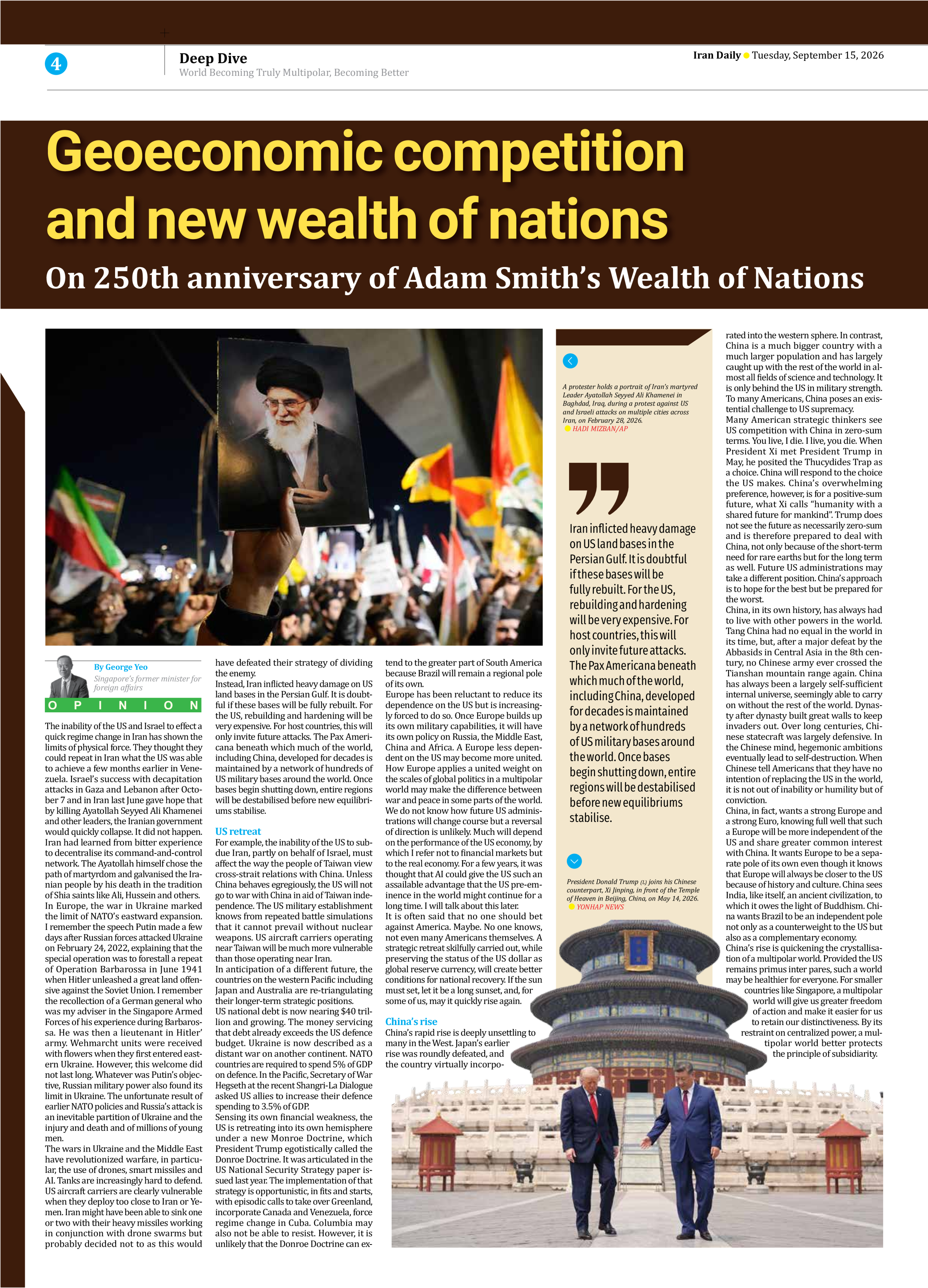
The inability of the US and Israel to effect a quick regime change in Iran has shown the limits of physical force. They thought they could repeat in Iran what the US was able to achieve a few months earlier in Venezuela. Israel’s success with decapitation attacks in Gaza and Lebanon after October 7 and in Iran last June gave hope that by killing Ayatollah Seyyed Ali Khamenei and other leaders, the Iranian government would quickly collapse. It did not happen. Iran had learned from bitter experience to decentralise its command-and-control network. The Ayatollah himself chose the path of martyrdom and galvanised the Iranian people by his death in the tradition of Shia saints like Ali, Hussein and others.
In Europe, the war in Ukraine marked the limit of NATO’s eastward expansion. I remember the speech Putin made a few days after Russian forces attacked Ukraine on February 24, 2022, explaining that the special operation was to forestall a repeat of Operation Barbarossa in June 1941 when Hitler unleashed a great land offensive against the Soviet Union. I remember the recollection of a German general who was my adviser in the Singapore Armed Forces of his experience during Barbarossa. He was then a lieutenant in Hitler’ army. Wehmarcht units were received with flowers when they first entered eastern Ukraine. However, this welcome did not last long. Whatever was Putin’s objective, Russian military power also found its limit in Ukraine. The unfortunate result of earlier NATO policies and Russia’s attack is an inevitable partition of Ukraine and the injury and death and of millions of young men.
The wars in Ukraine and the Middle East have revolutionized warfare, in particular, the use of drones, smart missiles and AI. Tanks are increasingly hard to defend. US aircraft carriers are clearly vulnerable when they deploy too close to Iran or Yemen. Iran might have been able to sink one or two with their heavy missiles working in conjunction with drone swarms but probably decided not to as this would have defeated their strategy of dividing the enemy.
Instead, Iran inflicted heavy damage on US land bases in the Persian Gulf. It is doubtful if these bases will be fully rebuilt. For the US, rebuilding and hardening will be very expensive. For host countries, this will only invite future attacks. The Pax Americana beneath which much of the world, including China, developed for decades is maintained by a network of hundreds of US military bases around the world. Once bases begin shutting down, entire regions will be destabilised before new equilibriums stabilise.
US retreat
For example, the inability of the US to subdue Iran, partly on behalf of Israel, must affect the way the people of Taiwan view cross-strait relations with China. Unless China behaves egregiously, the US will not go to war with China in aid of Taiwan independence. The US military establishment knows from repeated battle simulations that it cannot prevail without nuclear weapons. US aircraft carriers operating near Taiwan will be much more vulnerable than those operating near Iran.
In anticipation of a different future, the countries on the western Pacific including Japan and Australia are re-triangulating their longer-term strategic positions.
US national debt is now nearing $40 trillion and growing. The money servicing that debt already exceeds the US defence budget. Ukraine is now described as a distant war on another continent. NATO countries are required to spend 5% of GDP on defence. In the Pacific, Secretary of War Hegseth at the recent Shangri-La Dialogue asked US allies to increase their defence spending to 3.5% of GDP.
Sensing its own financial weakness, the US is retreating into its own hemisphere under a new Monroe Doctrine, which President Trump egotistically called the Donroe Doctrine. It was articulated in the US National Security Strategy paper issued last year. The implementation of that strategy is opportunistic, in fits and starts, with episodic calls to take over Greenland, incorporate Canada and Venezuela, force regime change in Cuba. Columbia may also not be able to resist. However, it is unlikely that the Donroe Doctrine can extend to the greater part of South America because Brazil will remain a regional pole of its own.
Europe has been reluctant to reduce its dependence on the US but is increasingly forced to do so. Once Europe builds up its own military capabilities, it will have its own policy on Russia, the Middle East, China and Africa. A Europe less dependent on the US may become more united. How Europe applies a united weight on the scales of global politics in a multipolar world may make the difference between war and peace in some parts of the world.
We do not know how future US administrations will change course but a reversal of direction is unlikely. Much will depend on the performance of the US economy, by which I refer not to financial markets but to the real economy. For a few years, it was thought that AI could give the US such an assailable advantage that the US pre-eminence in the world might continue for a long time. I will talk about this later.
It is often said that no one should bet against America. Maybe. No one knows, not even many Americans themselves. A strategic retreat skilfully carried out, while preserving the status of the US dollar as global reserve currency, will create better conditions for national recovery. If the sun must set, let it be a long sunset, and, for some of us, may it quickly rise again.
China’s rise
China’s rapid rise is deeply unsettling to many in the West. Japan’s earlier rise was roundly defeated, and the country virtually incorporated into the western sphere. In contrast, China is a much bigger country with a much larger population and has largely caught up with the rest of the world in almost all fields of science and technology. It is only behind the US in military strength. To many Americans, China poses an existential challenge to US supremacy.
Many American strategic thinkers see US competition with China in zero-sum terms. You live, I die. I live, you die. When President Xi met President Trump in May, he posited the Thucydides Trap as a choice. China will respond to the choice the US makes. China’s overwhelming preference, however, is for a positive-sum future, what Xi calls “humanity with a shared future for mankind”. Trump does not see the future as necessarily zero-sum and is therefore prepared to deal with China, not only because of the short-term need for rare earths but for the long term as well. Future US administrations may take a different position. China’s approach is to hope for the best but be prepared for the worst.
China, in its own history, has always had to live with other powers in the world. Tang China had no equal in the world in its time, but, after a major defeat by the Abbasids in Central Asia in the 8th century, no Chinese army ever crossed the Tianshan mountain range again. China has always been a largely self-sufficient internal universe, seemingly able to carry on without the rest of the world. Dynasty after dynasty built great walls to keep invaders out. Over long centuries, Chinese statecraft was largely defensive. In the Chinese mind, hegemonic ambitions eventually lead to self-destruction. When Chinese tell Americans that they have no intention of replacing the US in the world, it is not out of inability or humility but of conviction.
China, in fact, wants a strong Europe and a strong Euro, knowing full well that such a Europe will be more independent of the US and share greater common interest with China. It wants Europe to be a separate pole of its own even though it knows that Europe will always be closer to the US because of history and culture. China sees India, like itself, an ancient civilization, to which it owes the light of Buddhism. China wants Brazil to be an independent pole not only as a counterweight to the US but also as a complementary economy.
China’s rise is quickening the crystallisation of a multipolar world. Provided the US remains primus inter pares, such a world may be healthier for everyone. For smaller countries like Singapore, a multipolar world will give us greater freedom of action and make it easier for us to retain our distinctiveness. By its restraint on centralized power, a multipolar world better protects the principle of subsidiarity.
Data intensity as a measure of development
China is an unusually homogeneous country. A country with a population twice that of Europe has one written language, one literature and one set of heroes. When China is organised, it is highly productive. When it is in decline, the people go through decades of internal strife and hardship.
China’s script is not alphabetic but ideographic. Chinese characters retain their meaning even though pronunciations change across time and space. This gives the written script a digital quality. Every character has a fixed value. Primary school children are able to read and recite verses from the Analects by Confucius written over two thousand years ago.
China also invented paper over two thousand years ago and was able to maintain the techonology of its mass production until the defeat in Central Asia I referred to earlier. From Chinese prisoners of war, the Islamic world learned how to make paper and was transformed by it.
Alan Turing, whose ancestry was part Scottish, taught us that with an unlimited amount of paper, one could do an unlimited number of algorithmic calculations. Paper and ideographic writing enabled Chinese civilization to organise more human beings than anywhere else on earth by a large margin. During the Covid pandemic, the head of Chinese medicine pronounced that China had complete records of all epidemics that erupted in China over two thousand years. The collection and processing of data made possible a fine division of labour and therefore a highly productive economy when the country was at peace. It also facilitated the development of continental-scale infrastructural networks for irrigation, flood control, grain and salt distribution, water transportation, taxation and, of course, domestic political control. China has always been a data-intensive society. In sharp contrast to Europeans, Chinese people are less concerned with data privacy.
The scholars were the data specialists. For over a thousand years, they were selected by examinations and populated a civil service organised into ministries reporting through senior mandarins to the Emperor. It was only in relatively recent times that the rest of the world developed comparable civil services often through competitive examinations. Scholar-officials spent most of their time doing close work. Myopia became a competitive advantage. They also had many wives and children. It is not an accident that the Chinese have the higher incidence of myopia in the world. In today’s world, one has to worry what mobile phones and endless scrolling will do for the eyesight of our children.
For the purpose of data recording and processing, brush ink and paper was orders of magnitude faster than nib ink and parchment. One can see the difference in the time needed to execute a painting using brunch ink and paper compared to one using paint brush and canvas. They are different art forms, of course.
One way to gauge the level of advancement of a society is data intensity. Data intensity is a measure of education level, administrative efficiency and market dynamism. Good administration and efficient markets, in turn, draw talent into the social network. The healthy development of a community depends on its political, social and economic development. Markets cannot work well if the political system is dysfunctional and participants lack integrity and a sense of solidarity. Adam Smith’s enduring legacy is not only the Wealth of Nations which explained how the market works its magic, but also in his Theory of Moral Sentiments which showed the importance of society having a healthy political and social framework within which an efficient market operates. Smith was first a moral philosopher, then an economist.
Codification and energy
Each human being in society can be likened to a computer chip networked to other human beings by an operating system which is composed of politics, law, values and culture. Part of the network is well defined like the electoral system and the legal system. They change relatively slowly. A large part of the network is market-driven and can change at high speed. The more advanced a society is, the more highly coded it is.
Coding needs energy. Darwin’s natural selection is driven by the competition for energy. Without energy, no organism can defend itself or attack others, or to find a mate and replicate. Within an organism, there is ceaseless competition for energy by different cells and organs. Cancers gobble up energy and can be overcome by depriving them of energy. All life is coding. The same four nucleotide bases A, C, G, T are the building block of all life on earth. In groups of three, they make up the 20 or 21 amino acids from which all proteins are made. Without the input of energy, order eventually breaks down, what in thermodynamics we call entropy. The struggle for life is therefore the struggle for energy and its efficient use.
Human civilization is equally driven by energy availability and efficiency. The agricultural revolution was an energy revolution. Civilization began in the great deltas after swamps were cleared for the cultivation of food crops. Seeds had to be selected, irrigation systems established, grain storage introduced and distribution systems organised. The surplus enabled armies to fan out and conquer. Empires grew until the cost of expansion outweighed the benefit. At that point, the energy equation turns negative.
In China, the agricultural system was largely unbroken over four thousand years. Control of water has always been key. The country continues to embark on huge water works today. The growing of rice which requires a high degree of organisation produces the most calories or energy per hectare of any crop. A complex internal network of canals facilitated efficient distribution over a vast area. China’s agricultural system produced the energy which enabled a complex codification of its society. The steam engine invented by James Watt, a contemporary of Adam Smith, ushered in a new energy revolution, which led eventually to western domination of the world. Coal fired steam ships and trains. Later oil fueled cars and aeroplanes. The conversion of heat to mechanical power required an understanding of metallurgy especially of iron and thermodynamics. Singapore had three large markets built with Scottish cast iron. One still stands in Lau Pa Sat and is often frequented by tourists. Unfortunately, that energy revolution unleashed in Scotland also led eventually to slaughter on an industrial scale in the 20th century.
Energy and AI
The technology for producing energy and its efficient use has always underpinned political and military power in human history. So it remains today in the new age of AI.
British coal powered British manufacturing. The sea reduced friction of transportation, making energy use more efficient. Coal today is a fuel of the past, but I still have vivid memories of 1973 as a nineteen-year-old going up to Cambridge to study engineering. There was a miners’ strike led by Joe Gormley and Arthur Scargill. Prime Minister Edward Heath’s response was a three-day working week. On the other days, the shops in Picadilley Circus and Leicester Square were lit by hurricane lamps.
America had not only coal but also abundant oil. Japan was forced into the Second World War because the US imposed an oil embargo in response to its invasion of China. In February 1945, after the Yalta Summit, President Roosevelt on board the USS Quincy stopped five days in the Suez Canal to confer with King Abdelaziz of Saudi Arabia. Out of that meeting, a historic agreement was made that in return for US protection of the kingdom, Saudi oil would be priced in US dollars. For decades, the US dominated energy markets in the world. The current standoff in Iran with double blockades of the Straits of Hormuz has altered an old dispensation. Energy markets continue to operate efficiently, but US dominance has been significantly weakened. King Abdelaziz’s grandson, Mohamad bin Salman, is moving slowly to diversify away from the US dollar.
China, in the meantime, has made rapid strides in developing alternative energy sources, particularly solar and wind. China has also steadily brought down the cost of battery storage. With sun and wind everywhere, political power will no longer be concentrated in the hands of major energy producers.
Energy will however always be scarce because the demand will keep growing with the development of AI. Energy is the ultimate constraint on the amount of computation that AI can do. The constraint is not in technology because the technology is readily available, but in politics. Elon Musk has repeated complained about how difficult it is to get approvals and public support for the construction of energy infrastructure in the US.
It is China that has made the most progress in energy production and distribution. Household electricity costs continue to fall and is among the lowest in the world. Just a few months ago, I was in Shantou near where my paternal grandfather and my mother grew up. There huge turbines capture energy from strong winds in the Taiwan Strait which is a veritable wind tunnel. I was told the electricity energy cost in Shantou is half that of China’s average. The city is now considering two uses of that energy, for the generation of hydrogen and for data processing. China now generates more electricity than the US and Europe combined.
For a time, it seemed that the US’ lead in AI would secure its superpower status into an indefinite future. By pushing its AI stack to all parts of the world, US intelligence and security agencies will potentially know everything about everyone at any time through the Magnificent Seven. When DeepSeek released its first AI LLM, it was surprisingly good and open source. Probably directed by the Central Government, all Chinese LLMs are now open source and keeping pace with US LLMs. This has enabled the use of AI to diffuse into all parts of the Chinese economy and beyond. Chinese LLMs are no more than six to nine months at most behind US LLMs. Nvidia CEO Jensen Huang has repeatedly warned that Chinese AI is catching up with US AI.
In chip technology, despite intense efforts by the US to stymie China, China has redoubled efforts to achieve self-sufficiency. Ironically, it is the US which is now pushing China to buy lower-end Nvidia GPUs. In physical AI, meaning the incorporation of AI into manufacturing systems and products, such as cars, drones and robots, China is advancing rapidly. China is ahead not because it has a monopoly of the technologies but because it has a huge domestic market which enables a division of labour no other country can match. By promoting free trade with its neighbours along the belt and road, China is extending this division of labour over a much wider region and a much larger population.
How much a country can benefit from open source AI and ubiquitous energy will increasingly depend on the political and social system it has in order to educate its people and engender cooperative effort and healthy competition.
Moral challenge of AI
Pope Leo XIV in one of his recent encyclical on AI, Magnfica Humanitas, talks about the moral challenge of AI. He described AI as a fruit of human intelligence. He likened the development of AI more as “cultivation” than as production upon a preconceived design. The fruit can be sweet; it can be bitter. It can be good or it can be bad.
The concentration of power in the hands of a few cannot be good because it will inevitably lead to the degradation of humanity. From this perspective, multipolarity in AI is a good phenomenon. It will create healthy competition and curb abuse. By breaking the US monopoly, China’s AI development is a blessing to all of humanity and will encourage the growth of other AI centers in the world. As Kai-Fu Lee pointed out a few years ago, AI systems are inevitably values-based. The Islamic world, for example, will allocate weights differently in their models.
The key is always the availability of energy and its efficient use. Europe with its high energy cost is severely handicapped. The wound is partly self-inflicted. To overcome this crippling weakness, Europe will have to review its policy towards Russia, the Middle East and North Africa, and China.
India is not naturally endowed with plentiful energy but is determined to source oil and gas cheaply and to develop alternative energy. It has every ambition to be an AI power and will eventually become one too. Brazil has the potential as well and will not be left behind. Africa has energy in abundance but many parts are unfortunately held back by underdeveloped political and social structures. China is now building much needed physical infrastructure in this vast continent. It is in Europe’s interest to work with China in helping Africa to grow sustainably.
AI can enhance our intelligence and creativity, or it can dumb us down and make us lazy. It can make us more human or less human. What is clear is that humanity is on the threshold of a new age.
The full article first appeared on The China Academy.