







Copy in clipboard...
Tehran raps Vienna’s barring of nuclear chief from IAEA meet as ‘serious violation’
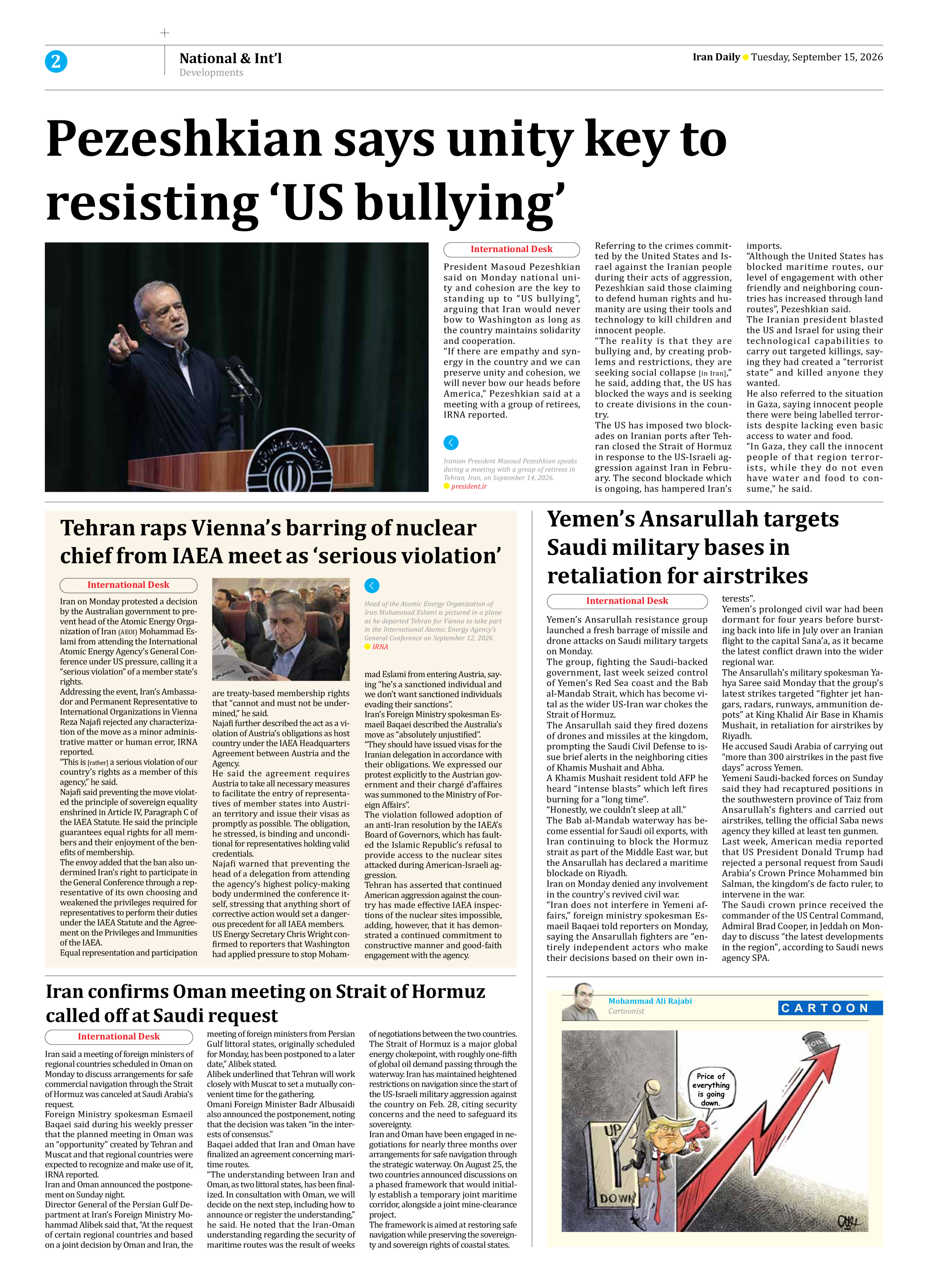
Iran on Monday protested a decision by the Australian government to prevent head of the Atomic Energy Organization of Iran (AEOI) Mohammad Eslami from attending the International Atomic Energy Agency’s General Conference under US pressure, calling it a “serious violation” of a member state’s rights.
Addressing the event, Iran’s Ambassador and Permanent Representative to International Organizations in Vienna Reza Najafi rejected any characterization of the move as a minor administrative matter or human error, IRNA reported.
“This is [rather] a serious violation of our country’s rights as a member of this agency,” he said.
Najafi said preventing the move violated the principle of sovereign equality enshrined in Article IV, Paragraph C of the IAEA Statute. He said the principle guarantees equal rights for all members and their enjoyment of the benefits of membership.
The envoy added that the ban also undermined Iran’s right to participate in the General Conference through a representative of its own choosing and weakened the privileges required for representatives to perform their duties under the IAEA Statute and the Agreement on the Privileges and Immunities of the IAEA.
Equal representation and participation are treaty-based membership rights that “cannot and must not be undermined,” he said.
Najafi further described the act as a violation of Austria’s obligations as host country under the IAEA Headquarters Agreement between Austria and the Agency.
He said the agreement requires Austria to take all necessary measures to facilitate the entry of representatives of member states into Austrian territory and issue their visas as promptly as possible. The obligation, he stressed, is binding and unconditional for representatives holding valid credentials.
Najafi warned that preventing the head of a delegation from attending the agency’s highest policy-making body undermined the conference itself, stressing that anything short of corrective action would set a dangerous precedent for all IAEA members.
US Energy Secretary Chris Wright confirmed to reporters that Washington had applied pressure to stop Mohammad Eslami from entering Austria, saying “he’s a sanctioned individual and we don’t want sanctioned individuals evading their sanctions”.
Iran’s Foreign Ministry spokesman Esmaeil Baqaei described the Australia’s move as “absolutely unjustified”.
“They should have issued visas for the Iranian delegation in accordance with their obligations. We expressed our protest explicitly to the Austrian government and their chargé d’affaires was summoned to the Ministry of Foreign Affairs”.
The violation followed adoption of an anti-Iran resolution by the IAEA’s Board of Governors, which has faulted the Islamic Republic’s refusal to provide access to the nuclear sites attacked during American-Israeli aggression.
Tehran has asserted that continued American aggression against the country has made effective IAEA inspections of the nuclear sites impossible, adding, however, that it has demonstrated a continued commitment to constructive manner and good-faith engagement with the agency.