







Copy in clipboard...
BRICS condemns attacks on civilian infrastructure, nuclear facilities
Pezeshkian calls for bloc’s ‘more active role’ in defending members’ sovereignty
The BRICS group of emerging economies in a joint statement on Sunday condemned attacks on civilian infrastructure and nuclear sites as the United States continues its acts of aggression against Iran.
“We express serious concern over deliberate attacks on civilian infrastructure and peaceful nuclear facilities under full safeguards of the International Atomic Energy Agency [IAEA], in violation of international law and relevant resolutions of the IAEA,” the joint statement said at the end of the 18th BRICS Summit in Indian capital, New Delhi.
“Nuclear safeguards, safety and security must always be upheld, including in armed conflicts, to protect people and the environment from harm,” the statement added.
It also expressed concern over the continued escalation of tensions in the region.
“We express deep concern over the continued escalation of tensions in Middle East/West Asia ... call for exercising maximum restraint, as well as avoiding actions that could further aggravate the situation.”
The statement called for the protection of civilians, urged respect for the sovereignty and territorial integrity of states, and stressed the need to protect global trade, supply chains, energy flows and maritime security.
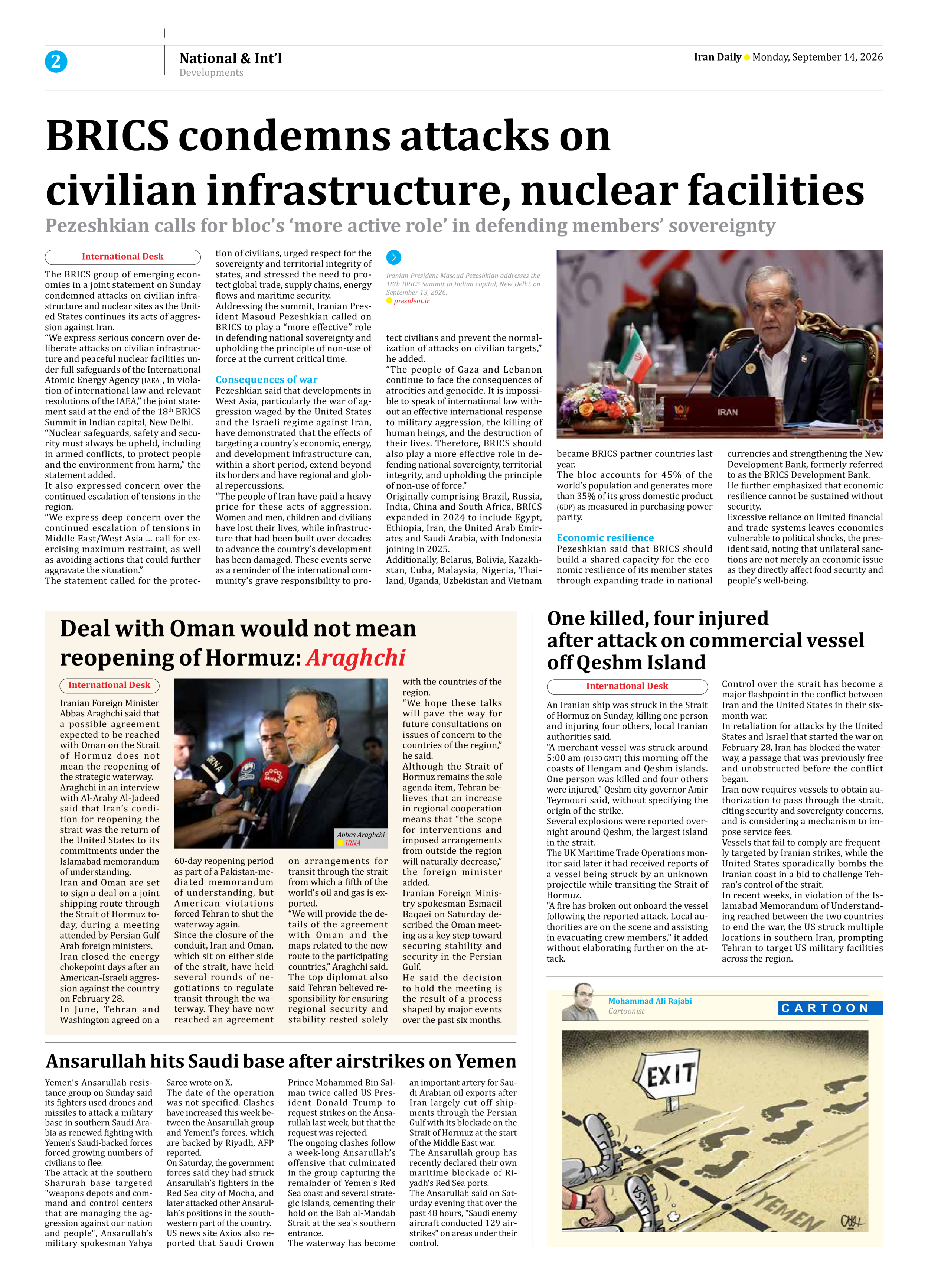
Addressing the summit, Iranian President Masoud Pezeshkian called on BRICS to play a “more effective” role in defending national sovereignty and upholding the principle of non-use of force at the current critical time.
Consequences of war
Pezeshkian said that developments in West Asia, particularly the war of aggression waged by the United States and the Israeli regime against Iran, have demonstrated that the effects of targeting a country’s economic, energy, and development infrastructure can, within a short period, extend beyond its borders and have regional and global repercussions.
“The people of Iran have paid a heavy price for these acts of aggression. Women and men, children and civilians have lost their lives, while infrastructure that had been built over decades to advance the country’s development has been damaged. These events serve as a reminder of the international community’s grave responsibility to protect civilians and prevent the normalization of attacks on civilian targets,” he added.
“The people of Gaza and Lebanon continue to face the consequences of atrocities and genocide. It is impossible to speak of international law without an effective international response to military aggression, the killing of human beings, and the destruction of their lives. Therefore, BRICS should also play a more effective role in defending national sovereignty, territorial integrity, and upholding the principle of non-use of force.”
Originally comprising Brazil, Russia, India, China and South Africa, BRICS expanded in 2024 to include Egypt, Ethiopia, Iran, the United Arab Emirates and Saudi Arabia, with Indonesia joining in 2025.
Additionally, Belarus, Bolivia, Kazakhstan, Cuba, Malaysia, Nigeria, Thailand, Uganda, Uzbekistan and Vietnam became BRICS partner countries last year.
The bloc accounts for 45% of the world’s population and generates more than 35% of its gross domestic product (GDP) as measured in purchasing power parity.
Economic resilience
Pezeshkian said that BRICS should build a shared capacity for the economic resilience of its member states through expanding trade in national currencies and strengthening the New Development Bank, formerly referred to as the BRICS Development Bank.
He further emphasized that economic resilience cannot be sustained without security.
Excessive reliance on limited financial and trade systems leaves economies vulnerable to political shocks, the president said, noting that unilateral sanctions are not merely an economic issue as they directly affect food security and people’s well-being.