







Zanjan’s knife-making industry moves from traditional craft toward industrial production
700 workshops turn out 6m knives annually
By Sadeq Dehqan
Staff writer
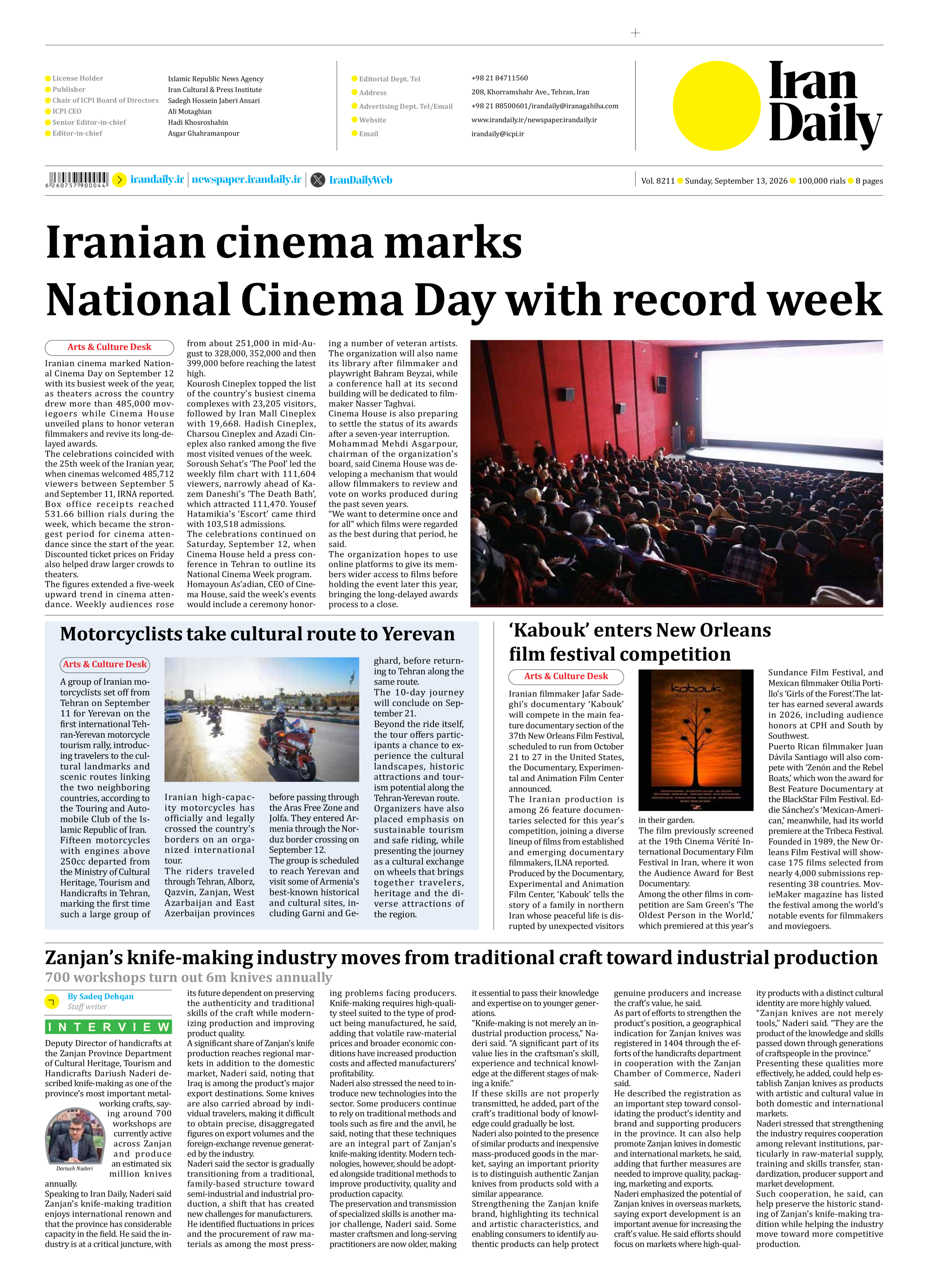
Deputy Director of handicrafts at the Zanjan Province Department of Cultural Heritage, Tourism and Handicrafts Dariush Naderi described knife-making as one of the province’s most important metalworking crafts, saying around 700 workshops are currently active across Zanjan and produce an estimated six million knives annually.
Speaking to Iran Daily, Naderi said Zanjan’s knife-making tradition enjoys international renown and that the province has considerable capacity in the field. He said the industry is at a critical juncture, with its future dependent on preserving the authenticity and traditional skills of the craft while modernizing production and improving product quality.
A significant share of Zanjan’s knife production reaches regional markets in addition to the domestic market, Naderi said, noting that Iraq is among the product’s major export destinations. Some knives are also carried abroad by individual travelers, making it difficult to obtain precise, disaggregated figures on export volumes and the foreign-exchange revenue generated by the industry.
Naderi said the sector is gradually transitioning from a traditional, family-based structure toward semi-industrial and industrial production, a shift that has created new challenges for manufacturers.
He identified fluctuations in prices and the procurement of raw materials as among the most pressing problems facing producers. Knife-making requires high-quality steel suited to the type of product being manufactured, he said, adding that volatile raw-material prices and broader economic conditions have increased production costs and affected manufacturers’ profitability.
Naderi also stressed the need to introduce new technologies into the sector. Some producers continue to rely on traditional methods and tools such as fire and the anvil, he said, noting that these techniques are an integral part of Zanjan’s knife-making identity. Modern technologies, however, should be adopted alongside traditional methods to improve productivity, quality and production capacity.
The preservation and transmission of specialized skills is another major challenge, Naderi said. Some master craftsmen and long-serving practitioners are now older, making it essential to pass their knowledge and expertise on to younger generations.
“Knife-making is not merely an industrial production process,” Naderi said. “A significant part of its value lies in the craftsman’s skill, experience and technical knowledge at the different stages of making a knife.”
If these skills are not properly transmitted, he added, part of the craft’s traditional body of knowledge could gradually be lost.
Naderi also pointed to the presence of similar products and inexpensive mass-produced goods in the market, saying an important priority is to distinguish authentic Zanjan knives from products sold with a similar appearance.
Strengthening the Zanjan knife brand, highlighting its technical and artistic characteristics, and enabling consumers to identify authentic products can help protect genuine producers and increase the craft’s value, he said.
As part of efforts to strengthen the product’s position, a geographical indication for Zanjan knives was registered in 1404 through the efforts of the handicrafts department in cooperation with the Zanjan Chamber of Commerce, Naderi said.
He described the registration as an important step toward consolidating the product’s identity and brand and supporting producers in the province. It can also help promote Zanjan knives in domestic and international markets, he said, adding that further measures are needed to improve quality, packaging, marketing and exports.
Naderi emphasized the potential of Zanjan knives in overseas markets, saying export development is an important avenue for increasing the craft’s value. He said efforts should focus on markets where high-quality products with a distinct cultural identity are more highly valued.
“Zanjan knives are not merely tools,” Naderi said. “They are the product of the knowledge and skills passed down through generations of craftspeople in the province.”
Presenting these qualities more effectively, he added, could help establish Zanjan knives as products with artistic and cultural value in both domestic and international markets.
Naderi stressed that strengthening the industry requires cooperation among relevant institutions, particularly in raw-material supply, training and skills transfer, standardization, producer support and market development.
Such cooperation, he said, can help preserve the historic standing of Zanjan’s knife-making tradition while helping the industry move toward more competitive production.