





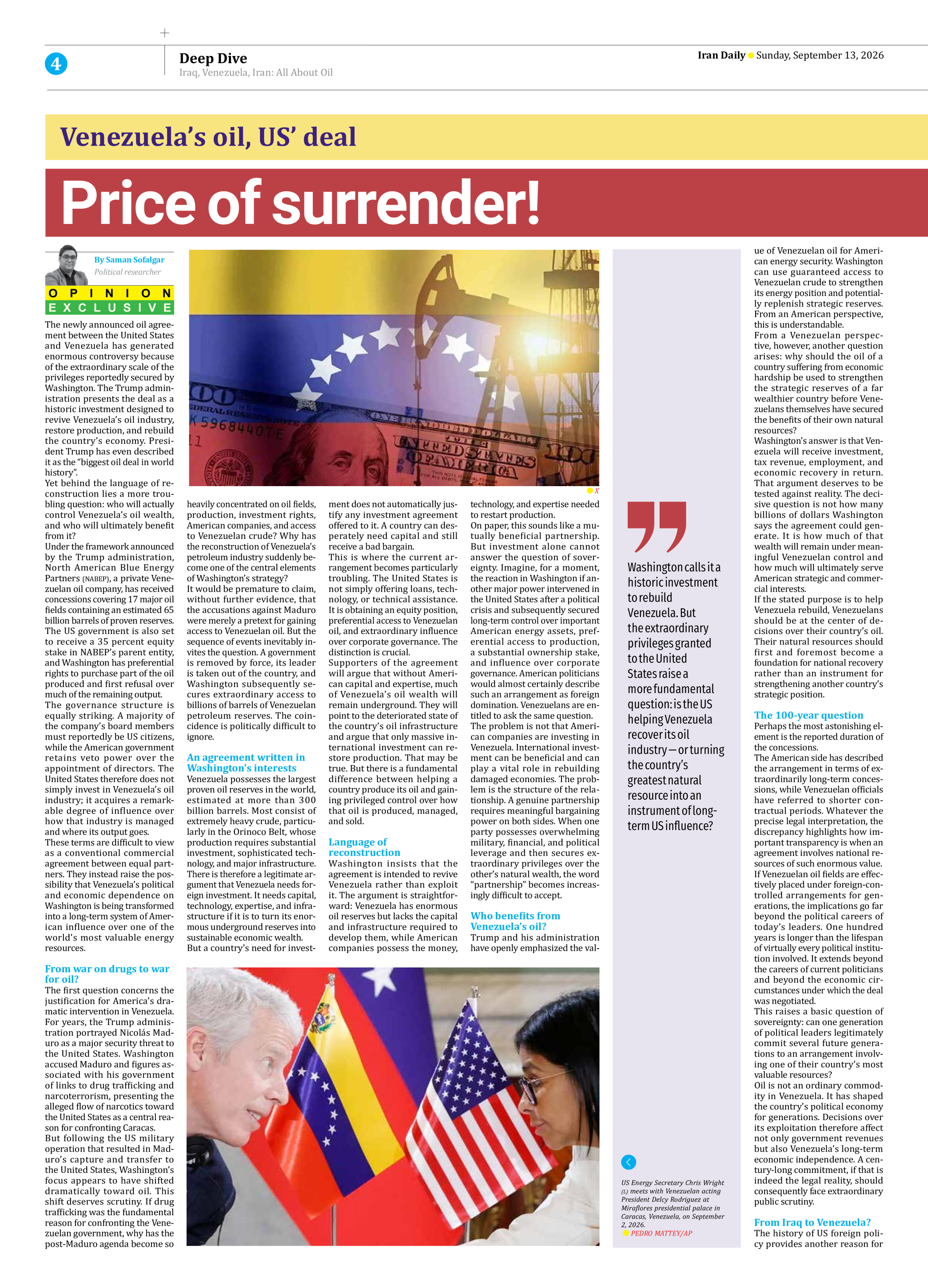


Venezuela’s oil, US’ deal
Price of surrender!
By Saman Sofalgar
Political researcher
The newly announced oil agreement between the United States and Venezuela has generated enormous controversy because of the extraordinary scale of the privileges reportedly secured by Washington. The Trump administration presents the deal as a historic investment designed to revive Venezuela’s oil industry, restore production, and rebuild the country’s economy. President Trump has even described it as the “biggest oil deal in world history”.
Yet behind the language of reconstruction lies a more troubling question: who will actually control Venezuela’s oil wealth, and who will ultimately benefit from it?
Under the framework announced by the Trump administration, North American Blue Energy Partners (NABEP), a private Venezuelan oil company, has received concessions covering 17 major oil fields containing an estimated 65 billion barrels of proven reserves. The US government is also set to receive a 35 percent equity stake in NABEP’s parent entity, and Washington has preferential rights to purchase part of the oil produced and first refusal over much of the remaining output.
The governance structure is equally striking. A majority of the company’s board members must reportedly be US citizens, while the American government retains veto power over the appointment of directors. The United States therefore does not simply invest in Venezuela’s oil industry; it acquires a remarkable degree of influence over how that industry is managed and where its output goes.
These terms are difficult to view as a conventional commercial agreement between equal partners. They instead raise the possibility that Venezuela’s political and economic dependence on Washington is being transformed into a long-term system of American influence over one of the world’s most valuable energy resources.
From war on drugs to war for oil?
The first question concerns the justification for America’s dramatic intervention in Venezuela. For years, the Trump administration portrayed Nicolás Maduro as a major security threat to the United States. Washington accused Maduro and figures associated with his government of links to drug trafficking and narcoterrorism, presenting the alleged flow of narcotics toward the United States as a central reason for confronting Caracas.
But following the US military operation that resulted in Maduro’s capture and transfer to the United States, Washington’s focus appears to have shifted dramatically toward oil. This shift deserves scrutiny. If drug trafficking was the fundamental reason for confronting the Venezuelan government, why has the post-Maduro agenda become so heavily concentrated on oil fields, production, investment rights, American companies, and access to Venezuelan crude? Why has the reconstruction of Venezuela’s petroleum industry suddenly become one of the central elements of Washington’s strategy?
It would be premature to claim, without further evidence, that the accusations against Maduro were merely a pretext for gaining access to Venezuelan oil. But the sequence of events inevitably invites the question. A government is removed by force, its leader is taken out of the country, and Washington subsequently secures extraordinary access to billions of barrels of Venezuelan petroleum reserves. The coincidence is politically difficult to ignore.
An agreement written in Washington’s interests
Venezuela possesses the largest proven oil reserves in the world, estimated at more than 300 billion barrels. Most consist of extremely heavy crude, particularly in the Orinoco Belt, whose production requires substantial investment, sophisticated technology, and major infrastructure.
There is therefore a legitimate argument that Venezuela needs foreign investment. It needs capital, technology, expertise, and infrastructure if it is to turn its enormous underground reserves into sustainable economic wealth.
But a country’s need for investment does not automatically justify any investment agreement offered to it. A country can desperately need capital and still receive a bad bargain.
This is where the current arrangement becomes particularly troubling. The United States is not simply offering loans, technology, or technical assistance. It is obtaining an equity position, preferential access to Venezuelan oil, and extraordinary influence over corporate governance. The distinction is crucial.
Supporters of the agreement will argue that without American capital and expertise, much of Venezuela’s oil wealth will remain underground. They will point to the deteriorated state of the country’s oil infrastructure and argue that only massive international investment can restore production. That may be true. But there is a fundamental difference between helping a country produce its oil and gaining privileged control over how that oil is produced, managed, and sold.
Language of reconstruction
Washington insists that the agreement is intended to revive Venezuela rather than exploit it. The argument is straightforward: Venezuela has enormous oil reserves but lacks the capital and infrastructure required to develop them, while American companies possess the money, technology, and expertise needed to restart production.
On paper, this sounds like a mutually beneficial partnership. But investment alone cannot answer the question of sovereignty. Imagine, for a moment, the reaction in Washington if another major power intervened in the United States after a political crisis and subsequently secured long-term control over important American energy assets, preferential access to production, a substantial ownership stake, and influence over corporate governance. American politicians would almost certainly describe such an arrangement as foreign domination. Venezuelans are entitled to ask the same question.
The problem is not that American companies are investing in Venezuela. International investment can be beneficial and can play a vital role in rebuilding damaged economies. The problem is the structure of the relationship. A genuine partnership requires meaningful bargaining power on both sides. When one party possesses overwhelming military, financial, and political leverage and then secures extraordinary privileges over the other’s natural wealth, the word “partnership” becomes increasingly difficult to accept.
Who benefits from Venezuela’s oil?
Trump and his administration have openly emphasized the value of Venezuelan oil for American energy security. Washington can use guaranteed access to Venezuelan crude to strengthen its energy position and potentially replenish strategic reserves. From an American perspective, this is understandable.
From a Venezuelan perspective, however, another question arises: why should the oil of a country suffering from economic hardship be used to strengthen the strategic reserves of a far wealthier country before Venezuelans themselves have secured the benefits of their own natural resources?
Washington’s answer is that Venezuela will receive investment, tax revenue, employment, and economic recovery in return. That argument deserves to be tested against reality. The decisive question is not how many billions of dollars Washington says the agreement could generate. It is how much of that wealth will remain under meaningful Venezuelan control and how much will ultimately serve American strategic and commercial interests.
If the stated purpose is to help Venezuela rebuild, Venezuelans should be at the center of decisions over their country’s oil. Their natural resources should first and foremost become a foundation for national recovery rather than an instrument for strengthening another country’s strategic position.
The 100-year question
Perhaps the most astonishing element is the reported duration of the concessions.
The American side has described the arrangement in terms of extraordinarily long-term concessions, while Venezuelan officials have referred to shorter contractual periods. Whatever the precise legal interpretation, the discrepancy highlights how important transparency is when an agreement involves national resources of such enormous value.
If Venezuelan oil fields are effectively placed under foreign-controlled arrangements for generations, the implications go far beyond the political careers of today’s leaders. One hundred years is longer than the lifespan of virtually every political institution involved. It extends beyond the careers of current politicians and beyond the economic circumstances under which the deal was negotiated.
This raises a basic question of sovereignty: can one generation of political leaders legitimately commit several future generations to an arrangement involving one of their country’s most valuable resources?
Oil is not an ordinary commodity in Venezuela. It has shaped the country’s political economy for generations. Decisions over its exploitation therefore affect not only government revenues but also Venezuela’s long-term economic independence. A century-long commitment, if that is indeed the legal reality, should consequently face extraordinary public scrutiny.
From Iraq to Venezuela?
The history of US foreign policy provides another reason for caution whenever military intervention, political transformation, and natural resources become intertwined.
Washington will argue that Venezuela is different. It will point to Maduro’s style of governance, the collapse of the Venezuelan economy, and the need to attract international capital. But neither should the broader historical pattern be ignored.
The United States has repeatedly presented foreign interventions in the language of security, democracy, stability, or humanitarian necessity. Yet strategic and economic interests have often existed alongside those stated objectives.
Iraq remains one of the clearest examples of why the international community should be cautious when military intervention and strategic resources become intertwined. Venezuela is obviously a different case, and simplistic comparisons should be avoided. But the broader lesson remains relevant: when a powerful country intervenes in a weaker state and subsequently obtains extraordinary economic privileges there, questions about motive are inevitable.
The real test
There is one relatively simple way to determine whether this is genuinely a reconstruction agreement or a modern form of resource domination: follow the money.
If Venezuelans receive transparent and substantial benefits; if oil revenues are invested in infrastructure, education, healthcare, and productive capacity; if the country retains meaningful sovereign control over its natural resources; if contracts are subject to public scrutiny; and if future Venezuelan governments retain genuine legal authority over their oil industry, Washington will have a credible argument that the agreement is a reconstruction project rather than a resource grab.
But if Venezuela becomes dependent on American companies and institutions for access to its own oil wealth, while Washington retains preferential purchasing rights, corporate influence, and long-term control, history may judge the agreement very differently.
The fundamental issue is therefore not whether Venezuela needs American investment. It does. The fundamental issue is whether that investment must come at the price of sovereignty. A country emerging from political crisis and economic collapse is particularly vulnerable to unequal bargains. That makes transparency, democratic legitimacy, and independent legal review more important, not less. The United States has every right to pursue its national interests. Venezuela has the same right.
That is precisely why this agreement deserves close international scrutiny. If Washington genuinely intends to help Venezuela rebuild, it should have nothing to fear from a transparent arrangement in which Venezuelans can clearly see what they are giving away, what they are receiving in return, and who will control their oil in the decades ahead.
Otherwise, the language of partnership risks becoming little more than a polite description of power exercised by the stronger party over the weaker one. Venezuela does not merely need more oil production. It needs the ability to determine what its oil means for the future of its own people.
A highway, a factory, or an oil field can generate wealth. But sovereignty determines who gets to decide how that wealth is used. And that may ultimately be the real question behind the US’ historic oil deal with Venezuela: is Washington helping Venezuela recover its wealth, or is Venezuela being asked to surrender control of it in exchange for the promise of recovery?