







Aviation chief warns ICAO of US sanctions impact on global air transport
The head of Iran’s Civil Aviation Organization warned the International Civil Aviation Organization (ICAO) that continued sanctions on the country’s aviation sector could have consequences for regional and international air transport, saying civil aviation should not be used as a tool of political and economic pressure.
The statement, reported by ISNA on Saturday, followed US sanctions on 27 Iranian airlines last week.
Abouzar Shiroudi called on the ICAO to urgently address the serious and continuing consequences of US restrictive and extraterritorial measures against Iran’s civil aviation sector.
He said pressure on Iran’s aviation industry had intensified, adding that following the failure of the United States and Israel to achieve their objectives during the wars of 2025 and 2026, pressure had expanded to Iran’s civil aviation sector.
He said all Iranian airlines were targeted by sanctions on Sept. 8, 2026.
Shiroudi said such measures ran counter to the objectives and principles set out in the preamble to the 1944 Chicago Convention on International Civil Aviation, which describes the future development of international civil aviation as a means of creating and preserving friendship and understanding among nations and peoples.
He also warned that the misuse of civil aviation could become a threat to public safety.
Shiroudi said the measures against Iran’s aviation sector also posed a serious obstacle to achieving the central objective of the ICAO’s 2026-2050 strategic plan, “No Country Left Behind,” saying there was a significant gap between that goal and the situation in countries facing such restrictions.
He further warned that military attacks on Iran’s civil aviation, alongside unilateral sanctions, had consequences extending beyond the country’s borders, including restrictions on airspace, disruptions to flight operations, increased diversions and operating costs, and reduced access to essential aviation equipment and services.
Seven Iranian airports were targeted during the 40-day US-Israeli war that began in late February, with the attacks focusing more on tourism, passenger and cargo infrastructure than on military facilities.
On Tuesday, the US Treasury Department imposed additional sanctions on 27 Iranian airlines as part of a new sanctions package unveiled on Aug. 24, which threatens secondary penalties against countries or entities maintaining trade ties with Tehran. The Treasury said the measures also target 35 companies and one individual, including foreign intermediaries linked to Iranian airlines in Turkey, Malaysia, Kazakhstan and the UAE. The sanctions could affect companies involved in financing, servicing and the international operation of Iran’s air transport sector in addition to the airlines themselves.
Shiroudi said on Wednesday that the US measures could increase operating and procurement costs but would not bring Iran’s flight operations to a halt.
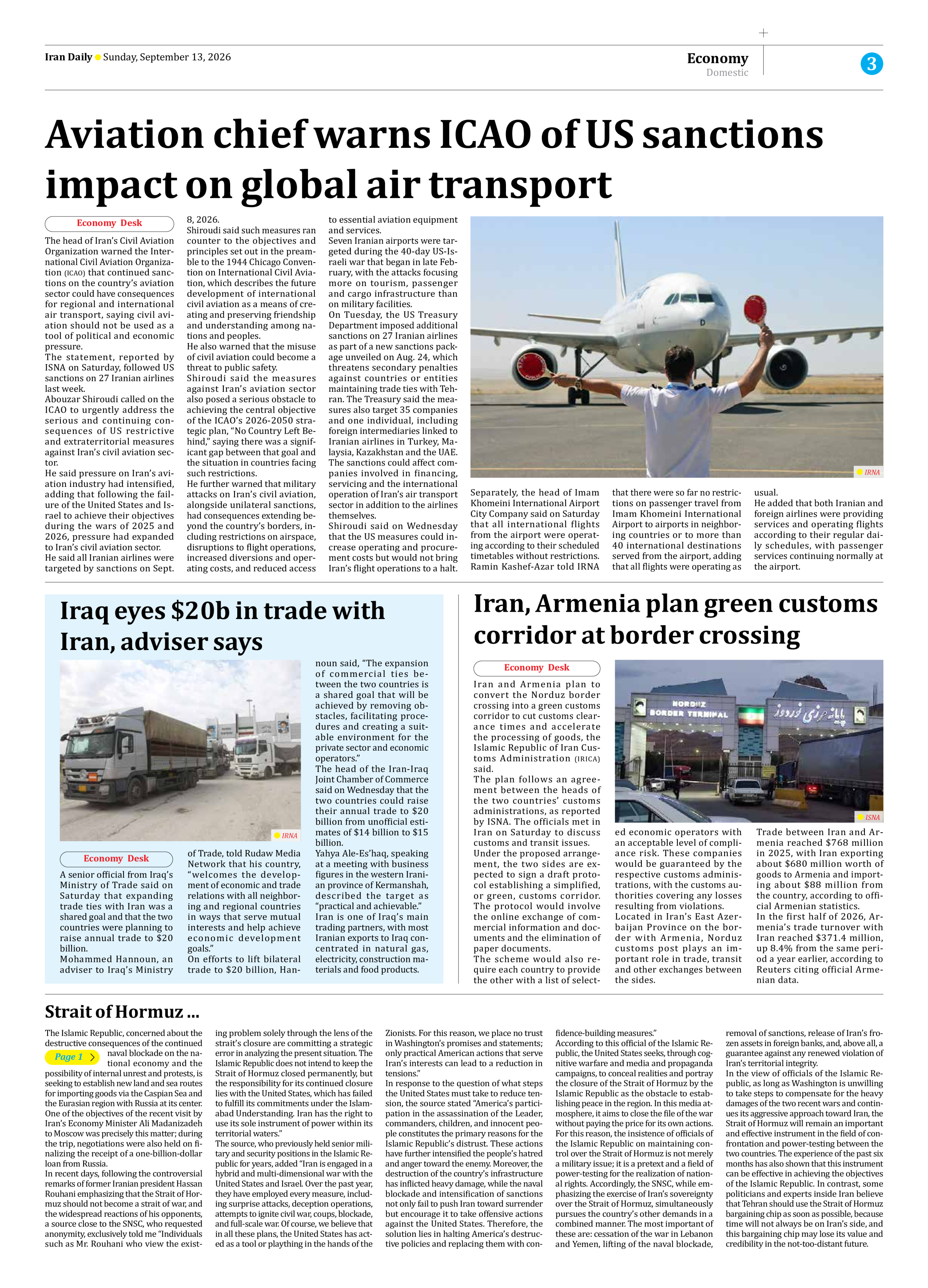
Separately, the head of Imam Khomeini International Airport City Company said on Saturday that all international flights from the airport were operating according to their scheduled timetables without restrictions.
Ramin Kashef-Azar told IRNA that there were so far no restrictions on passenger travel from Imam Khomeini International Airport to airports in neighboring countries or to more than 40 international destinations served from the airport, adding that all flights were operating as usual.
He added that both Iranian and foreign airlines were providing services and operating flights according to their regular daily schedules, with passenger services continuing normally at the airport.