







From UCL nights to fading fortunes in Asia:
How Iranian football lost its European pedigree
As the new UEFA Champions League season kicked off across Europe on Tuesday, football fans in Iran were confronted with a harsh reality: for the first time since the 2017/18 campaign, no Iranian player is involved in the continent’s most prestigious club competition.
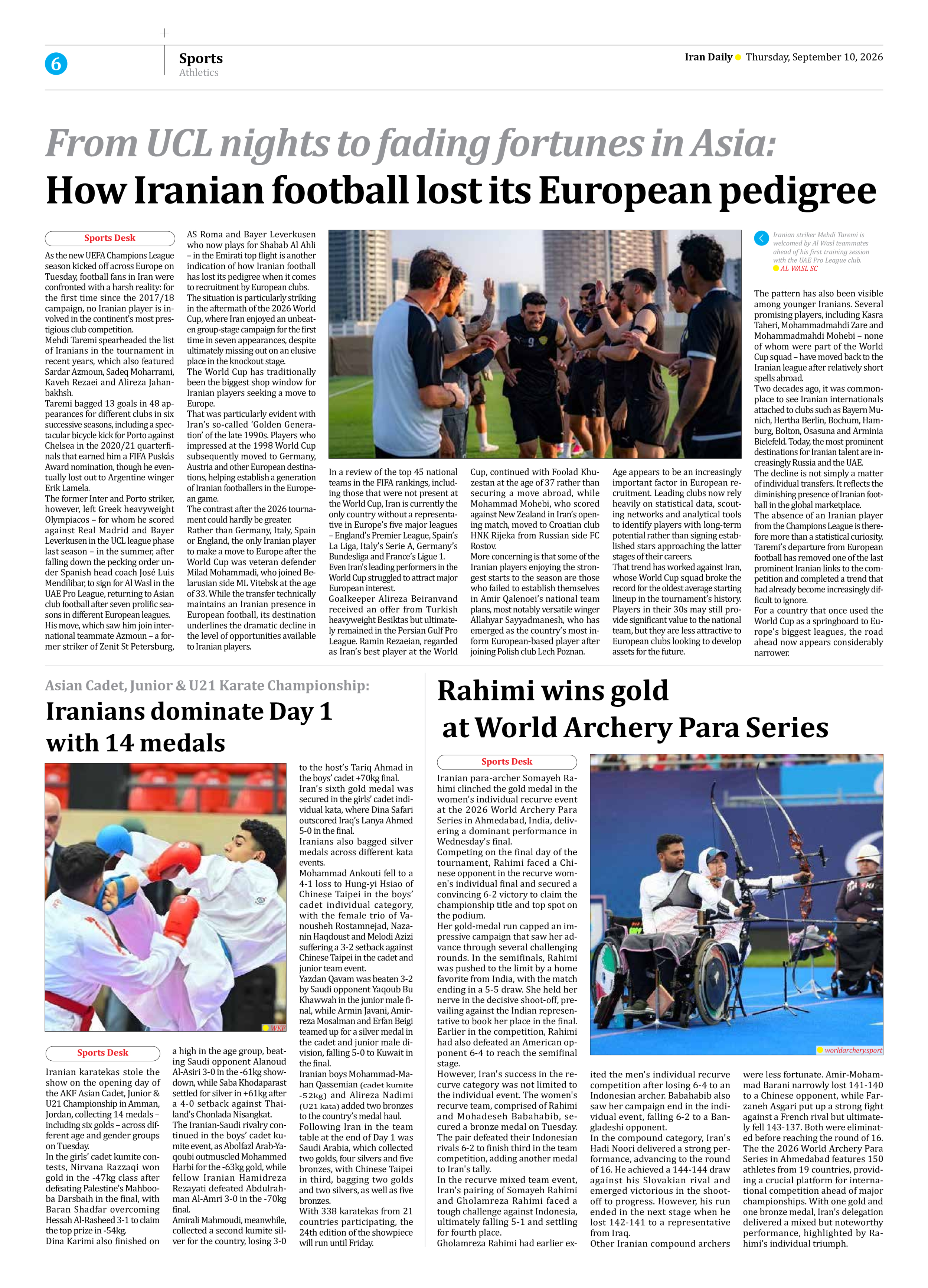
Mehdi Taremi spearheaded the list of Iranians in the tournament in recent years, which also featured Sardar Azmoun, Sadeq Moharrami, Kaveh Rezaei and Alireza Jahanbakhsh.
Taremi bagged 13 goals in 48 appearances for different clubs in six successive seasons, including a spectacular bicycle kick for Porto against Chelsea in the 2020/21 quarterfinals that earned him a FIFA Puskás Award nomination, though he eventually lost out to Argentine winger Erik Lamela.
The former Inter and Porto striker, however, left Greek heavyweight Olympiacos – for whom he scored against Real Madrid and Bayer Leverkusen in the UCL league phase last season – in the summer, after falling down the pecking order under Spanish head coach José Luis Mendilibar, to sign for Al Wasl in the UAE Pro League, returning to Asian club football after seven prolific seasons in different European leagues.
His move, which saw him join international teammate Azmoun – a former striker of Zenit St Petersburg, AS Roma and Bayer Leverkusen who now plays for Shabab Al Ahli – in the Emirati top flight is another indication of how Iranian football has lost its pedigree when it comes to recruitment by European clubs.
The situation is particularly striking in the aftermath of the 2026 World Cup, where Iran enjoyed an unbeaten group-stage campaign for the first time in seven appearances, despite ultimately missing out on an elusive place in the knockout stage.
The World Cup has traditionally been the biggest shop window for Iranian players seeking a move to Europe.
That was particularly evident with Iran’s so-called ‘Golden Generation’ of the late 1990s. Players who impressed at the 1998 World Cup subsequently moved to Germany, Austria and other European destinations, helping establish a generation of Iranian footballers in the European game.
The contrast after the 2026 tournament could hardly be greater.
Rather than Germany, Italy, Spain or England, the only Iranian player to make a move to Europe after the World Cup was veteran defender Milad Mohammadi, who joined Belarusian side ML Vitebsk at the age of 33. While the transfer technically maintains an Iranian presence in European football, its destination underlines the dramatic decline in the level of opportunities available to Iranian players.
In a review of the top 45 national teams in the FIFA rankings, including those that were not present at the World Cup, Iran is currently the only country without a representative in Europe’s five major leagues – England’s Premier League, Spain’s La Liga, Italy’s Serie A, Germany’s Bundesliga and France’s Ligue 1.
Even Iran’s leading performers in the World Cup struggled to attract major European interest.
Goalkeeper Alireza Beiranvand received an offer from Turkish heavyweight Besiktas but ultimately remained in the Persian Gulf Pro League. Ramin Rezaeian, regarded as Iran’s best player at the World Cup, continued with Foolad Khuzestan at the age of 37 rather than securing a move abroad, while Mohammad Mohebi, who scored against New Zealand in Iran’s opening match, moved to Croatian club HNK Rijeka from Russian side FC Rostov.
More concerning is that some of the Iranian players enjoying the strongest starts to the season are those who failed to establish themselves in Amir Qalenoei’s national team plans, most notably versatile winger Allahyar Sayyadmanesh, who has emerged as the country’s most in-form European-based player after joining Polish club Lech Poznan.
Age appears to be an increasingly important factor in European recruitment. Leading clubs now rely heavily on statistical data, scouting networks and analytical tools to identify players with long-term potential rather than signing established stars approaching the latter stages of their careers.
That trend has worked against Iran, whose World Cup squad broke the record for the oldest average starting lineup in the tournament’s history. Players in their 30s may still provide significant value to the national team, but they are less attractive to European clubs looking to develop assets for the future.
The pattern has also been visible among younger Iranians. Several promising players, including Kasra Taheri, Mohammadmahdi Zare and Mohammadmahdi Mohebi – none of whom were part of the World Cup squad – have moved back to the Iranian league after relatively short spells abroad.
Two decades ago, it was commonplace to see Iranian internationals attached to clubs such as Bayern Munich, Hertha Berlin, Bochum, Hamburg, Bolton, Osasuna and Arminia Bielefeld. Today, the most prominent destinations for Iranian talent are increasingly Russia and the UAE.
The decline is not simply a matter of individual transfers. It reflects the diminishing presence of Iranian football in the global marketplace.
The absence of an Iranian player from the Champions League is therefore more than a statistical curiosity. Taremi’s departure from European football has removed one of the last prominent Iranian links to the competition and completed a trend that had already become increasingly difficult to ignore.
For a country that once used the World Cup as a springboard to Europe’s biggest leagues, the road ahead now appears considerably narrower.