







Nepal’s latest disaster signals a need to redesign monitoring, early warning systems
By Austin Lord
Senior fellow in the Stimson Center
On August 26, 2026, a massive volume of bedrock and glacial ice broke loose 5,200 meters above sea level on the north side of Nepal’s Langtang range, triggering a “rock-ice avalanche” that crashed into the Lhende River on the Nepal-China border fueling the deadliest extreme flow disaster on record in the country. This cascade barreled downstream at an average of ~160 kilometers per hour downstream toward the Nepal-China border. It slammed into and overwhelmed Chinese border facilities at Rasuwagadhi just 7.5 minutes after the mountain gave way, then tore across the border and down the Bhotekoshi/Trishuli River corridor into Nepal, swallowing towns and causing extensive damage over 100 kilometers from its source.
As of 2:00pm ET on September 3, a total of 1,259 people were confirmed dead and over 5,000 people were still reported missing. These numbers include Nepalis living and working along the river corridor, hundreds of foreign tourists visiting the Langtang region and pilgrims crossing to Mount Kailash, and hundreds of hydropower workers trapped in tunnels. The border town of Timure and the market hub of Syaphrubesi were essentially wiped away; 19 bridges and 40 kilometers of highway are gone, and more than 430 megawatts of hydropower capacity, representing more than 10% of Nepal’s national supply, went offline.
The residents of Nepal’s Rasuwa district, which includes a large Tamang population, have lived with disaster risk (e.g. floods, landslides, earthquakes, and avalanches) for centuries and they have adapted to and managed these risks. But the risks are changing fast, and the level of exposure communities face today is unprecedented.
I say this, having spent nearly 14 years conducting research in this river basin (in all of the affected settlements in Rasuwa), having led post-disaster relief activities in many of these towns after the 2015 Gorkha earthquake, and having personally survived a massive glacier avalanche on the other side of the very same mountain, which led to years of research and direct engagement. None of this is abstract to me, and my heart breaks for Rasuwa again.
A cascade, not a rainfall disaster
This catastrophic event happened on a clear day. Unlike many of Nepal’s recent disasters, it wasn’t triggered by extreme rainfall or an earthquake, and surprisingly, given the volume of water, there wasn’t a lake involved. Post-event analysis points to an unexpected culprit: the sheer force of the rock-ice avalanche that became more flood-like as it gathered water, rock, and sediment and funneled through the Trishuli’s tight canyons, arriving downstream as a fast-moving wall of concrete. This was a single, continuous, cascading extreme flow event.
Scientists are still working to establish whether climate change played a role in destabilizing the source area, and formal processes of evaluating attribution are now underway. But the frequency of extreme flow events in recent years suggests that climate change is destabilizing the mountain cryosphere across the Himalayan region. Simply put, warming and climatic volatility can impact glaciers, weaken permafrost, and drive rapid or unseasonal changes in snowpack. In Nepal, climate-related risks interact with monsoon dynamics and seismic risk to compound danger in ways that existing monitoring frameworks aren’t built to see.
This event joins a grim and growing list of Himalayan cascading disasters — the 2021 Chamoli flood, the 2021 Melamchi disaster, the 2023 South Lhonak GLOF (Glacial Lake Outburst Flow), and the 2025 Blatten collapse in Switzerland. Notably, a smaller glacial flood struck this exact watershed in July 2025, destroying the same border bridge and killing 19 people — a warning sign that didn’t translate into readiness for what came next.
Of blind spots and needles in haystacks
It would be wrong to read this as a failure of Nepal’s early warning systems. The source area sits in a genuine gap — a narrow sliver of unpopulated Nepali territory that drains north into China, falling between the scientific attention long focused on the south side of the Langtang range and the Chinese monitoring effort that intensified after last year’s flood. Nepal’s gauge and station networks were built to catch monsoon floods and glacial lake outbursts, not a catastrophic flow that outran any possible alert. But generating alerts for an event like this isn’t just a problem of data scarcity or blind spots, it’s also a problem of speed and scale. The Himalaya has more slopes capable of failing this catastrophically, across more vertical relief, than anywhere else on Earth. Scientists can and have highlighted a variety of high-risk areas and landforms, but finding subtle changes in a timely fashion requires skillfully separating signal from noise as risk changes across the Himalaya.
The overall point is that experts need a signal to effectively direct their tools and attention — and finding these signals can often feel like finding needles in Himalaya haystacks. Of roughly a dozen extreme flow events in the region over the past decade, only one — the 2023 South Lhonak outburst — struck a site already flagged as risky. Every other event originated from somewhere no one was watching, including this one.
Learning from disasters like this
Each event offers lessons and insights that allow us to return with greater precision and a new understanding of where similar hazard chains might be stacking up. For example, the 2024 Thame (GLOF) taught researchers that small glacial lakes can grow dangerously fast; last year’s transboundary flood event along the same Lhende River into Rasuwa showed that supraglacial lakes — lakes on top of glaciers — can expand and drain catastrophically. This recent event highlights the increasing prevalence of another kind of risk: showing how an ice-rock avalanche can trigger a massive flood-like event and impact communities more than 100 kilometers downstream.
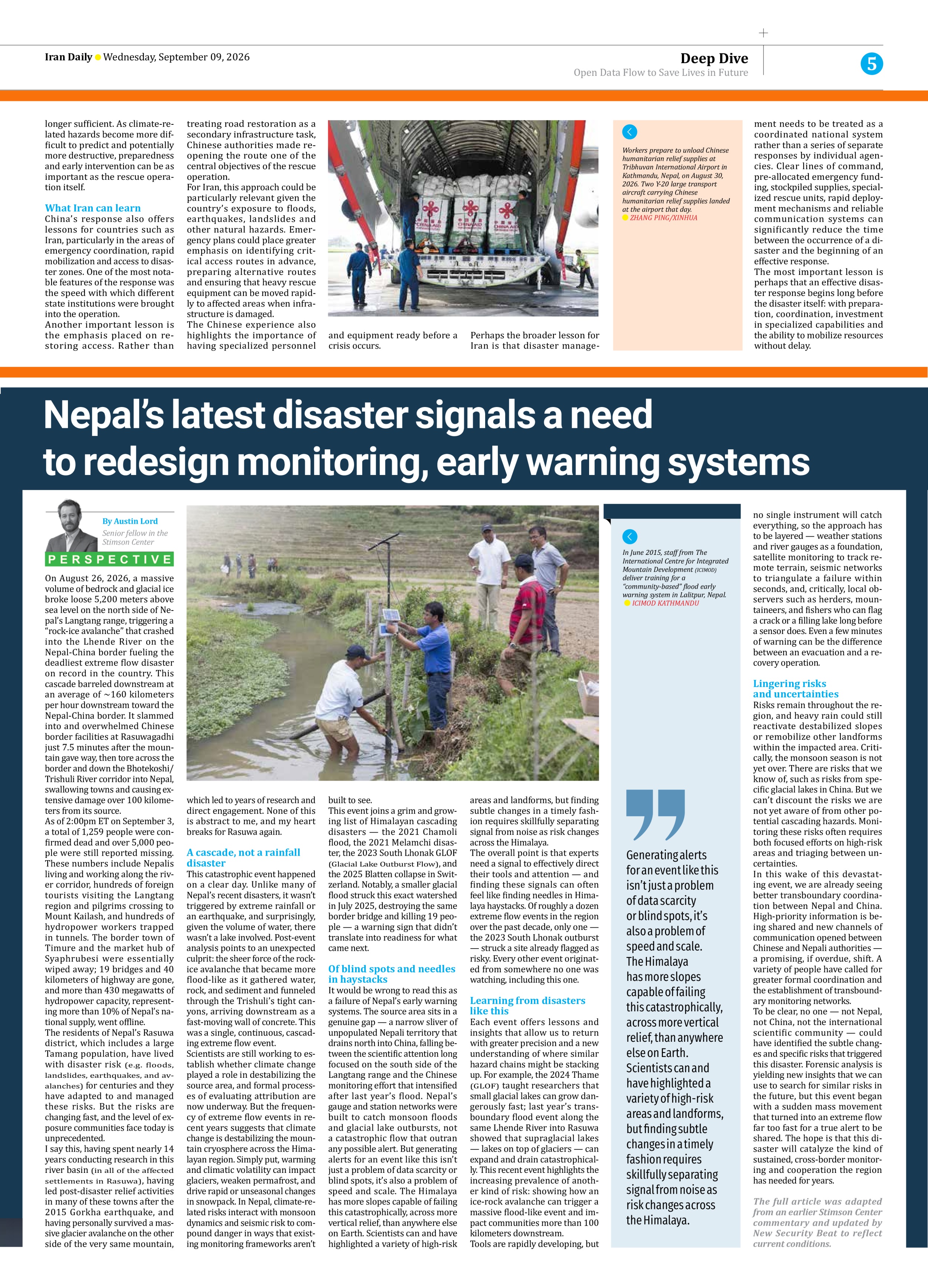
Tools are rapidly developing, but no single instrument will catch everything, so the approach has to be layered — weather stations and river gauges as a foundation, satellite monitoring to track remote terrain, seismic networks to triangulate a failure within seconds, and, critically, local observers such as herders, mountaineers, and fishers who can flag a crack or a filling lake long before a sensor does. Even a few minutes of warning can be the difference between an evacuation and a recovery operation.
Lingering risks
and uncertainties
Risks remain throughout the region, and heavy rain could still reactivate destabilized slopes or remobilize other landforms within the impacted area. Critically, the monsoon season is not yet over. There are risks that we know of, such as risks from specific glacial lakes in China. But we can’t discount the risks we are not yet aware of from other potential cascading hazards. Monitoring these risks often requires both focused efforts on high-risk areas and triaging between uncertainties.
In this wake of this devastating event, we are already seeing better transboundary coordination between Nepal and China. High-priority information is being shared and new channels of communication opened between Chinese and Nepali authorities — a promising, if overdue, shift. A variety of people have called for greater formal coordination and the establishment of transboundary monitoring networks.
To be clear, no one — not Nepal, not China, not the international scientific community — could have identified the subtle changes and specific risks that triggered this disaster. Forensic analysis is yielding new insights that we can use to search for similar risks in the future, but this event began with a sudden mass movement that turned into an extreme flow far too fast for a true alert to be shared. The hope is that this disaster will catalyze the kind of sustained, cross-border monitoring and cooperation the region has needed for years.
The full article was adapted from an earlier Stimson Center commentary and updated by New Security Beat to reflect
current conditions.