







China’s response to Himalayan disaster
Lessons for Iran
By Delaram Ahmadi
Staff writer
On August 26, 2026, a catastrophic glacier collapse and subsequent ice-rock avalanche and debris flow struck the Nepal-China border region, causing immense destruction and a staggering humanitarian crisis, often described as a “Himalayan tsunami”.
The debris flow, or mudslide, surged 22 kilometers in just seven minutes, washing away almost everything in its path.
The primary cause was a high-altitude glacier collapse on the Nepalese side, which sent a devastating mix of ice, rock and debris downstream into the Bhotekoshi and Trishuli rivers.
Rescue operations were severely hampered by the treacherous terrain and persistent rain.
The disaster received extensive coverage in media outlets around the world, as such devastating events often do. Reports used poignant images to evoke an emotional response from audiences, including a picture of a toy rabbit beside the river of debris, seemingly waiting for its young owner to return.
But the question is: has the disaster relief effort received the same level of coverage?
The following is a detailed account of how the Chinese side responded to the disaster, examining both the strengths of its response and areas that warrant further attention.
Rapid mobilization
and emergency response
On the first day, shortly after the disaster was reported, China’s National Commission for Disaster Prevention, Mitigation and Relief and the Ministry of Emergency Management jointly activated the national Level II emergency response for disaster relief.
Rescue forces were dispatched to the disaster area, with the first group comprising 249 firefighters and rescue workers, along with 325 engineering rescue personnel who arrived at the scene with equipment.
By 8 p.m. that evening, a total of 601 firefighters and rescue workers had been deployed.
A total of 31 experts from relevant fields and multiple institutions were also mobilized to assist with rescue operations.
Skipping lengthy administrative procedures, the Ministry of Finance and the Ministry of Emergency Management urgently pre-allocated 120 million yuan ($17.6 million) from the central natural disaster relief fund.
Some 30,000 items of central emergency supplies, including tents, heating stoves, clothing and bedding, folding beds and moisture-proof mats, were also allocated.
Technical support was provided as well, including instant communications and magnetic exploration equipment.
Frontline command headquarters were established at different levels — national, provincial and county — including one in the Tibet Autonomous Region, headed by its chairman, Gama Zedeng.
On August 27, the second day, Premier Li Qiang inspected the disaster zone and directed rescue efforts.
On the third day, the Political Bureau of the Communist Party of China held a meeting chaired by President Xi Jinping to map out rescue efforts for the Gyirong debris-flow disaster.
Journalists were initially not allowed to enter the region because of dangerous conditions, risks to life and the potential for secondary disasters. Reporters were advised to rely on CGTN Live for updates. However, a press conference was eventually held on September 2 to brief journalists on the situation.
Later, after the G216 road was reopened and electricity was restored, China announced plans to organize visits for international journalists to the core disaster area.
Rescue operations
and restoring access
The operations focused on four major goals: searching for and rescuing missing people; making every effort to restore the G216 land route, effectively the only land access route to Gyirong Port; providing the families of victims with the utmost care, empathy and thorough support; and strictly guarding against secondary disasters.
When the landslide destroyed sections of G216 on August 26, the disaster area was cut off by road, seriously hampering rescue operations.
While the road remained blocked, China had to airlift supplies and equipment, while rescuers faced difficulties reaching the site.
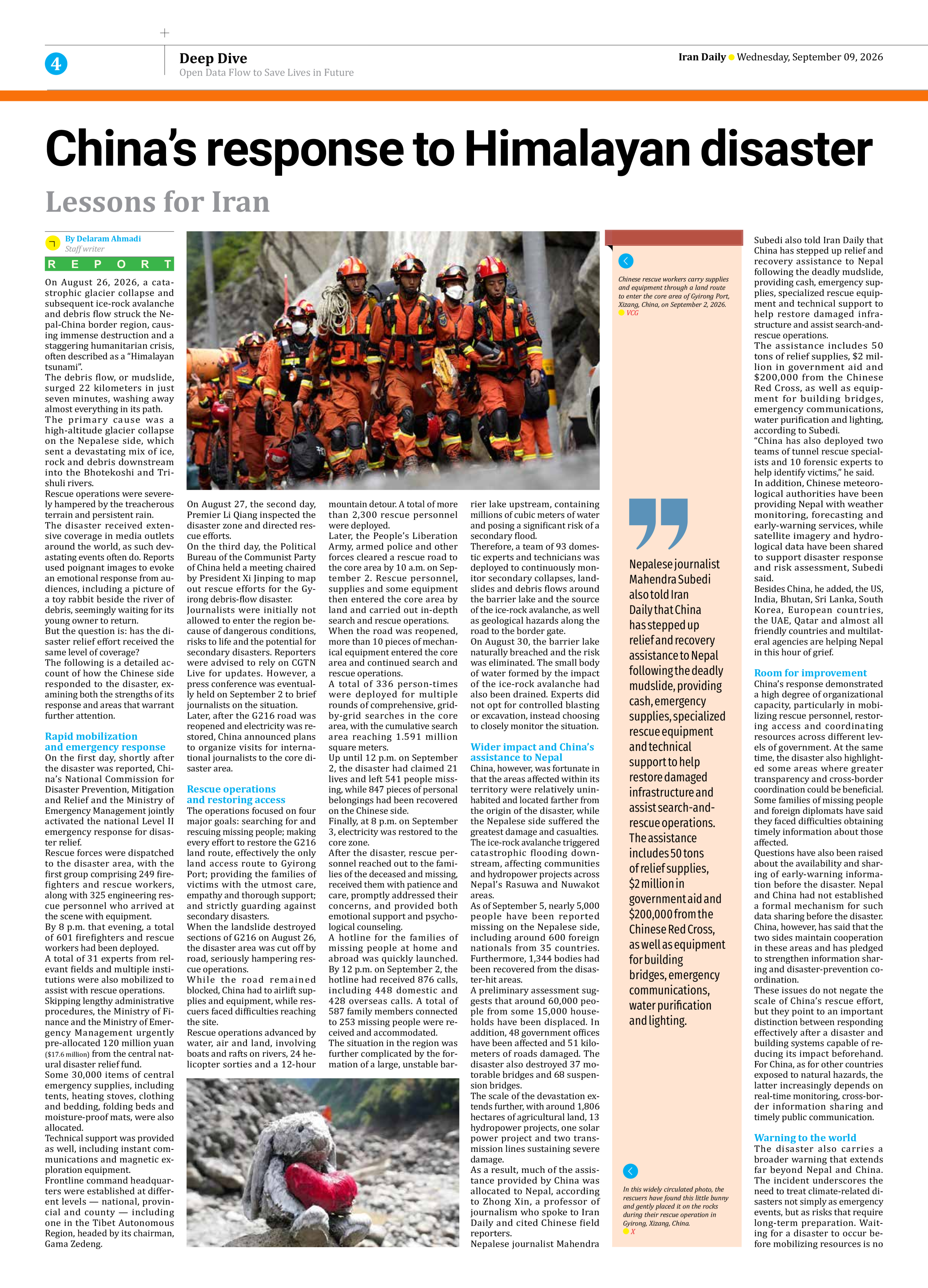
Rescue operations advanced by water, air and land, involving boats and rafts on rivers, 24 helicopter sorties and a 12-hour mountain detour. A total of more than 2,300 rescue personnel were deployed.
Later, the People’s Liberation Army, armed police and other forces cleared a rescue road to the core area by 10 a.m. on September 2. Rescue personnel, supplies and some equipment then entered the core area by land and carried out in-depth search and rescue operations.
When the road was reopened, more than 10 pieces of mechanical equipment entered the core area and continued search and rescue operations.
A total of 336 person-times were deployed for multiple rounds of comprehensive, grid-by-grid searches in the core area, with the cumulative search area reaching 1.591 million square meters.
Up until 12 p.m. on September 2, the disaster had claimed 21 lives and left 541 people missing, while 847 pieces of personal belongings had been recovered on the Chinese side.
Finally, at 8 p.m. on September 3, electricity was restored to the core zone.
After the disaster, rescue personnel reached out to the families of the deceased and missing, received them with patience and care, promptly addressed their concerns, and provided both emotional support and psychological counseling.
A hotline for the families of missing people at home and abroad was quickly launched. By 12 p.m. on September 2, the hotline had received 876 calls, including 448 domestic and 428 overseas calls. A total of 587 family members connected to 253 missing people were received and accommodated.
The situation in the region was further complicated by the formation of a large, unstable barrier lake upstream, containing millions of cubic meters of water and posing a significant risk of a secondary flood.
Therefore, a team of 93 domestic experts and technicians was deployed to continuously monitor secondary collapses, landslides and debris flows around the barrier lake and the source of the ice-rock avalanche, as well as geological hazards along the road to the border gate.
On August 30, the barrier lake naturally breached and the risk was eliminated. The small body of water formed by the impact of the ice-rock avalanche had also been drained. Experts did not opt for controlled blasting or excavation, instead choosing to closely monitor the situation.
Wider impact and China’s assistance to Nepal
China, however, was fortunate in that the areas affected within its territory were relatively uninhabited and located farther from the origin of the disaster, while the Nepalese side suffered the greatest damage and casualties.
The ice-rock avalanche triggered catastrophic flooding downstream, affecting communities and hydropower projects across Nepal’s Rasuwa and Nuwakot areas.
As of September 5, nearly 5,000 people have been reported missing on the Nepalese side, including around 600 foreign nationals from 35 countries. Furthermore, 1,344 bodies had been recovered from the disaster-hit areas.
A preliminary assessment suggests that around 60,000 people from some 15,000 households have been displaced. In addition, 48 government offices have been affected and 51 kilometers of roads damaged. The disaster also destroyed 37 motorable bridges and 68 suspension bridges.
The scale of the devastation extends further, with around 1,806 hectares of agricultural land, 13 hydropower projects, one solar power project and two transmission lines sustaining severe damage.
As a result, much of the assistance provided by China was allocated to Nepal, according to Zhong Xin, a professor of journalism who spoke to Iran Daily and cited Chinese field reporters.
Nepalese journalist Mahendra Subedi also told Iran Daily that China has stepped up relief and recovery assistance to Nepal following the deadly mudslide, providing cash, emergency supplies, specialized rescue equipment and technical support to help restore damaged infrastructure and assist search-and-rescue operations.
The assistance includes 50 tons of relief supplies, $2 million in government aid and $200,000 from the Chinese Red Cross, as well as equipment for building bridges, emergency communications, water purification and lighting, according to Subedi.
“China has also deployed two teams of tunnel rescue specialists and 10 forensic experts to help identify victims,” he said.
In addition, Chinese meteorological authorities have been providing Nepal with weather monitoring, forecasting and early-warning services, while satellite imagery and hydrological data have been shared to support disaster response and risk assessment, Subedi said.
Besides China, he added, the US, India, Bhutan, Sri Lanka, South Korea, European countries, the UAE, Qatar and almost all friendly countries and multilateral agencies are helping Nepal in this hour of grief.
Room for improvement
China’s response demonstrated a high degree of organizational capacity, particularly in mobilizing rescue personnel, restoring access and coordinating resources across different levels of government. At the same time, the disaster also highlighted some areas where greater transparency and cross-border coordination could be beneficial.
Some families of missing people and foreign diplomats have said they faced difficulties obtaining timely information about those affected.
Questions have also been raised about the availability and sharing of early-warning information before the disaster. Nepal and China had not established a formal mechanism for such data sharing before the disaster. China, however, has said that the two sides maintain cooperation in these areas and has pledged to strengthen information sharing and disaster-prevention coordination.
These issues do not negate the scale of China’s rescue effort, but they point to an important distinction between responding effectively after a disaster and building systems capable of reducing its impact beforehand. For China, as for other countries exposed to natural hazards, the latter increasingly depends on real-time monitoring, cross-border information sharing and timely public communication.
Warning to the world
The disaster also carries a broader warning that extends far beyond Nepal and China. The incident underscores the need to treat climate-related disasters not simply as emergency events, but as risks that require long-term preparation. Waiting for a disaster to occur before mobilizing resources is no
longer sufficient. As climate-related hazards become more difficult to predict and potentially more destructive, preparedness and early intervention can be as important as the rescue operation itself.
What Iran can learn
China’s response also offers lessons for countries such as Iran, particularly in the areas of emergency coordination, rapid mobilization and access to disaster zones. One of the most notable features of the response was the speed with which different state institutions were brought into the operation.
Another important lesson is the emphasis placed on restoring access. Rather than treating road restoration as a secondary infrastructure task, Chinese authorities made reopening the route one of the central objectives of the rescue operation.
For Iran, this approach could be particularly relevant given the country’s exposure to floods, earthquakes, landslides and other natural hazards. Emergency plans could place greater emphasis on identifying critical access routes in advance, preparing alternative routes and ensuring that heavy rescue equipment can be moved rapidly to affected areas when infrastructure is damaged.
The Chinese experience also highlights the importance of having specialized personnel and equipment ready before a crisis occurs.
Perhaps the broader lesson for Iran is that disaster management needs to be treated as a coordinated national system rather than a series of separate responses by individual agencies. Clear lines of command, pre-allocated emergency funding, stockpiled supplies, specialized rescue units, rapid deployment mechanisms and reliable communication systems can significantly reduce the time between the occurrence of a disaster and the beginning of an effective response.
The most important lesson is perhaps that an effective disaster response begins long before the disaster itself: with preparation, coordination, investment in specialized capabilities and the ability to mobilize resources without delay.