





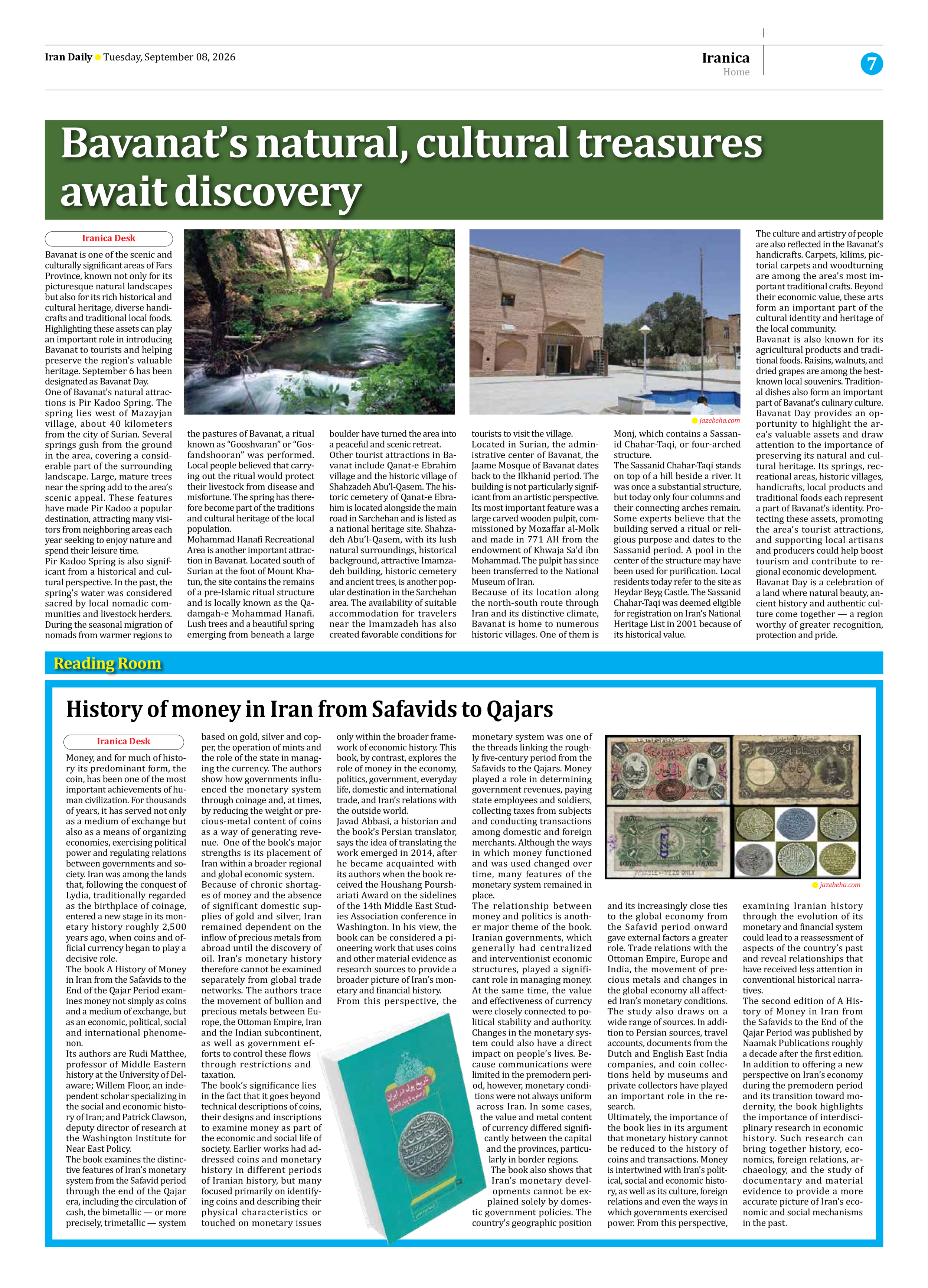


Bavanat’s natural, cultural treasures await discovery
Bavanat is one of the scenic and culturally significant areas of Fars Province, known not only for its picturesque natural landscapes but also for its rich historical and cultural heritage, diverse handicrafts and traditional local foods. Highlighting these assets can play an important role in introducing Bavanat to tourists and helping preserve the region’s valuable heritage. September 6 has been designated as Bavanat Day.
One of Bavanat’s natural attractions is Pir Kadoo Spring. The spring lies west of Mazayjan village, about 40 kilometers from the city of Surian. Several springs gush from the ground in the area, covering a considerable part of the surrounding landscape. Large, mature trees near the spring add to the area’s scenic appeal. These features have made Pir Kadoo a popular destination, attracting many visitors from neighboring areas each year seeking to enjoy nature and spend their leisure time.
Pir Kadoo Spring is also significant from a historical and cultural perspective. In the past, the spring’s water was considered sacred by local nomadic communities and livestock herders. During the seasonal migration of nomads from warmer regions to the pastures of Bavanat, a ritual known as “Gooshvaran” or “Gosfandshooran” was performed. Local people believed that carrying out the ritual would protect their livestock from disease and misfortune. The spring has therefore become part of the traditions and cultural heritage of the local population.
Mohammad Hanafi Recreational Area is another important attraction in Bavanat. Located south of Surian at the foot of Mount Khatun, the site contains the remains of a pre-Islamic ritual structure and is locally known as the Qadamgah-e Mohammad Hanafi. Lush trees and a beautiful spring emerging from beneath a large boulder have turned the area into a peaceful and scenic retreat.
Other tourist attractions in Bavanat include Qanat-e Ebrahim village and the historic village of Shahzadeh Abu’l-Qasem. The historic cemetery of Qanat-e Ebrahim is located alongside the main road in Sarchehan and is listed as a national heritage site. Shahzadeh Abu’l-Qasem, with its lush natural surroundings, historical background, attractive Imamzadeh building, historic cemetery and ancient trees, is another popular destination in the Sarchehan area. The availability of suitable accommodation for travelers near the Imamzadeh has also created favorable conditions for tourists to visit the village.
Located in Surian, the administrative center of Bavanat, the Jaame Mosque of Bavanat dates back to the Ilkhanid period. The building is not particularly significant from an artistic perspective. Its most important feature was a large carved wooden pulpit, commissioned by Mozaffar al-Molk and made in 771 AH from the endowment of Khwaja Sa’d ibn Mohammad. The pulpit has since been transferred to the National Museum of Iran.
Because of its location along the north-south route through Iran and its distinctive climate, Bavanat is home to numerous historic villages. One of them is Monj, which contains a Sassanid Chahar-Taqi, or four-arched structure.
The Sassanid Chahar-Taqi stands on top of a hill beside a river. It was once a substantial structure, but today only four columns and their connecting arches remain. Some experts believe that the building served a ritual or religious purpose and dates to the Sassanid period. A pool in the center of the structure may have been used for purification. Local residents today refer to the site as Heydar Beyg Castle. The Sassanid Chahar-Taqi was deemed eligible for registration on Iran’s National Heritage List in 2001 because of its historical value.
The culture and artistry of people are also reflected in the Bavanat’s handicrafts. Carpets, kilims, pictorial carpets and woodturning are among the area’s most important traditional crafts. Beyond their economic value, these arts form an important part of the cultural identity and heritage of the local community.
Bavanat is also known for its agricultural products and traditional foods. Raisins, walnuts, and dried grapes are among the best-known local souvenirs. Traditional dishes also form an important part of Bavanat’s culinary culture.
Bavanat Day provides an opportunity to highlight the area’s valuable assets and draw attention to the importance of preserving its natural and cultural heritage. Its springs, recreational areas, historic villages, handicrafts, local products and traditional foods each represent a part of Bavanat’s identity. Protecting these assets, promoting the area’s tourist attractions, and supporting local artisans and producers could help boost tourism and contribute to regional economic development.
Bavanat Day is a celebration of a land where natural beauty, ancient history and authentic culture come together — a region worthy of greater recognition, protection and pride.