







Economic cooperation, autonomy in SCO Bishkek Summit
The Bishkek SCO summit signals the member states’ effort to strengthen the organisation as an alternative centre of political and economic coordination in response to current international security and geopolitical pressures, including those associated with the West.
Leaders endorsed agreements and initiatives covering transport connectivity, energy security, economic cooperation, artificial intelligence and climate policy, indicating an attempt to expand the SCO’s role beyond security cooperation into wider economic and technological coordination.
However, divergent foreign-policy priorities, security interests and economic objectives among member states remain the main constraints on implementation and could limit the organisation’s ability to translate political commitments into effective collective mechanisms.
Context
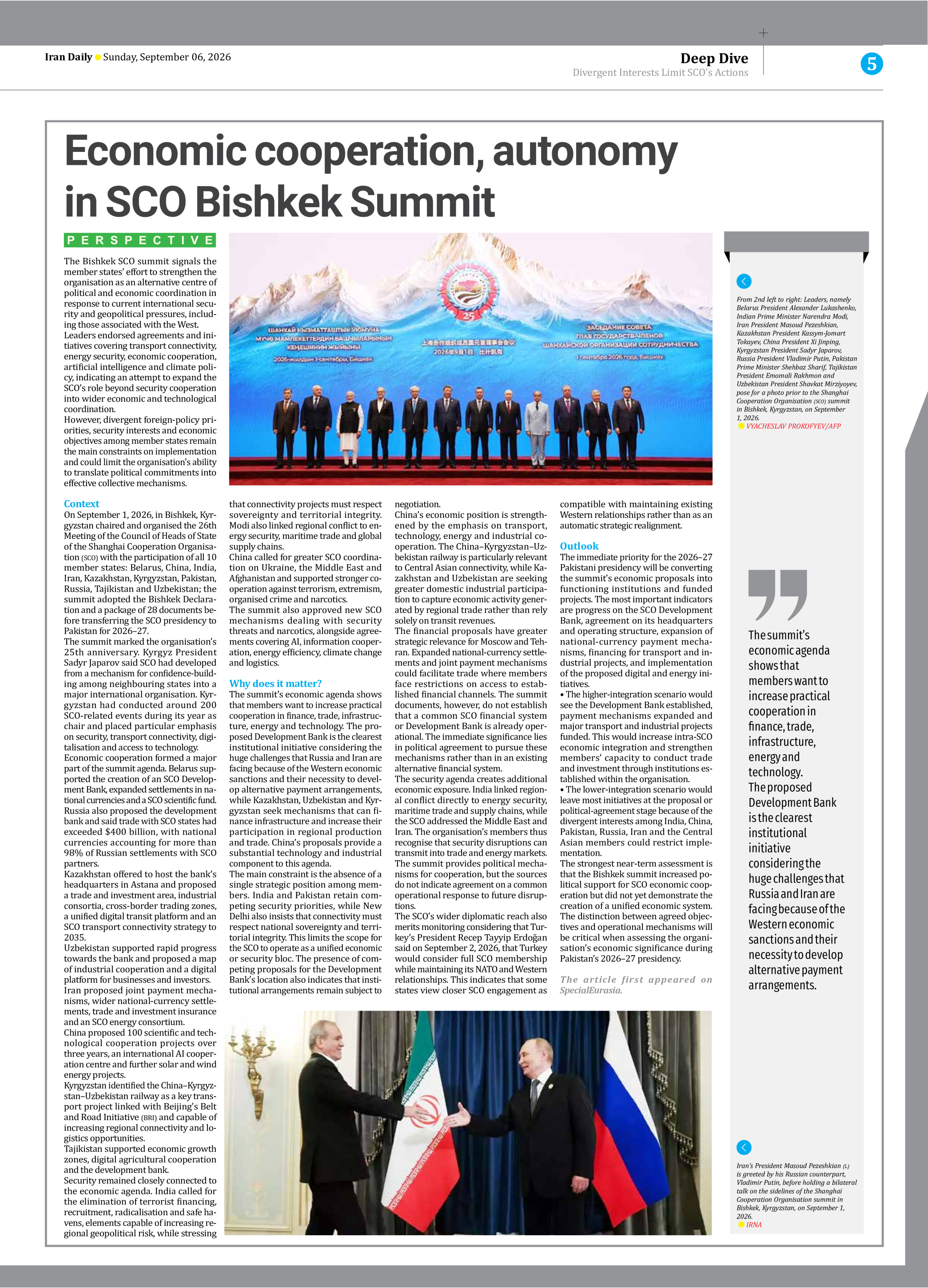
On September 1, 2026, in Bishkek, Kyrgyzstan chaired and organised the 26th Meeting of the Council of Heads of State of the Shanghai Cooperation Organisation (SCO) with the participation of all 10 member states: Belarus, China, India, Iran, Kazakhstan, Kyrgyzstan, Pakistan, Russia, Tajikistan and Uzbekistan; the summit adopted the Bishkek Declaration and a package of 28 documents before transferring the SCO presidency to Pakistan for 2026–27.
The summit marked the organisation’s 25th anniversary. Kyrgyz President Sadyr Japarov said SCO had developed from a mechanism for confidence-building among neighbouring states into a major international organisation. Kyrgyzstan had conducted around 200 SCO-related events during its year as chair and placed particular emphasis on security, transport connectivity, digitalisation and access to technology.
Economic cooperation formed a major part of the summit agenda. Belarus supported the creation of an SCO Development Bank, expanded settlements in national currencies and a SCO scientific fund.
Russia also proposed the development bank and said trade with SCO states had exceeded $400 billion, with national currencies accounting for more than 98% of Russian settlements with SCO partners.
Kazakhstan offered to host the bank’s headquarters in Astana and proposed a trade and investment area, industrial consortia, cross-border trading zones, a unified digital transit platform and an SCO transport connectivity strategy to 2035.
Uzbekistan supported rapid progress towards the bank and proposed a map of industrial cooperation and a digital platform for businesses and investors.
Iran proposed joint payment mechanisms, wider national-currency settlements, trade and investment insurance and an SCO energy consortium.
China proposed 100 scientific and technological cooperation projects over three years, an international AI cooperation centre and further solar and wind energy projects.
Kyrgyzstan identified the China–Kyrgyzstan–Uzbekistan railway as a key transport project linked with Beijing’s Belt and Road Initiative (BRI) and capable of increasing regional connectivity and logistics opportunities.
Tajikistan supported economic growth zones, digital agricultural cooperation and the development bank.
Security remained closely connected to the economic agenda. India called for the elimination of terrorist financing, recruitment, radicalisation and safe havens, elements capable of increasing regional geopolitical risk, while stressing that connectivity projects must respect sovereignty and territorial integrity. Modi also linked regional conflict to energy security, maritime trade and global supply chains.
China called for greater SCO coordination on Ukraine, the Middle East and Afghanistan and supported stronger cooperation against terrorism, extremism, organised crime and narcotics.
The summit also approved new SCO mechanisms dealing with security threats and narcotics, alongside agreements covering AI, information cooperation, energy efficiency, climate change and logistics.
Why does it matter?
The summit’s economic agenda shows that members want to increase practical cooperation in finance, trade, infrastructure, energy and technology. The proposed Development Bank is the clearest institutional initiative considering the huge challenges that Russia and Iran are facing because of the Western economic sanctions and their necessity to develop alternative payment arrangements, while Kazakhstan, Uzbekistan and Kyrgyzstan seek mechanisms that can finance infrastructure and increase their participation in regional production and trade. China’s proposals provide a substantial technology and industrial component to this agenda.
The main constraint is the absence of a single strategic position among members. India and Pakistan retain competing security priorities, while New Delhi also insists that connectivity must respect national sovereignty and territorial integrity. This limits the scope for the SCO to operate as a unified economic or security bloc. The presence of competing proposals for the Development Bank’s location also indicates that institutional arrangements remain subject to negotiation.
China’s economic position is strengthened by the emphasis on transport, technology, energy and industrial cooperation. The China–Kyrgyzstan–Uzbekistan railway is particularly relevant to Central Asian connectivity, while Kazakhstan and Uzbekistan are seeking greater domestic industrial participation to capture economic activity generated by regional trade rather than rely solely on transit revenues.
The financial proposals have greater strategic relevance for Moscow and Tehran. Expanded national-currency settlements and joint payment mechanisms could facilitate trade where members face restrictions on access to established financial channels. The summit documents, however, do not establish that a common SCO financial system or Development Bank is already operational. The immediate significance lies in political agreement to pursue these mechanisms rather than in an existing alternative financial system.
The security agenda creates additional economic exposure. India linked regional conflict directly to energy security, maritime trade and supply chains, while the SCO addressed the Middle East and Iran. The organisation’s members thus recognise that security disruptions can transmit into trade and energy markets. The summit provides political mechanisms for cooperation, but the sources do not indicate agreement on a common operational response to future disruptions.
The SCO’s wider diplomatic reach also merits monitoring considering that Turkey’s President Recep Tayyip Erdoğan said on September 2, 2026, that Turkey would consider full SCO membership while maintaining its NATO and Western relationships. This indicates that some states view closer SCO engagement as compatible with maintaining existing Western relationships rather than as an automatic strategic realignment.
Outlook
The immediate priority for the 2026–27 Pakistani presidency will be converting the summit’s economic proposals into functioning institutions and funded projects. The most important indicators are progress on the SCO Development Bank, agreement on its headquarters and operating structure, expansion of national-currency payment mechanisms, financing for transport and industrial projects, and implementation of the proposed digital and energy initiatives.
• The higher-integration scenario would see the Development Bank established, payment mechanisms expanded and major transport and industrial projects funded. This would increase intra-SCO economic integration and strengthen members’ capacity to conduct trade and investment through institutions established within the organisation.
• The lower-integration scenario would leave most initiatives at the proposal or political-agreement stage because of the divergent interests among India, China, Pakistan, Russia, Iran and the Central Asian members could restrict implementation.
The strongest near-term assessment is that the Bishkek summit increased political support for SCO economic cooperation but did not yet demonstrate the creation of a unified economic system. The distinction between agreed objectives and operational mechanisms will be critical when assessing the organisation’s economic significance during Pakistan’s 2026–27 presidency.
The article first appeared on
SpecialEurasia.