





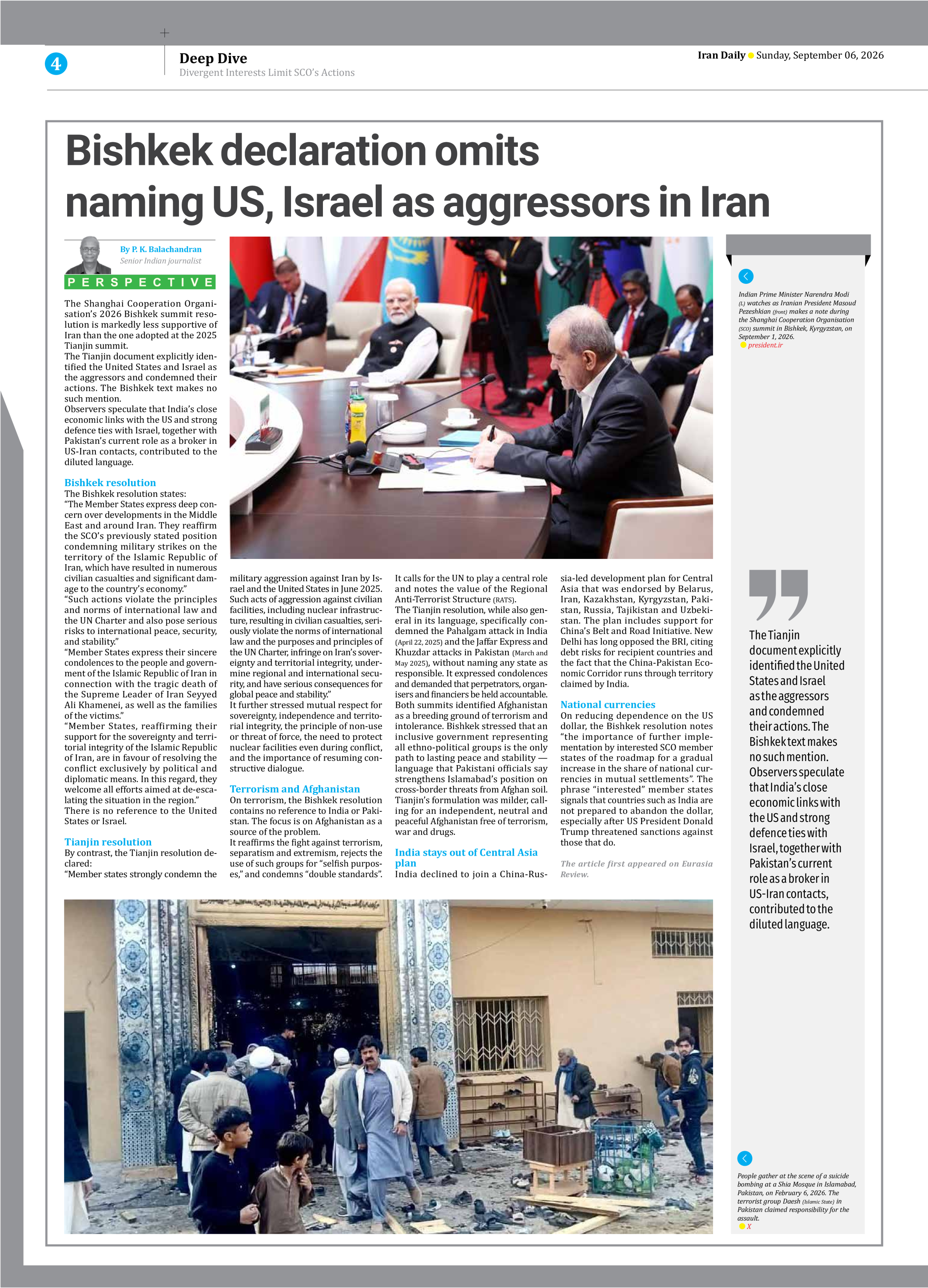


Bishkek declaration omits naming US, Israel as aggressors in Iran
By P. K. Balachandran
Senior Indian journalist
The Shanghai Cooperation Organisation’s 2026 Bishkek summit resolution is markedly less supportive of Iran than the one adopted at the 2025 Tianjin summit.
The Tianjin document explicitly identified the United States and Israel as the aggressors and condemned their actions. The Bishkek text makes no such mention.
Observers speculate that India’s close economic links with the US and strong defence ties with Israel, together with Pakistan’s current role as a broker in US-Iran contacts, contributed to the diluted language.
Bishkek resolution
The Bishkek resolution states:
“The Member States express deep concern over developments in the Middle East and around Iran. They reaffirm the SCO’s previously stated position condemning military strikes on the territory of the Islamic Republic of Iran, which have resulted in numerous civilian casualties and significant damage to the country’s economy.”
“Such actions violate the principles and norms of international law and the UN Charter and also pose serious risks to international peace, security, and stability.”
“Member States express their sincere condolences to the people and government of the Islamic Republic of Iran in connection with the tragic death of the Supreme Leader of Iran Seyyed Ali Khamenei, as well as the families of the victims.”
“Member States, reaffirming their support for the sovereignty and territorial integrity of the Islamic Republic of Iran, are in favour of resolving the conflict exclusively by political and diplomatic means. In this regard, they welcome all efforts aimed at de-escalating the situation in the region.”
There is no reference to the United States or Israel.
Tianjin resolution
By contrast, the Tianjin resolution declared:
“Member states strongly condemn the military aggression against Iran by Israel and the United States in June 2025. Such acts of aggression against civilian facilities, including nuclear infrastructure, resulting in civilian casualties, seriously violate the norms of international law and the purposes and principles of the UN Charter, infringe on Iran’s sovereignty and territorial integrity, undermine regional and international security, and have serious consequences for global peace and stability.”
It further stressed mutual respect for sovereignty, independence and territorial integrity, the principle of non-use or threat of force, the need to protect nuclear facilities even during conflict, and the importance of resuming constructive dialogue.
Terrorism and Afghanistan
On terrorism, the Bishkek resolution contains no reference to India or Pakistan. The focus is on Afghanistan as a source of the problem.
It reaffirms the fight against terrorism, separatism and extremism, rejects the use of such groups for “selfish purposes,” and condemns “double standards”. It calls for the UN to play a central role and notes the value of the Regional Anti-Terrorist Structure (RATS).
The Tianjin resolution, while also general in its language, specifically condemned the Pahalgam attack in India (April 22, 2025) and the Jaffar Express and Khuzdar attacks in Pakistan (March and May 2025), without naming any state as responsible. It expressed condolences and demanded that perpetrators, organisers and financiers be held accountable.
Both summits identified Afghanistan as a breeding ground of terrorism and intolerance. Bishkek stressed that an inclusive government representing all ethno-political groups is the only path to lasting peace and stability — language that Pakistani officials say strengthens Islamabad’s position on cross-border threats from Afghan soil. Tianjin’s formulation was milder, calling for an independent, neutral and peaceful Afghanistan free of terrorism, war and drugs.
India stays out of Central Asia plan
India declined to join a China-Russia-led development plan for Central Asia that was endorsed by Belarus, Iran, Kazakhstan, Kyrgyzstan, Pakistan, Russia, Tajikistan and Uzbekistan. The plan includes support for China’s Belt and Road Initiative. New Delhi has long opposed the BRI, citing debt risks for recipient countries and the fact that the China-Pakistan Economic Corridor runs through territory claimed by India.
National currencies
On reducing dependence on the US dollar, the Bishkek resolution notes “the importance of further implementation by interested SCO member states of the roadmap for a gradual increase in the share of national currencies in mutual settlements”. The phrase “interested” member states signals that countries such as India are not prepared to abandon the dollar, especially after US President Donald Trump threatened sanctions against those that do.
The article first appeared on Eurasia
Review.