





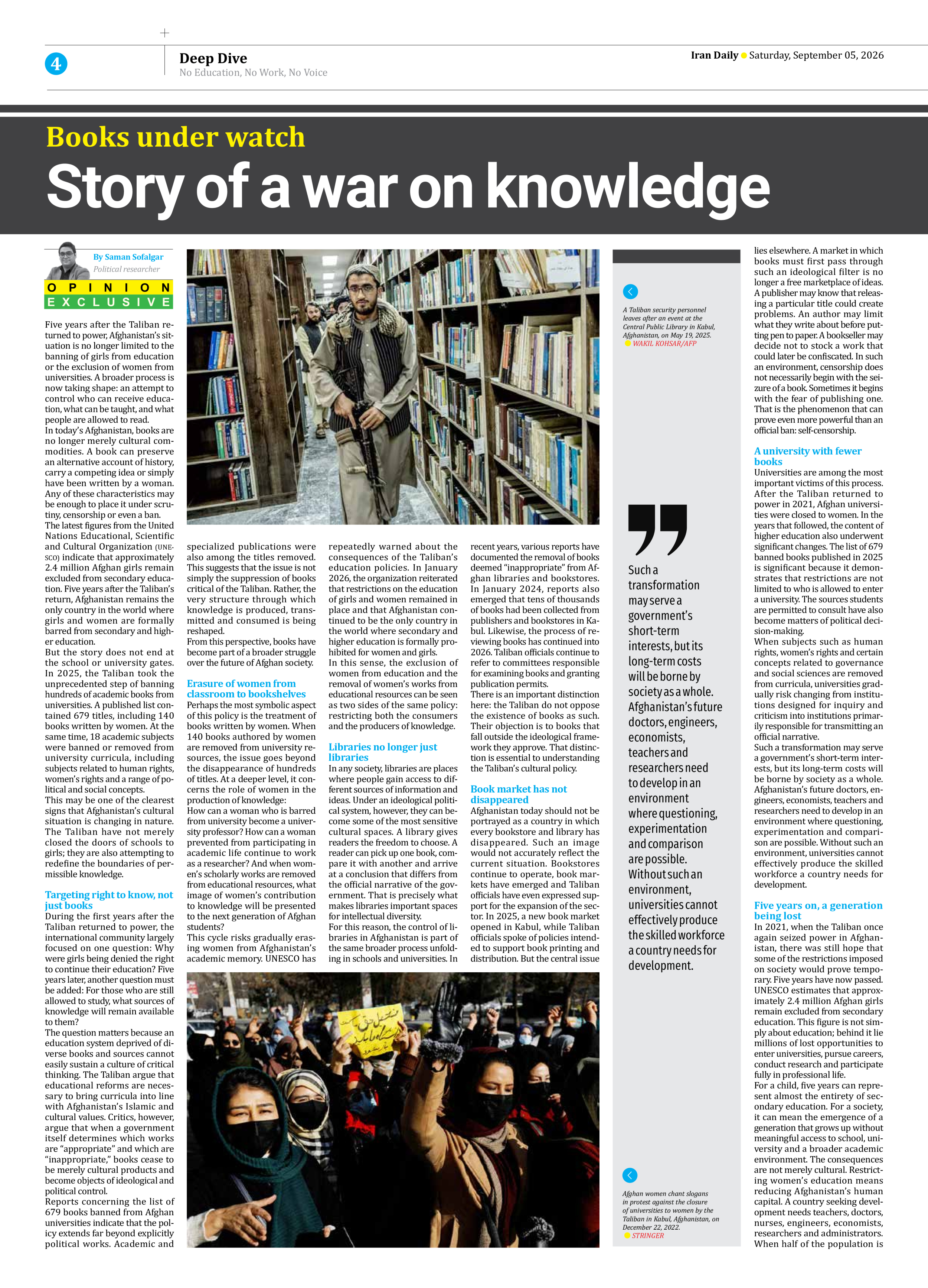


Books under watch
Story of a war on knowledge
By Saman Sofalgar
Political researcher
Five years after the Taliban returned to power, Afghanistan’s situation is no longer limited to the banning of girls from education or the exclusion of women from universities. A broader process is now taking shape: an attempt to control who can receive education, what can be taught, and what people are allowed to read.
In today’s Afghanistan, books are no longer merely cultural commodities. A book can preserve an alternative account of history, carry a competing idea or simply have been written by a woman. Any of these characteristics may be enough to place it under scrutiny, censorship or even a ban.
The latest figures from the United Nations Educational, Scientific and Cultural Organization (UNESCO) indicate that approximately 2.4 million Afghan girls remain excluded from secondary education. Five years after the Taliban’s return, Afghanistan remains the only country in the world where girls and women are formally barred from secondary and higher education.
But the story does not end at the school or university gates. In 2025, the Taliban took the unprecedented step of banning hundreds of academic books from universities. A published list contained 679 titles, including 140 books written by women. At the same time, 18 academic subjects were banned or removed from university curricula, including subjects related to human rights, women’s rights and a range of political and social concepts.
This may be one of the clearest signs that Afghanistan’s cultural situation is changing in nature. The Taliban have not merely closed the doors of schools to girls; they are also attempting to redefine the boundaries of permissible knowledge.
Targeting right to know, not just books
During the first years after the Taliban returned to power, the international community largely focused on one question: Why were girls being denied the right to continue their education? Five years later, another question must be added: For those who are still allowed to study, what sources of knowledge will remain available to them?
The question matters because an education system deprived of diverse books and sources cannot easily sustain a culture of critical thinking. The Taliban argue that educational reforms are necessary to bring curricula into line with Afghanistan’s Islamic and cultural values. Critics, however, argue that when a government itself determines which works are “appropriate” and which are “inappropriate,” books cease to be merely cultural products and become objects of ideological and political control.
Reports concerning the list of 679 books banned from Afghan universities indicate that the policy extends far beyond explicitly political works. Academic and specialized publications were also among the titles removed. This suggests that the issue is not simply the suppression of books critical of the Taliban. Rather, the very structure through which knowledge is produced, transmitted and consumed is being reshaped.
From this perspective, books have become part of a broader struggle over the future of Afghan society.
Erasure of women from classroom to bookshelves
Perhaps the most symbolic aspect of this policy is the treatment of books written by women. When 140 books authored by women are removed from university resources, the issue goes beyond the disappearance of hundreds of titles. At a deeper level, it concerns the role of women in the production of knowledge:
How can a woman who is barred from university become a university professor? How can a woman prevented from participating in academic life continue to work as a researcher? And when women’s scholarly works are removed from educational resources, what image of women’s contribution to knowledge will be presented to the next generation of Afghan students?
This cycle risks gradually erasing women from Afghanistan’s academic memory. UNESCO has repeatedly warned about the consequences of the Taliban’s education policies. In January 2026, the organization reiterated that restrictions on the education of girls and women remained in place and that Afghanistan continued to be the only country in the world where secondary and higher education is formally prohibited for women and girls.
In this sense, the exclusion of women from education and the removal of women’s works from educational resources can be seen as two sides of the same policy: restricting both the consumers and the producers of knowledge.
Libraries no longer just libraries
In any society, libraries are places where people gain access to different sources of information and ideas. Under an ideological political system, however, they can become some of the most sensitive cultural spaces. A library gives readers the freedom to choose. A reader can pick up one book, compare it with another and arrive at a conclusion that differs from the official narrative of the government. That is precisely what makes libraries important spaces for intellectual diversity.
For this reason, the control of libraries in Afghanistan is part of the same broader process unfolding in schools and universities. In recent years, various reports have documented the removal of books deemed “inappropriate” from Afghan libraries and bookstores. In January 2024, reports also emerged that tens of thousands of books had been collected from publishers and bookstores in Kabul. Likewise, the process of reviewing books has continued into 2026. Taliban officials continue to refer to committees responsible for examining books and granting publication permits.
There is an important distinction here: the Taliban do not oppose the existence of books as such. Their objection is to books that fall outside the ideological framework they approve. That distinction is essential to understanding the Taliban’s cultural policy.
Book market has not disappeared
Afghanistan today should not be portrayed as a country in which every bookstore and library has disappeared. Such an image would not accurately reflect the current situation. Bookstores continue to operate, book markets have emerged and Taliban officials have even expressed support for the expansion of the sector. In 2025, a new book market opened in Kabul, while Taliban officials spoke of policies intended to support book printing and distribution. But the central issue lies elsewhere. A market in which books must first pass through such an ideological filter is no longer a free marketplace of ideas.
A publisher may know that releasing a particular title could create problems. An author may limit what they write about before putting pen to paper. A bookseller may decide not to stock a work that could later be confiscated. In such an environment, censorship does not necessarily begin with the seizure of a book. Sometimes it begins with the fear of publishing one. That is the phenomenon that can prove even more powerful than an official ban: self-censorship.
A university with fewer books
Universities are among the most important victims of this process. After the Taliban returned to power in 2021, Afghan universities were closed to women. In the years that followed, the content of higher education also underwent significant changes. The list of 679 banned books published in 2025 is significant because it demonstrates that restrictions are not limited to who is allowed to enter a university. The sources students are permitted to consult have also become matters of political decision-making.
When subjects such as human rights, women’s rights and certain concepts related to governance and social sciences are removed from curricula, universities gradually risk changing from institutions designed for inquiry and criticism into institutions primarily responsible for transmitting an official narrative.
Such a transformation may serve a government’s short-term interests, but its long-term costs will be borne by society as a whole. Afghanistan’s future doctors, engineers, economists, teachers and researchers need to develop in an environment where questioning, experimentation and comparison are possible. Without such an environment, universities cannot effectively produce the skilled workforce a country needs for development.
Five years on, a generation being lost
In 2021, when the Taliban once again seized power in Afghanistan, there was still hope that some of the restrictions imposed on society would prove temporary. Five years have now passed. UNESCO estimates that approximately 2.4 million Afghan girls remain excluded from secondary education. This figure is not simply about education; behind it lie millions of lost opportunities to enter universities, pursue careers, conduct research and participate fully in professional life.
For a child, five years can represent almost the entirety of secondary education. For a society, it can mean the emergence of a generation that grows up without meaningful access to school, university and a broader academic environment. The consequences are not merely cultural. Restricting women’s education means reducing Afghanistan’s human capital. A country seeking development needs teachers, doctors, nurses, engineers, economists, researchers and administrators. When half of the population is excluded from a significant part of the education system, the country’s ability to produce that human capital inevitably suffers.
UNICEF and UNESCO warned in January 2026 that, beyond the ban on girls’ education, Afghanistan was also facing a broader learning dilemma, with a significant proportion of children failing to achieve basic reading proficiency by the end of primary school. Afghanistan therefore faces a double whammy: some children are being denied continued access to education, while others are being educated within a system whose content is increasingly contested and ideologically shaped.
Books as last avenue for learning
Yet amid this cultural darkness, one fact remains important: the desire to learn has not disappeared from Afghanistan. Many Afghan women and girls who have been excluded from schools and universities continue to pursue education through informal channels. Home-based classes, distance learning, digital resources and books have become substitutes, however imperfect, for formal educational institutions.
New technologies have also entered this struggle. Recent research on Afghan women indicates that some are turning to artificial intelligence tools and online education to continue learning and develop new skills despite restrictions on formal education. At the same time, concerns over security, surveillance and reliable access remain serious.
This reality demonstrates that the desire for knowledge cannot simply be eliminated by closing schools or removing books from libraries. A university can be closed, but the question itself cannot be shut down. A book can be removed from a library, but the need to know cannot simply be erased from the mind of a generation.
Afghanistan’s situation not only about today
Ultimately, what is happening to books, universities and schools in Afghanistan is about the country’s future. Five years after returning to power, the Taliban have consolidated their territorial control and expanded their diplomatic engagement with a number of countries. Yet the situation of the rights of women and girls remains one of the most significant obstacles to the normalization of Afghanistan’s relations with the international community.
From this perspective, books are not a peripheral issue. A country that restricts its books is also restricting its collective memory. A country that excludes women from universities is setting aside a significant part of its human capital. A country that rewrites its curriculum according to ideological considerations is shaping the intellectual future of its next generation. And a country that restricts free access to diverse sources of knowledge gradually loses part of its ability to debate its own future.
Afghanistan today is facing something larger than a book trouble. It is facing a trouble of access to knowledge. A trouble that began in schools, moved into universities and is now affecting the bookshelves and libraries that once provided Afghans with access to a wider intellectual world.
Perhaps that is why, in today’s Afghanistan, an ordinary book can carry a meaning far greater than its few hundred pages. A book can represent a world in which asking questions is not forbidden, women can be university students, writers can write without fear, and universities can remain the meeting ground of competing ideas.
Five years after the Taliban’s return to power, the central question is no longer simply how many books remain in Afghanistan. The deeper question is this: Will the next generation of Afghans still have the opportunity to read different books and decide for themselves which version of the world they choose to believe? The answer may determine Afghanistan’s cultural future more clearly than any figure.