





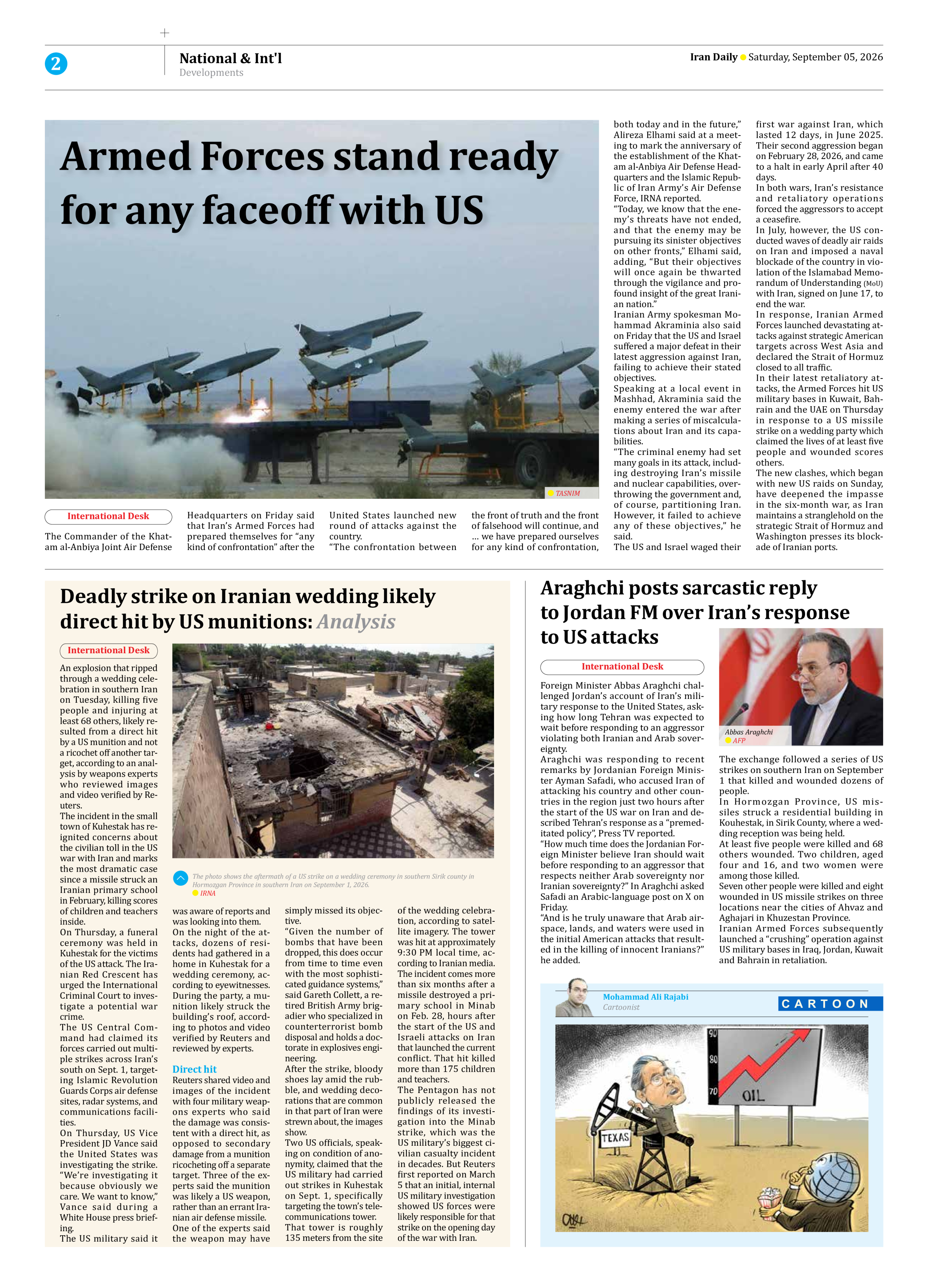


Deadly strike on Iranian wedding likely direct hit by US munitions: Analysis
An explosion that ripped through a wedding celebration in southern Iran on Tuesday, killing five people and injuring at least 68 others, likely resulted from a direct hit by a US munition and not a ricochet off another target, according to an analysis by weapons experts who reviewed images and video verified by Reuters.
The incident in the small town of Kuhestak has reignited concerns about the civilian toll in the US war with Iran and marks the most dramatic case since a missile struck an Iranian primary school in February, killing scores of children and teachers inside.
On Thursday, a funeral ceremony was held in Kuhestak for the victims of the US attack. The Iranian Red Crescent has urged the International Criminal Court to investigate a potential war crime.
The US Central Command had claimed its forces carried out multiple strikes across Iran’s south on Sept. 1, targeting Islamic Revolution Guards Corps air defense sites, radar systems, and communications facilities.
On Thursday, US Vice President JD Vance said the United States was investigating the strike. “We’re investigating it because obviously we care. We want to know,” Vance said during a White House press briefing.
The US military said it was aware of reports and was looking into them.
On the night of the attacks, dozens of residents had gathered in a home in Kuhestak for a wedding ceremony, according to eyewitnesses. During the party, a munition likely struck the building’s roof, according to photos and video verified by Reuters and reviewed by experts.
Direct hit
Reuters shared video and images of the incident with four military weapons experts who said the damage was consistent with a direct hit, as opposed to secondary damage from a munition ricocheting off a separate target. Three of the experts said the munition was likely a US weapon, rather than an errant Iranian air defense missile.
One of the experts said the weapon may have simply missed its objective.
“Given the number of bombs that have been dropped, this does occur from time to time even with the most sophisticated guidance systems,” said Gareth Collett, a retired British Army brigadier who specialized in counterterrorist bomb disposal and holds a doctorate in explosives engineering.
After the strike, bloody shoes lay amid the rubble, and wedding decorations that are common in that part of Iran were strewn about, the images show.
Two US officials, speaking on condition of anonymity, claimed that the US military had carried out strikes in Kuhestak on Sept. 1, specifically targeting the town’s telecommunications tower.
That tower is roughly 135 meters from the site of the wedding celebration, according to satellite imagery. The tower was hit at approximately 9:30 PM local time, according to Iranian media.
The incident comes more than six months after a missile destroyed a primary school in Minab on Feb. 28, hours after the start of the US and Israeli attacks on Iran that launched the current conflict. That hit killed more than 175 children and teachers.
The Pentagon has not publicly released the findings of its investigation into the Minab strike, which was the US military’s biggest civilian casualty incident in decades. But Reuters first reported on March 5 that an initial, internal US military investigation showed US forces were likely responsible for that strike on the opening day of the war with Iran.