







Alamut Castle still holds secrets beneath its ruins after centuries
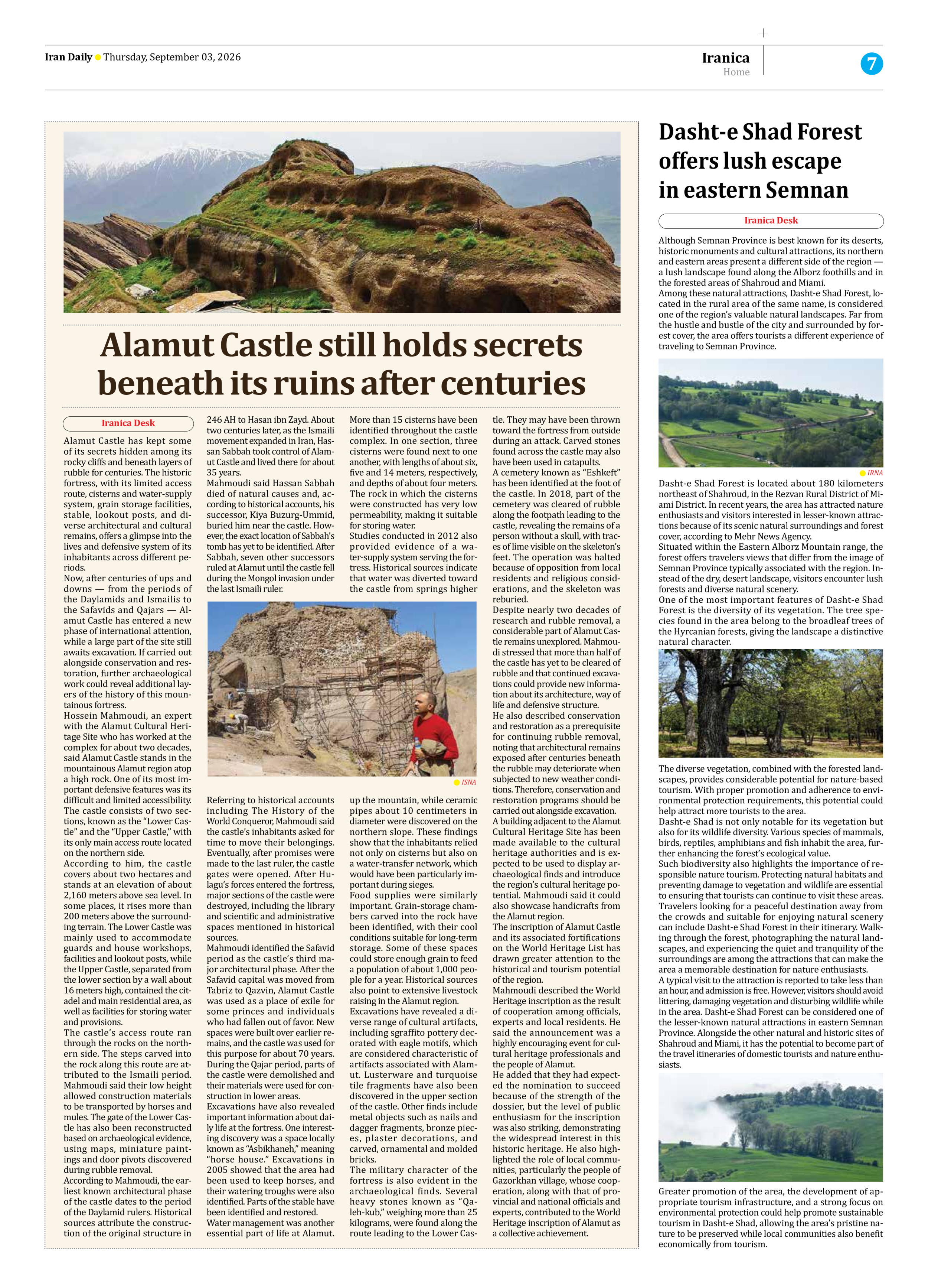
Alamut Castle has kept some of its secrets hidden among its rocky cliffs and beneath layers of rubble for centuries. The historic fortress, with its limited access route, cisterns and water-supply system, grain storage facilities, stable, lookout posts, and diverse architectural and cultural remains, offers a glimpse into the lives and defensive system of its inhabitants across different periods.
Now, after centuries of ups and downs — from the periods of the Daylamids and Ismailis to the Safavids and Qajars — Alamut Castle has entered a new phase of international attention, while a large part of the site still awaits excavation. If carried out alongside conservation and restoration, further archaeological work could reveal additional layers of the history of this mountainous fortress.
Hossein Mahmoudi, an expert with the Alamut Cultural Heritage Site who has worked at the complex for about two decades, said Alamut Castle stands in the mountainous Alamut region atop a high rock. One of its most important defensive features was its difficult and limited accessibility. The castle consists of two sections, known as the “Lower Castle” and the “Upper Castle,” with its only main access route located on the northern side.
According to him, the castle covers about two hectares and stands at an elevation of about 2,160 meters above sea level. In some places, it rises more than 200 meters above the surrounding terrain. The Lower Castle was mainly used to accommodate guards and house workshops, facilities and lookout posts, while the Upper Castle, separated from the lower section by a wall about 16 meters high, contained the citadel and main residential area, as well as facilities for storing water and provisions.
The castle’s access route ran through the rocks on the northern side. The steps carved into the rock along this route are attributed to the Ismaili period. Mahmoudi said their low height allowed construction materials to be transported by horses and mules. The gate of the Lower Castle has also been reconstructed based on archaeological evidence, using maps, miniature paintings and door pivots discovered during rubble removal.
According to Mahmoudi, the earliest known architectural phase of the castle dates to the period of the Daylamid rulers. Historical sources attribute the construction of the original structure in 246 AH to Hasan ibn Zayd. About two centuries later, as the Ismaili movement expanded in Iran, Hassan Sabbah took control of Alamut Castle and lived there for about 35 years.
Mahmoudi said Hassan Sabbah died of natural causes and, according to historical accounts, his successor, Kiya Buzurg-Ummid, buried him near the castle. However, the exact location of Sabbah’s tomb has yet to be identified. After Sabbah, seven other successors ruled at Alamut until the castle fell during the Mongol invasion under the last Ismaili ruler.
Referring to historical accounts including The History of the World Conqueror, Mahmoudi said the castle’s inhabitants asked for time to move their belongings. Eventually, after promises were made to the last ruler, the castle gates were opened. After Hulagu’s forces entered the fortress, major sections of the castle were destroyed, including the library and scientific and administrative spaces mentioned in historical sources.
Mahmoudi identified the Safavid period as the castle’s third major architectural phase. After the Safavid capital was moved from Tabriz to Qazvin, Alamut Castle was used as a place of exile for some princes and individuals who had fallen out of favor. New spaces were built over earlier remains, and the castle was used for this purpose for about 70 years. During the Qajar period, parts of the castle were demolished and their materials were used for construction in lower areas.
Excavations have also revealed important information about daily life at the fortress. One interesting discovery was a space locally known as “Asbikhaneh,” meaning “horse house.” Excavations in 2005 showed that the area had been used to keep horses, and their watering troughs were also identified. Parts of the stable have been identified and restored.
Water management was another essential part of life at Alamut. More than 15 cisterns have been identified throughout the castle complex. In one section, three cisterns were found next to one another, with lengths of about six, five and 14 meters, respectively, and depths of about four meters. The rock in which the cisterns were constructed has very low permeability, making it suitable for storing water.
Studies conducted in 2012 also provided evidence of a water-supply system serving the fortress. Historical sources indicate that water was diverted toward the castle from springs higher up the mountain, while ceramic pipes about 10 centimeters in diameter were discovered on the northern slope. These findings show that the inhabitants relied not only on cisterns but also on a water-transfer network, which would have been particularly important during sieges.
Food supplies were similarly important. Grain-storage chambers carved into the rock have been identified, with their cool conditions suitable for long-term storage. Some of these spaces could store enough grain to feed a population of about 1,000 people for a year. Historical sources also point to extensive livestock raising in the Alamut region.
Excavations have revealed a diverse range of cultural artifacts, including sgraffito pottery decorated with eagle motifs, which are considered characteristic of artifacts associated with Alamut. Lusterware and turquoise tile fragments have also been discovered in the upper section of the castle. Other finds include metal objects such as nails and dagger fragments, bronze pieces, plaster decorations, and carved, ornamental and molded bricks.
The military character of the fortress is also evident in the archaeological finds. Several heavy stones known as “Qaleh-kub,” weighing more than 25 kilograms, were found along the route leading to the Lower Castle. They may have been thrown toward the fortress from outside during an attack. Carved stones found across the castle may also have been used in catapults.
A cemetery known as “Eshkeft” has been identified at the foot of the castle. In 2018, part of the cemetery was cleared of rubble along the footpath leading to the castle, revealing the remains of a person without a skull, with traces of lime visible on the skeleton’s feet. The operation was halted because of opposition from local residents and religious considerations, and the skeleton was reburied.
Despite nearly two decades of research and rubble removal, a considerable part of Alamut Castle remains unexplored. Mahmoudi stressed that more than half of the castle has yet to be cleared of rubble and that continued excavations could provide new information about its architecture, way of life and defensive structure.
He also described conservation and restoration as a prerequisite for continuing rubble removal, noting that architectural remains exposed after centuries beneath the rubble may deteriorate when subjected to new weather conditions. Therefore, conservation and restoration programs should be carried out alongside excavation.
A building adjacent to the Alamut Cultural Heritage Site has been made available to the cultural heritage authorities and is expected to be used to display archaeological finds and introduce the region’s cultural heritage potential. Mahmoudi said it could also showcase handicrafts from the Alamut region.
The inscription of Alamut Castle and its associated fortifications on the World Heritage List has drawn greater attention to the historical and tourism potential of the region.
Mahmoudi described the World Heritage inscription as the result of cooperation among officials, experts and local residents. He said the announcement was a highly encouraging event for cultural heritage professionals and the people of Alamut.
He added that they had expected the nomination to succeed because of the strength of the dossier, but the level of public enthusiasm for the inscription was also striking, demonstrating the widespread interest in this historic heritage. He also highlighted the role of local communities, particularly the people of Gazorkhan village, whose cooperation, along with that of provincial and national officials and experts, contributed to the World Heritage inscription of Alamut as a collective achievement.