





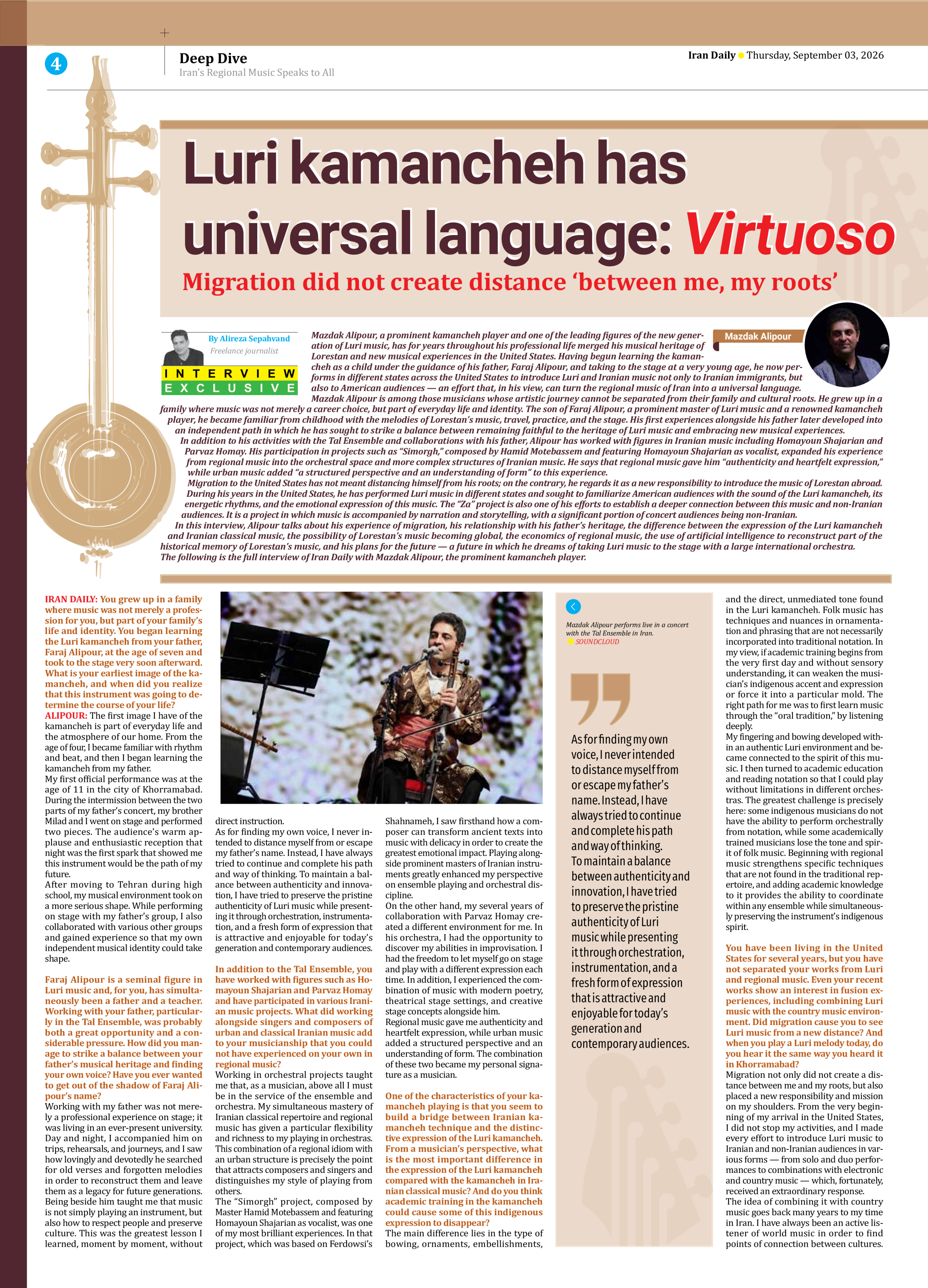


Luri kamancheh has universal language: Virtuoso
Migration did not create distance ‘between me, my roots’
Mazdak Alipour, a prominent kamancheh player and one of the leading figures of the new generation of Luri music, has for years throughout his professional life merged his musical heritage of Lorestan and new musical experiences in the United States. Having begun learning the kamancheh as a child under the guidance of his father, Faraj Alipour, and taking to the stage at a very young age, he now performs in different states across the United States to introduce Luri and Iranian music not only to Iranian immigrants, but also to American audiences — an effort that, in his view, can turn the regional music of Iran into a universal language. Mazdak Alipour is among those musicians whose artistic journey cannot be separated from their family and cultural roots. He grew up in a family where music was not merely a career choice, but part of everyday life and identity. The son of Faraj Alipour, a prominent master of Luri music and a renowned kamancheh player, he became familiar from childhood with the melodies of Lorestan’s music, travel, practice, and the stage. His first experiences alongside his father later developed into an independent path in which he has sought to strike a balance between remaining faithful to the heritage of Luri music and embracing new musical experiences. In addition to his activities with the Tal Ensemble and collaborations with his father, Alipour has worked with figures in Iranian music including Homayoun Shajarian and Parvaz Homay. His participation in projects such as “Simorgh,” composed by Hamid Motebassem and featuring Homayoun Shajarian as vocalist, expanded his experience from regional music into the orchestral space and more complex structures of Iranian music. He says that regional music gave him “authenticity and heartfelt expression,” while urban music added “a structured perspective and an understanding of form” to this experience. Migration to the United States has not meant distancing himself from his roots; on the contrary, he regards it as a new responsibility to introduce the music of Lorestan abroad. During his years in the United States, he has performed Luri music in different states and sought to familiarize American audiences with the sound of the Luri kamancheh, its energetic rhythms, and the emotional expression of this music. The “Za” project is also one of his efforts to establish a deeper connection between this music and non-Iranian audiences. It is a project in which music is accompanied by narration and storytelling, with a significant portion of concert audiences being non-Iranian. In this interview, Alipour talks about his experience of migration, his relationship with his father’s heritage, the difference between the expression of the Luri kamancheh and Iranian classical music, the possibility of Lorestan’s music becoming global, the economics of regional music, the use of artificial intelligence to reconstruct part of the historical memory of Lorestan’s music, and his plans for the future — a future in which he dreams of taking Luri music to the stage with a large international orchestra. The following is the full interview of Iran Daily with Mazdak Alipour, the prominent kamancheh player.
By Alireza Sepahvand
Freelance journalist
IRAN DAILY: You grew up in a family where music was not merely a profession for you, but part of your family’s life and identity. You began learning the Luri kamancheh from your father, Faraj Alipour, at the age of seven and took to the stage very soon afterward. What is your earliest image of the kamancheh, and when did you realize that this instrument was going to determine the course of your life?
ALIPOUR: The first image I have of the kamancheh is part of everyday life and the atmosphere of our home. From the age of four, I became familiar with rhythm and beat, and then I began learning the kamancheh from my father.
My first official performance was at the age of 11 in the city of Khorramabad. During the intermission between the two parts of my father’s concert, my brother Milad and I went on stage and performed two pieces. The audience’s warm applause and enthusiastic reception that night was the first spark that showed me this instrument would be the path of my future.
After moving to Tehran during high school, my musical environment took on a more serious shape. While performing on stage with my father’s group, I also collaborated with various other groups and gained experience so that my own independent musical identity could take shape.
Faraj Alipour is a seminal figure in Luri music and, for you, has simultaneously been a father and a teacher. Working with your father, particularly in the Tal Ensemble, was probably both a great opportunity and a considerable pressure. How did you manage to strike a balance between your father’s musical heritage and finding your own voice? Have you ever wanted to get out of the shadow of Faraj Alipour’s name?
Working with my father was not merely a professional experience on stage; it was living in an ever-present university. Day and night, I accompanied him on trips, rehearsals, and journeys, and I saw how lovingly and devotedly he searched for old verses and forgotten melodies in order to reconstruct them and leave them as a legacy for future generations. Being beside him taught me that music is not simply playing an instrument, but also how to respect people and preserve culture. This was the greatest lesson I learned, moment by moment, without direct instruction.
As for finding my own voice, I never intended to distance myself from or escape my father’s name. Instead, I have always tried to continue and complete his path and way of thinking. To maintain a balance between authenticity and innovation, I have tried to preserve the pristine authenticity of Luri music while presenting it through orchestration, instrumentation, and a fresh form of expression that is attractive and enjoyable for today’s generation and contemporary audiences.
In addition to the Tal Ensemble, you have worked with figures such as Homayoun Shajarian and Parvaz Homay and have participated in various Iranian music projects. What did working alongside singers and composers of urban and classical Iranian music add to your musicianship that you could not have experienced on your own in regional music?
Working in orchestral projects taught me that, as a musician, above all I must be in the service of the ensemble and orchestra. My simultaneous mastery of Iranian classical repertoire and regional music has given a particular flexibility and richness to my playing in orchestras. This combination of a regional idiom with an urban structure is precisely the point that attracts composers and singers and distinguishes my style of playing from others.
The “Simorgh” project, composed by Master Hamid Motebassem and featuring Homayoun Shajarian as vocalist, was one of my most brilliant experiences. In that project, which was based on Ferdowsi’s Shahnameh, I saw firsthand how a composer can transform ancient texts into music with delicacy in order to create the greatest emotional impact. Playing alongside prominent masters of Iranian instruments greatly enhanced my perspective on ensemble playing and orchestral discipline.
On the other hand, my several years of collaboration with Parvaz Homay created a different environment for me. In his orchestra, I had the opportunity to discover my abilities in improvisation. I had the freedom to let myself go on stage and play with a different expression each time. In addition, I experienced the combination of music with modern poetry, theatrical stage settings, and creative stage concepts alongside him.
Regional music gave me authenticity and heartfelt expression, while urban music added a structured perspective and an understanding of form. The combination of these two became my personal signature as a musician.
One of the characteristics of your kamancheh playing is that you seem to build a bridge between Iranian kamancheh technique and the distinctive expression of the Luri kamancheh. From a musician’s perspective, what is the most important difference in the expression of the Luri kamancheh compared with the kamancheh in Iranian classical music? And do you think academic training in the kamancheh could cause some of this indigenous expression to disappear?
The main difference lies in the type of bowing, ornaments, embellishments, and the direct, unmediated tone found in the Luri kamancheh. Folk music has techniques and nuances in ornamentation and phrasing that are not necessarily incorporated into traditional notation. In my view, if academic training begins from the very first day and without sensory understanding, it can weaken the musician’s indigenous accent and expression or force it into a particular mold. The right path for me was to first learn music through the “oral tradition,” by listening deeply.
My fingering and bowing developed within an authentic Luri environment and became connected to the spirit of this music. I then turned to academic education and reading notation so that I could play without limitations in different orchestras. The greatest challenge is precisely here: some indigenous musicians do not have the ability to perform orchestrally from notation, while some academically trained musicians lose the tone and spirit of folk music. Beginning with regional music strengthens specific techniques that are not found in the traditional repertoire, and adding academic knowledge to it provides the ability to coordinate within any ensemble while simultaneously preserving the instrument’s indigenous spirit.
You have been living in the United States for several years, but you have not separated your works from Luri and regional music. Even your recent works show an interest in fusion experiences, including combining Luri music with the country music environment. Did migration cause you to see Luri music from a new distance? And when you play a Luri melody today, do you hear it the same way you heard it in Khorramabad?
Migration not only did not create a distance between me and my roots, but also placed a new responsibility and mission on my shoulders. From the very beginning of my arrival in the United States, I did not stop my activities, and I made every effort to introduce Luri music to Iranian and non-Iranian audiences in various forms — from solo and duo performances to combinations with electronic and country music — which, fortunately, received an extraordinary response.
The idea of combining it with country music goes back many years to my time in Iran. I have always been an active listener of world music in order to find points of connection between cultures. Like Luri music, country music is rooted in authentic life, nature, and popular culture. When these two geographies become intertwined, a universal and highly appealing language is born.
Today, when I play a Luri melody, I still feel the same authenticity and emotion of Khorramabad flowing through me, but with a broader perspective. I feel a duty and responsibility on my shoulders to take this heritage to prestigious international universities and collaborate as a kamancheh soloist with leading orchestras around the world, so that I can be a worthy representative of the people and culture of my homeland.
In the United States, you have tried to bring maqami music and Luri melodies to audiences in different states. How do Americans respond to Luri music? Do they genuinely connect with the music itself, or do you first have to explain the story, language, culture, and geography of Lorestan to them?
The response of American and non-Iranian audiences has been extraordinary. Even though it has deep sorrow and emotional expression in its melodies, Luri music affects listeners without any intermediary because of its energetic rhythms. At many events, without any prior explanation, I have seen how a non-Iranian listener becomes captivated by the power and appeal of this music.
However, to deepen this connection, in my new project called “Za” — which is being released both as an album and performed as a concert tour in the United States — I have taken a different approach. I have designed a coherent scenario and storyline for the project. Memorable and new pieces are connected to this storyline. Before each piece is performed, a brief explanation of its story and emotional atmosphere is given to the audience, and the text of the narration is also provided to them. The result was astonishing. The audience remains focused and excited, riveted to the performance until the very last moment.
The interesting point is that at most of our concerts, approximately half of the audience consists of non-Iranian listeners. Seeing them become immersed in the story, music, and sound of the kamancheh — despite not knowing the language — proves that Luri music has tremendous potential to connect with a global audience.
In 2025, you undertook a very different project in which you reintroduced the voice of the late Pirvali Karimi, one of the important figures in the history of Luri music, to today’s audience after approximately six decades, in the form of a new work featuring the kamancheh and your own arrangement. The project also used artificial intelligence in its visual component. Was this experience more of a musical project for you, or an effort to save part of the historical memory of Lorestan’s music? And to what extent do you consider the use of artificial intelligence acceptable in reconstructing such heritage?
This project was far more than a musical work for me. It was a tribute and a sincere effort to keep alive the historical memory of Lorestan’s music. I have always enjoyed Master Pirvali Karimi’s style of kamancheh playing, and with the emergence of artificial intelligence in the visual field, I saw an opportunity to bring this historical figure closer to today’s audience. I reconstructed the only surviving photograph of Pirvali and old photographs of Khorramabad, wrote a storyline and screenplay, and placed Pirvali and QorchAli together in the old neighborhoods. Choosing the piece was a major challenge, but eventually I selected a song that would complete the spirit of the image. Over Pirvali’s kamancheh recording, I recorded my own kamancheh and the Dohol, and in the final section, I sang part of the melody so that the connection between generations would become tangible.
The use of artificial intelligence is acceptable as long as it serves preserving the spirit of the work and transmitting its identity, rather than distorting it. I am doing everything within my ability to preserve and develop these ancient works and present them at universities and prestigious halls. The tremendous support of all Luri speakers — including our dear Bakhtiari Lurs — at concerts in the United States gives me the strength to continue striving not for personal fame or honor, but for future generations and the preservation of this ancient heritage.
Regional music in Iran has long faced a contradiction: on the one hand, it has a great deal of audience interest and appeal, while on the other hand, many of its masters and musicians face difficult economic circumstances. In the United States, have you realized that local music can be turned into a sustainable professional and economic activity? What exists in that cultural system that we do not have in Iran?
The main difference lies in a change in the artist’s mindset and in the support structure. In the United States, music is viewed as a professional occupation. A musician here conducts himself or herself as a musician with no inflated ego. From releasing works on global platforms and teaching to performing in a bar, a small venue, or a major concert, musicians make use of every opportunity. In addition, support systems such as grants (governmental or institutional funding) exist, which cover the costs of concerts and free artists from the concern of ticket sales so that people can enjoy art at the lowest possible cost or for free.
In Iran, by contrast, there are two major challenges: on the one hand, censorship and the exhausting process of obtaining permits, which consumes all the artist’s energy and rehearsal time in administrative follow-ups; and on the other hand, the blocking of global income-generating platforms. But alongside these issues, there is also the challenge of the artists’ own attitude; unfortunately, many colleagues stay at home, wait to be invited, and criticize from the sidelines.
I put my works on international platforms so that my sound and art can be heard — even if sanctions and Iran’s limitations prevent full monetization in that geography — because I hope that one day it will also be heard freely in Iran. The truth is that challenges exist everywhere in the world, but sitting at home and feeling sorry for oneself gets you nowhere. An artist must build his or her own path through perseverance.
If you were to introduce only three characteristics of Lorestan’s music to an American audience so that they could understand why this music deserves to become global, which three characteristics would you choose?
If I were to describe three unique characteristics of Lorestan’s music to an American audience to demonstrate why this art has the potential to become global, they would be:
1. Powerful, epic, and multilayered rhythms (especially asymmetrical rhythms): The rhythms of Luri music are not merely for dancing or celebration; they are rooted in epic traditions, labor, and a heroic way of life. The diverse rhythms such as Se-Pa, Sangin-Sama, and especially asymmetrical rhythms possess a magical movement and extraordinary energy that compel any listener from any culture to move and participate.
2. Deep and authentic emotional expression in the melodies: The Luri kamancheh has a direct and deeply intimate language. This music is capable of conveying the deepest human emotions, such as sorrow, love, longing, and yearning, without the need for words. This sorrowful quality and emotional expression is something that Western audiences can understand with their entire being without knowing the language or geography.
3. A direct and living connection with nature and historical antiquity: Luri music is a mirror of Lorestan’s geography, a sound that carries within it the sounds of nature, mountains, ancient rituals, and the thousands-of-years-old history of this people. This authentic and deeply rooted narrative offers the listener a musicological dimension that, in an age of modern and similar productions, appears highly valuable, fresh, and authentic to today’s listener.
And perhaps the most important question: You are the son of Faraj Alipour and have worked alongside him and in the Tal Ensemble for years, but you have now reached a stage where the next generation must recognize you as an independent musician and artist with your own voice. How do you make it happen?
I have a very heavy responsibility ahead of me, and I think about it every day. I closely follow the tastes and listening habits of the new generation and even put myself in their place to understand how I can attract their attention to Luri music. Young people today are looking for excitement and contemporary rhythms. Luri music has tremendous potential to keep pace with contemporary arrangements without altering its essence and authenticity.
To bring the younger generation into concert halls and familiarize them directly with this art, I have created a new group that performs Luri music — including melodies, vocal traditions, and even Bakhtiari Luri music — in an electronic format, with the kamancheh taking the central and leading role. In general, I am now pursuing Luri music in the United States in three separate formats:
1. Traditional orchestra
2. Duo performances and research-oriented performances
3. Electronic and fusion music.
My great goal and dream for the future is to bring this music to the stage with a large international orchestra and create a lasting work. At many performances, audiences see the Luri kamancheh for the first time, and when I tell them about its history and antiquity, they are astonished.
This is the very point at which I realize that my independent path has taken shape, a path toward introducing a culture to the world.