







Mahan Air launches flights to Vietnam in post-conflict push to revive routes
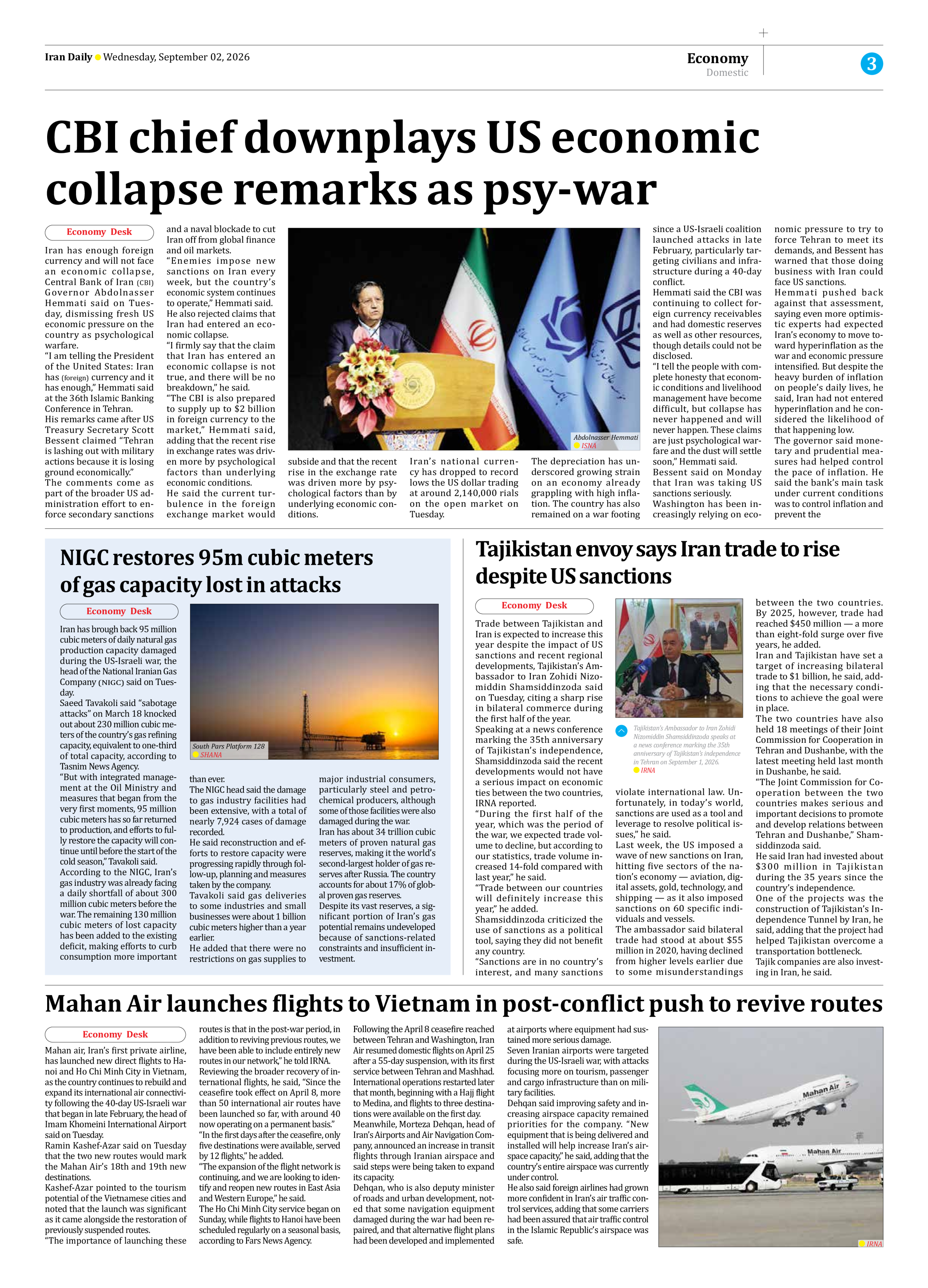
Mahan air, Iran’s first private airline, has launched new direct flights to Hanoi and Ho Chi Minh City in Vietnam, as the country continues to rebuild and expand its international air connectivity following the 40-day US-Israeli war that began in late February, the head of Imam Khomeini International Airport said on Tuesday.
Ramin Kashef-Azar said on Tuesday that the two new routes would mark the Mahan Air’s 18th and 19th new destinations.
Kashef-Azar pointed to the tourism potential of the Vietnamese cities and noted that the launch was significant as it came alongside the restoration of previously suspended routes.
“The importance of launching these routes is that in the post-war period, in addition to reviving previous routes, we have been able to include entirely new routes in our network,” he told IRNA.
Reviewing the broader recovery of international flights, he said, “Since the ceasefire took effect on April 8, more than 50 international air routes have been launched so far, with around 40 now operating on a permanent basis.”
“In the first days after the ceasefire, only five destinations were available, served by 12 flights,” he added.
“The expansion of the flight network is continuing, and we are looking to identify and reopen new routes in East Asia and Western Europe,” he said.
The Ho Chi Minh City service began on Sunday, while flights to Hanoi have been scheduled regularly on a seasonal basis, according to Fars News Agency.
Following the April 8 ceasefire reached between Tehran and Washington, Iran Air resumed domestic flights on April 25 after a 55-day suspension, with its first service between Tehran and Mashhad. International operations restarted later that month, beginning with a Hajj flight to Medina, and flights to three destinations were available on the first day.
Meanwhile, Morteza Dehqan, head of Iran’s Airports and Air Navigation Company, announced an increase in transit flights through Iranian airspace and said steps were being taken to expand its capacity.
Dehqan, who is also deputy minister of roads and urban development, noted that some navigation equipment damaged during the war had been repaired, and that alternative flight plans had been developed and implemented at airports where equipment had sustained more serious damage.
Seven Iranian airports were targeted during the US-Israeli war, with attacks focusing more on tourism, passenger and cargo infrastructure than on military facilities.
Dehqan said improving safety and increasing airspace capacity remained priorities for the company. “New equipment that is being delivered and installed will help increase Iran’s airspace capacity,” he said, adding that the country’s entire airspace was currently under control.
He also said foreign airlines had grown more confident in Iran’s air traffic control services, adding that some carriers had been assured that air traffic control in the Islamic Republic’s airspace was safe.