







Iran holds leading position in stem cell research across region, Asia: Royan Institute chief
New clinical studies target cancer, neurological diseases, fertility preservation
By Sadeq Dehqan
Staff writer
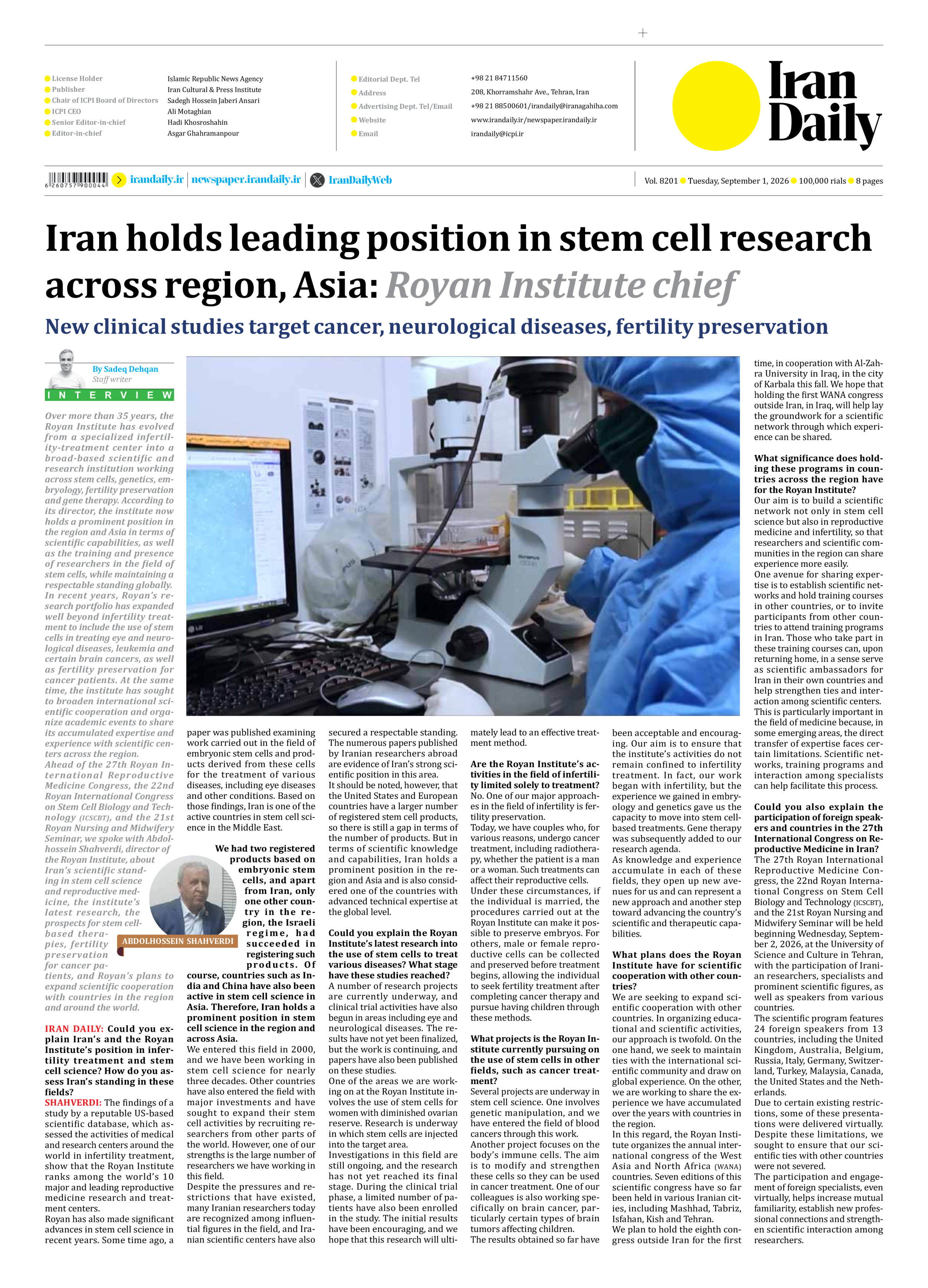
Over more than 35 years, the Royan Institute has evolved from a specialized infertility-treatment center into a broad-based scientific and research institution working across stem cells, genetics, embryology, fertility preservation and gene therapy. According to its director, the institute now holds a prominent position in the region and Asia in terms of scientific capabilities, as well as the training and presence of researchers in the field of stem cells, while maintaining a respectable standing globally.
In recent years, Royan’s research portfolio has expanded well beyond infertility treatment to include the use of stem cells in treating eye and neurological diseases, leukemia and certain brain cancers, as well as fertility preservation for cancer patients. At the same time, the institute has sought to broaden international scientific cooperation and organize academic events to share its accumulated expertise and experience with scientific centers across the region.
Ahead of the 27th Royan International Reproductive Medicine Congress, the 22nd Royan International Congress on Stem Cell Biology and Technology (ICSCBT), and the 21st Royan Nursing and Midwifery Seminar, we spoke with Abdolhossein Shahverdi, director of the Royan Institute, about Iran’s scientific standing in stem cell science and reproductive medicine, the institute’s latest research, the prospects for stem cell-based therapies, fertility preservation for cancer patients, and Royan’s plans to expand scientific cooperation with countries in the region and around the world.
IRAN DAILY: Could you explain Iran’s and the Royan Institute’s position in infertility treatment and stem cell science? How do you assess Iran’s standing in these fields?
SHAHVERDI: The findings of a study by a reputable US-based scientific database, which assessed the activities of medical and research centers around the world in infertility treatment, show that the Royan Institute ranks among the world’s 10 major and leading reproductive medicine research and treatment centers.
Royan has also made significant advances in stem cell science in recent years. Some time ago, a paper was published examining work carried out in the field of embryonic stem cells and products derived from these cells for the treatment of various diseases, including eye diseases and other conditions. Based on those findings, Iran is one of the active countries in stem cell science in the Middle East.
We had two registered products based on embryonic stem cells, and apart from Iran, only one other country in the region, the Israeli regime, had succeeded in registering such products. Of course, countries such as India and China have also been active in stem cell science in Asia. Therefore, Iran holds a prominent position in stem cell science in the region and across Asia.
We entered this field in 2000, and we have been working in stem cell science for nearly three decades. Other countries have also entered the field with major investments and have sought to expand their stem cell activities by recruiting researchers from other parts of the world. However, one of our strengths is the large number of researchers we have working in this field.
Despite the pressures and restrictions that have existed, many Iranian researchers today are recognized among influential figures in the field, and Iranian scientific centers have also secured a respectable standing. The numerous papers published by Iranian researchers abroad are evidence of Iran’s strong scientific position in this area.
It should be noted, however, that the United States and European countries have a larger number of registered stem cell products, so there is still a gap in terms of the number of products. But in terms of scientific knowledge and capabilities, Iran holds a prominent position in the region and Asia and is also considered one of the countries with advanced technical expertise at the global level.
Could you explain the Royan Institute’s latest research into the use of stem cells to treat various diseases? What stage have these studies reached?
A number of research projects are currently underway, and clinical trial activities have also begun in areas including eye and neurological diseases. The results have not yet been finalized, but the work is continuing, and papers have also been published on these studies.
One of the areas we are working on at the Royan Institute involves the use of stem cells for women with diminished ovarian reserve. Research is underway in which stem cells are injected into the target area.
Investigations in this field are still ongoing, and the research has not yet reached its final stage. During the clinical trial phase, a limited number of patients have also been enrolled in the study. The initial results have been encouraging, and we hope that this research will ultimately lead to an effective treatment method.
Are the Royan Institute’s activities in the field of infertility limited solely to treatment?
No. One of our major approaches in the field of infertility is fertility preservation.
Today, we have couples who, for various reasons, undergo cancer treatment, including radiotherapy, whether the patient is a man or a woman. Such treatments can affect their reproductive cells.
Under these circumstances, if the individual is married, the procedures carried out at the Royan Institute can make it possible to preserve embryos. For others, male or female reproductive cells can be collected and preserved before treatment begins, allowing the individual to seek fertility treatment after completing cancer therapy and pursue having children through these methods.
What projects is the Royan Institute currently pursuing on the use of stem cells in other fields, such as cancer treatment?
Several projects are underway in stem cell science. One involves genetic manipulation, and we have entered the field of blood cancers through this work.
Another project focuses on the body’s immune cells. The aim is to modify and strengthen these cells so they can be used in cancer treatment. One of our colleagues is also working specifically on brain cancer, particularly certain types of brain tumors affecting children.
The results obtained so far have been acceptable and encouraging. Our aim is to ensure that the institute’s activities do not remain confined to infertility treatment. In fact, our work began with infertility, but the experience we gained in embryology and genetics gave us the capacity to move into stem cell-based treatments. Gene therapy was subsequently added to our research agenda.
As knowledge and experience accumulate in each of these fields, they open up new avenues for us and can represent a new approach and another step toward advancing the country’s scientific and therapeutic capabilities.
What plans does the Royan Institute have for scientific cooperation with other countries?
We are seeking to expand scientific cooperation with other countries. In organizing educational and scientific activities, our approach is twofold. On the one hand, we seek to maintain ties with the international scientific community and draw on global experience. On the other, we are working to share the experience we have accumulated over the years with countries in the region.
In this regard, the Royan Institute organizes the annual international congress of the West Asia and North Africa (WANA) countries. Seven editions of this scientific congress have so far been held in various Iranian cities, including Mashhad, Tabriz, Isfahan, Kish and Tehran.
We plan to hold the eighth congress outside Iran for the first time, in cooperation with Al-Zahra University in Iraq, in the city of Karbala this fall. We hope that holding the first WANA congress outside Iran, in Iraq, will help lay the groundwork for a scientific network through which experience can be shared.
What significance does holding these programs in countries across the region have for the Royan Institute?
Our aim is to build a scientific network not only in stem cell science but also in reproductive medicine and infertility, so that researchers and scientific communities in the region can share experience more easily.
One avenue for sharing expertise is to establish scientific networks and hold training courses in other countries, or to invite participants from other countries to attend training programs in Iran. Those who take part in these training courses can, upon returning home, in a sense serve as scientific ambassadors for Iran in their own countries and help strengthen ties and interaction among scientific centers.
This is particularly important in the field of medicine because, in some emerging areas, the direct transfer of expertise faces certain limitations. Scientific networks, training programs and interaction among specialists can help facilitate this process.
Could you also explain the participation of foreign speakers and countries in the 27th International Congress on Reproductive Medicine in Iran?
The 27th Royan International Reproductive Medicine Congress, the 22nd Royan International Congress on Stem Cell Biology and Technology (ICSCBT), and the 21st Royan Nursing and Midwifery Seminar will be held beginning Wednesday, September 2, 2026, at the University of Science and Culture in Tehran, with the participation of Iranian researchers, specialists and prominent scientific figures, as well as speakers from various countries.
The scientific program features 24 foreign speakers from 13 countries, including the United Kingdom, Australia, Belgium, Russia, Italy, Germany, Switzerland, Turkey, Malaysia, Canada, the United States and the Netherlands.
Due to certain existing restrictions, some of these presentations were delivered virtually. Despite these limitations, we sought to ensure that our scientific ties with other countries were not severed.
The participation and engagement of foreign specialists, even virtually, helps increase mutual familiarity, establish new professional connections and strengthen scientific interaction among researchers.