







Negotiation for peace or cover for assault?
Was US attack on southern Iran legitimate self-defense?
Researcher at the Center for Middle East Strategic Studies
If the objective of a military attack is solely to repel an assault that is imminent, international law might, under exceedingly exceptional circumstances, afford latitude for discourse concerning preemptive self-defense. However, if the true objective is to weaken the strategic capacity of a state, to disrupt its energy resources and port infrastructures, to alter that state’s political calculations, and to coerce it into accepting a desired security order, then we are no longer confronting a simple defensive matter.
This distinction assumes particular significance with respect to the United States’ attacks on southern Iran in 2026. The attacks, executed in late June and subsequently in early July against targets along Iran’s southern littoral, appear, from a military perspective, to constitute part of a broader strategy for constraining Iran’s naval, missile, and logistical capabilities and for augmenting pressure upon Tehran. Nevertheless, this very circumstance poses a fundamental legal question: Was America’s objective genuinely the repulsion of an impending assault, or was Washington seeking to alter the balance of power in the Persian Gulf and to reduce Iran’s strategic capacities?
This is not merely a political question. It is a legal one: Exactly which attack was the US repelling? The answer matters because it determines whether the operation can be understood as an act of self-defense or as an unjustifiable use of force.
Herein, one must distinguish among three levels: first, the military description of the operation; second, its political objective; and third, its legal basis. An operation might be entirely comprehensible from a military standpoint, yet that fact does not render it lawful. An attack might be effective for deterrence, but deterrence does not per se constitute an exception to the prohibition against the use of force. Likewise, a state might defend an action on grounds of safeguarding energy security and freedom of navigation, but such interests, absent the conditions for self-defense, do not authorize an incursion into the territory of another state.
Hence, the legal point of departure is unequivocal. The governing principle is the “prohibition against the use of force,” and self-defense constitutes an exception. Consequently, a state invoking self-defense must demonstrate the existence of the requisite conditions for applying this exception.
In international law, self-defense is classically connected to the occurrence of an armed attack. Moreover, the defensive action must be necessary and proportionate. These two conditions bear substantial importance. A state cannot, merely because it perceives itself as threatened, employ any level of military force against another state.
The International Court of Justice, in the case of Nicaragua v. United States, likewise emphasized that the exercise of the right of self-defense is linked to the concept of armed attack and to the requirements of necessity and proportionality. In the case concerning Oil Platforms (Iran v. United States), these same criteria were considered in evaluating the American attacks on Iranian oil facilities. The legal outcome of these cases clarifies a critical principle: a state’s security claim does not substitute for the demonstration of the legal necessity for using force.
Therefore, the principal difficulty with America’s claim of “preemptive self-defense” resides precisely here.
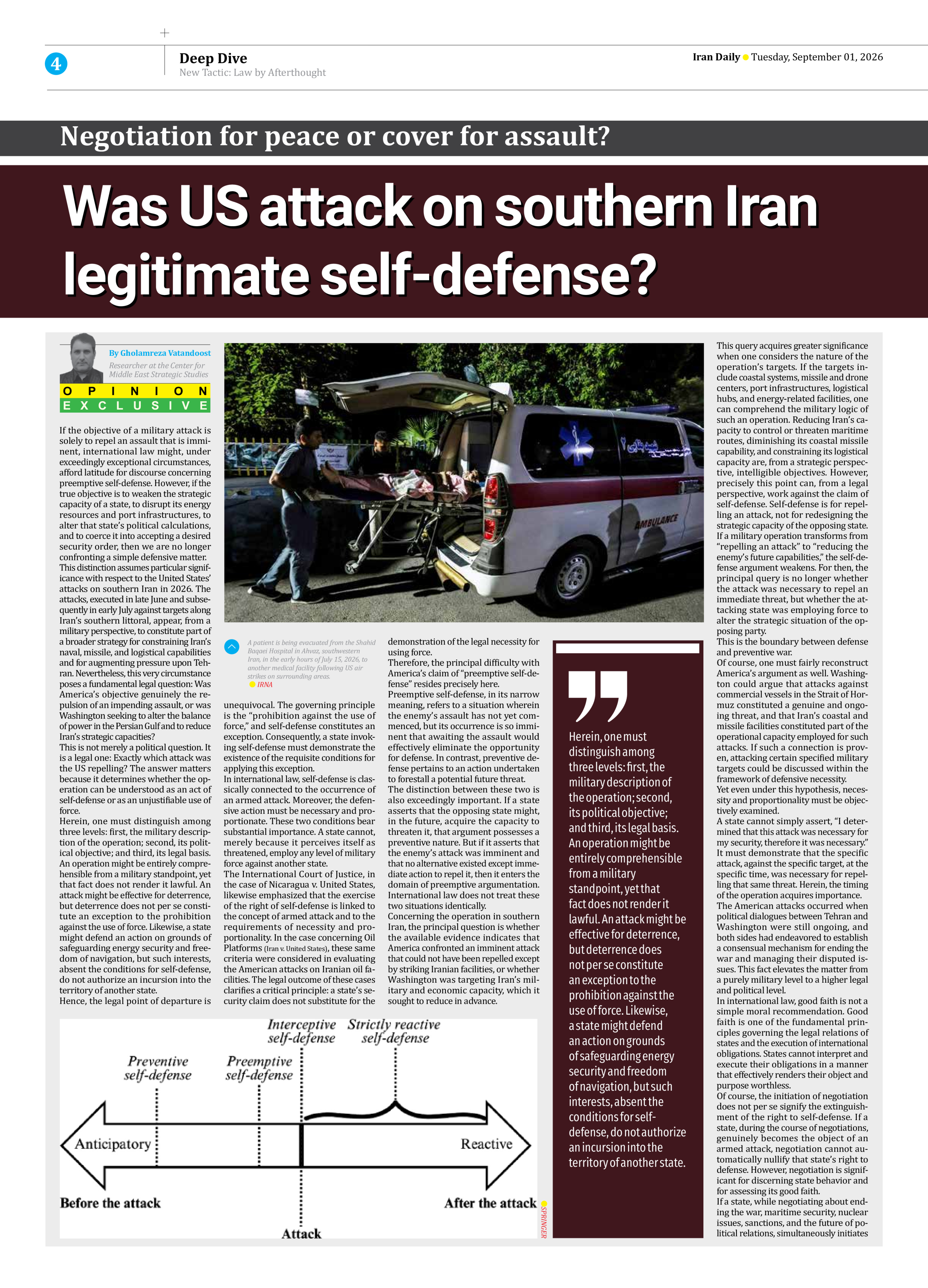
Preemptive self-defense, in its narrow meaning, refers to a situation wherein the enemy’s assault has not yet commenced, but its occurrence is so imminent that awaiting the assault would effectively eliminate the opportunity for defense. In contrast, preventive defense pertains to an action undertaken to forestall a potential future threat.
The distinction between these two is also exceedingly important. If a state asserts that the opposing state might, in the future, acquire the capacity to threaten it, that argument possesses a preventive nature. But if it asserts that the enemy’s attack was imminent and that no alternative existed except immediate action to repel it, then it enters the domain of preemptive argumentation. International law does not treat these two situations identically.
Concerning the operation in southern Iran, the principal question is whether the available evidence indicates that America confronted an imminent attack that could not have been repelled except by striking Iranian facilities, or whether Washington was targeting Iran’s military and economic capacity, which it sought to reduce in advance.
This query acquires greater significance when one considers the nature of the operation’s targets. If the targets include coastal systems, missile and drone centers, port infrastructures, logistical hubs, and energy-related facilities, one can comprehend the military logic of such an operation. Reducing Iran’s capacity to control or threaten maritime routes, diminishing its coastal missile capability, and constraining its logistical capacity are, from a strategic perspective, intelligible objectives. However, precisely this point can, from a legal perspective, work against the claim of self-defense. Self-defense is for repelling an attack, not for redesigning the strategic capacity of the opposing state.
If a military operation transforms from “repelling an attack” to “reducing the enemy’s future capabilities,” the self-defense argument weakens. For then, the principal query is no longer whether the attack was necessary to repel an immediate threat, but whether the attacking state was employing force to alter the strategic situation of the opposing party.
This is the boundary between defense and preventive war.
Of course, one must fairly reconstruct America’s argument as well. Washington could argue that attacks against commercial vessels in the Strait of Hormuz constituted a genuine and ongoing threat, and that Iran’s coastal and missile facilities constituted part of the operational capacity employed for such attacks. If such a connection is proven, attacking certain specified military targets could be discussed within the framework of defensive necessity.
Yet even under this hypothesis, necessity and proportionality must be objectively examined.
A state cannot simply assert, “I determined that this attack was necessary for my security, therefore it was necessary.” It must demonstrate that the specific attack, against the specific target, at the specific time, was necessary for repelling that same threat. Herein, the timing of the operation acquires importance.
The American attacks occurred when political dialogues between Tehran and Washington were still ongoing, and both sides had endeavored to establish a consensual mechanism for ending the war and managing their disputed issues. This fact elevates the matter from a purely military level to a higher legal and political level.
In international law, good faith is not a simple moral recommendation. Good faith is one of the fundamental principles governing the legal relations of states and the execution of international obligations. States cannot interpret and execute their obligations in a manner that effectively renders their object and purpose worthless.
Of course, the initiation of negotiation does not per se signify the extinguishment of the right to self-defense. If a state, during the course of negotiations, genuinely becomes the object of an armed attack, negotiation cannot automatically nullify that state’s right to defense. However, negotiation is significant for discerning state behavior and for assessing its good faith.
If a state, while negotiating about ending the war, maritime security, nuclear issues, sanctions, and the future of political relations, simultaneously initiates attacks that weaken the military and economic capacities of the opposing party, a significant question arises: Was negotiation truly a means for resolving the dispute, or was it part of a pressure strategy for improving the military position on the eve of an agreement? It is here that the concept of “cover negotiation” acquires importance.
“Cover negotiation” does not necessarily signify that all negotiations were dishonest from the outset; rather, one segment of the political structure might genuinely desire an agreement, while, simultaneously, another segment regards negotiation as an instrument for managing the battlefield and augmenting pressure upon the opposing party. But from a legal perspective, the crucial matter is what state behavior during negotiation reveals about its true objective. If negotiation proceeds simultaneously with military operations for weakening the strategic position of the opposing party, this behavior can constitute a serious clue for assessing good faith and the genuine nature of the diplomatic process.
In such a circumstance, negotiation is no longer necessarily the antithesis of war. Negotiation itself might become part of the strategy of war. This point assumes particular importance concerning the understanding between Iran and America. If both parties had accepted, within the framework of an understanding, to refrain from new military operations and to pursue disputed issues through dialogue, a simultaneous attack would have necessitated a dual legal justification.
The US may argue that Iran, through its military actions, violated the commitments of the Memorandum of understanding and that, therefore, a military response was necessary. Yet even under this hypothesis, the violation of an agreement does not automatically authorize unlimited force. This constitutes one of the common fallacies in political analyses of war. That “the opposing party violated first” does not conclude the legal analysis. One must ask what obligation was violated, what action was permissible in response, whether the use of force possessed an independent basis, whether an armed attack occurred, and whether the response was necessary and proportionate.
Given the available data and signs, the concept of “preemptive self-defense” appears excessively broad for describing the entirety of American operations in southern Iran. Why? Because the pattern of operations indicates that America’s objectives were not limited solely to repelling an immediate attack. The focus on southern Iran, the importance of the ports, the energy routes, the coastal facilities, and the military capacities indicate that the operations are understood within the framework of a broader strategic objective: reducing Iran’s capacity to exert pressure upon the Strait of Hormuz and altering the balance of power in the region.
This objective is strategically explainable. But strategic explainability differs from legal lawfulness. In international relations, great powers typically define economic security as part of national security. The US, too, can assert that the flow of energy and the freedom of navigation in the Strait of Hormuz are vitally important for the global economy. However, international law does not permit every threat against the energy market or global commerce to be automatically regarded as an armed attack.
If such an interpretation were accepted, any great power could employ any threat against its economic interests as a basis for the use of force. That outcome is incompatible with the logic of the United Nations Charter. From this same perspective, the statements of American officials concerning oil and Hormuz are also significant for understanding the strategic objective of the operation. In the American narrative, the opening of the Strait of Hormuz, the increase in oil flow, and the reduction of pressure on the energy market have been among the important objectives of the agreement and of subsequent developments. Vice President J.D. Vance, too, in explaining the American government’s positions, has emphasized the importance of opening Hormuz and restoring the flow of oil.
Of course, one must distinguish between a proven fact and a political interpretation. Without a reliable document, one cannot attribute a specific sentence to an American official or claim that the attacks were executed solely for the purpose of “filling oil reserves”. Yet even without accepting such a formulation, one critical fact remains: energy and freedom of navigation have been an important part of America’s calculations in this crisis. This fact alters the nature of the war. The war is no longer solely about missiles and military bases. It is also about oil, ports, straits, vessel insurance, trade routes, and economic bargaining power. Under such conditions, the risk exists that states will conflate their economic interests with the criteria of self-defense. But international law has precisely established rules such as necessity and proportionality for preventing such a situation.
Even if the principle of self-defense is accepted, not every target becomes permissible. The relationship between the target of the attack and the threat being repelled must be clear. If a target is attacked solely because its weakening would, in the future, weaken Iran’s position, that argument distances itself from immediate self-defense. If a target is attacked to prevent a specific and imminent attack, the situation is different. The boundary between these two is precisely the boundary that must be considered in the legal evaluation of the operation in southern Iran.
From the perspective of humanitarian law, the matter does not conclude. Even if the use of force were assumed justifiable at the level of the Charter, the parties to the conflict remain obligated to observe the rules of humanitarian law during the hostilities. The distinction between military and civilian targets, proportionality in attack, and the adoption of necessary precautions to mitigate harm to civilians all retain their importance. In other words, the legality of initiating the use of force and the modality of conducting the operation are two separate matters. A state might face difficulty with its claim of self-defense while, simultaneously, some specific attacks might be separately examinable from the perspective of humanitarian law.
This same distinction must be applied to Iran as well. But the most important issue, in the final analysis, is the relationship between negotiation and military operation. If negotiation is genuinely for ending the war, there must exist a minimum of trust and predictability within it. If one party perceives that the other is using the negotiating table to buy time and the battlefield to alter the conditions of negotiation, no incentive for trust remains. In that case, any provisional agreement becomes a fragile cease-fire, and any cease-fire becomes an opportunity for reconstituting military capacity. This cycle could transform into a permanent security dilemma in the Persian Gulf. The US asserts that, to prevent the Iranian threat, Iran’s capacity in Hormuz must be reduced. Iran asserts that, to prevent American pressure and attack, it must preserve and strengthen its deterrent capacity. Both parties characterize their behavior as defensive.
But the sum total of these behaviors is an increase in insecurity. This is the security dilemma wherein a state’s action for augmenting its own security is perceived, from the opposing party’s perspective, as a threat, and ultimately both parties move toward greater militarization. International law, in this context, has the role of a fundamental barrier. If the concept of self-defense is expanded to such an extent that states can invoke it for eliminating the potential future capacities of a rival, the boundary between defense and preventive war nearly vanishes. Then “defense” will no longer be a description of a legal situation; it will become a political label for rendering the use of force ostensibly legitimate. For this reason, in evaluating the American attacks, one must begin from a simple yet difficult question:
Exactly which attack was America repelling? If the answer is that the objective was preventing a specific and imminent attack, then the evidence thereof must be presented. If the answer is that the objective was reducing Iran’s capacity to threaten Hormuz, to control the flow of energy, and to alter the balance of power, then we are confronted with a different logic. The second logic might be exceedingly effective from a strategic perspective. But it is not necessarily self-defense. This distinction bears great importance for the region’s future. For if America can justify attacking Iran’s strategic infrastructures under the label of preemptive self-defense, Iran will find greater incentive to regard any future American or allied military action as an imminent threat and, on that same basis, to undertake preventive action. Under these conditions, the threshold for using force declines.
And when the threshold for using force declines, war ceases to be an exception and becomes an ordinary instrument of foreign policy. From this perspective, the issue of the attacks on southern Iran is not merely a dispute between Tehran and Washington. The issue is whether the restrictive rules governing the use of force can still resist the logic of power.
The response to these queries possesses extraordinary importance for the security order of the Persian Gulf. If negotiation becomes a cover for military pressure, trust in diplomacy diminishes. If preemptive self-defense becomes a concept for justifying attacks on future capacities, regional security will become more fragile. And if energy interests and global commerce alone can substitute for the legal criteria of self-defense, the principle of the prohibition against the use of force will become increasingly vacuous.
Therefore, based on the data and signs available as of the date of writing this article, one cannot categorically and exclusively situate the totality of American attacks on southern Iran within the framework of preemptive self-defense. On the contrary, the scope of the targets, the operational logic, the importance of the energy and port infrastructures, and the simultaneity of the attacks with the negotiation process create serious signs that the operation extended beyond repelling an immediate threat and constituted part of a broader strategy for weakening Iran’s strategic capacities and for altering the conditions of negotiation.
If that is the case, the more precise term for describing it is not “preemptive self-defense”; rather, it is the preventive use of force for altering the balance. And this is precisely the point at which international law must resist the logic of power. Negotiation possesses meaning when the parties know that the negotiating table is a substitute for the battlefield, not an extension thereof. If states hold the text of a memorandum of understanding in one hand and, in the other, a map of attack, the problem is not merely the violation of trust between two states. The problem is the erosion of the very meaning of diplomacy itself. And perhaps the most important question concerning the 2026 crisis is precisely this: Was negotiation undertaken to end the Iran war, or was war undertaken so that negotiation might continue under more favorable conditions?
The response is to be found, more than in official statements, in the interval between the time of signing the understanding, the time of commencing the attacks, and the type of targets that were struck in southern Iran. In international law, the label of the operation is not determinative. Its nature is determinative.